
Without taking into account the concept of punctum proposed by Roland Barthes—a seemingly irrelevant detail, unrelated to the purpose of composition, but one that eventually becomes essential to the image—the recent works by Peruvian Roberto Huarcaya, exhibited at the Dina Mitrani Gallery, would appear to join the innocuous multiplication of photographs that use the archives of art history and bring back the mise-en-scène. But such an impression is false, as Huarcaya sets in motion a sociopolitical dimension that filters through with irony this practice. The difference between his and other similar projects stems from the very genesis of this series and expands to his particular interactive process of participation and to the ludic and destabilizing power found in each photograph.
In 1992, during the revision of portfolios for the Mois de la Photo Biennial that occurred that year in Paris, a prominent French curator became interested in Huarcaya’s nudes, but something surprising occurred when the artist and curator engaged in conversation: as soon as he learned about Huarcaya’s geographical origin, the curator changed his reading radically and advised the artist to leave the nudes to the European and U.S. artists and to concentrate in the creation of images connected to the realities and identity of his region.
Created for the 2010 edition of the Mois de la Photo Biennial, this recent series by Huarcaya is an answer to the demand for a Latin Americanness constructed from the perspective of a foreign vision, superimposed from the western hegemonic spaces of the south—exactly like Edward Said’s denouncement of distorted orientalism—in a way that aims at legitimizing practices by limiting the scope of the genuine or appropriate, according to an exotist imaginary of that which is Latin American.
Huarcaya—another advocate of Oswald de Andrade’s Manifiesto Antropófago, but also of Duchampian gestures—appropriates the history of art and uses it as a found object, not solely in the way he once again pushes the boundaries between photography and painting, or vice versa—like his predecessor Sherrie Levine, Gerhard Richter, and Thomas Struth—but also by sidestepping the tacit demarcations of Latin Americanness and, paradoxically, by reaffirming its right to transit even across the borders of a reality that, having been “exotized,” remains intact amid the certain excesses of the continent.
In the work entitled After Mona Lisa, by Davinci, there is another type of challenge that emanates from the enigmatic smile of the young olive skin woman who poses—with an aristocracy of her own—wearing a traditional dress from the area of Puño, Peru. The image reaches far into the background and clearly depicts the mountains and sky of the Andean heights, as well as the rooftops of the shantytown below. The duchess and duke of Urbino—painted by Piero della Francesca in 1472—reappear in a diptych, embodied by a beautiful woman with curly black hair and a dark man wearing a red cap and jacket. Lima can be observed in the background, expanding across crowded and chaotic slums. The punctum of the red clothes—which successfully evaded the entire aristocratic condition, and even completed the appropriation and transference of the composition into the Latin American context—is approached through the exploration of sensuality or through the quiet scenes borrowed from other photographs.
Huarcaya appropriated the gesture of a painting from 1584 that depicts a nude Gabrielle D’Estrées pinching one of the nipples of her also nude sister, as they maintain a rigid and solemn expression amid a cold atmosphere. Huarcaya asked two girls—Frecia and Samy—from Iquitos, Peru, to reenact the scene. Unlike the original, the new version depicts a warm environment with colors that exude a tropical haze. There, a voluptuous Peruvian Gabrielle extends her hand to touch what appears to be a mole on her sister’s smooth skin—just above the breast—but turns out to be a dark tropical ant. The punctum emerges from the background, where a woman placidly seats on a rocking chair as she delouses the almost unnoticeable head of a small boy who rests on her lap. In another image, handsome Narcissus is played by Alessandro, a boy from Chorillos, and the reflection of his image blends with a chiaroscuro that is reminiscent of Caravaggio’s work but hides the fishing coves of the Peruvian coast.
The series challenges any restrictions on the right to appropriate the universal history of art; in a manner similar to that of the group of Mexican writers who decided to found the Crack Movement in order to defend their right to use German philosophy or any other universal theme, in novels; or like another Latin American literary movement that announced the allegiance of its members to “McOndo,” as a way of mockingly responding to European demands for stories that contained macondian realities. On the other hand, Huarcaya’s appropriations do not solely promote a Peruvian pluricultural, but they also have traces of those excesses, of the real-wonderful that embodies the continent.
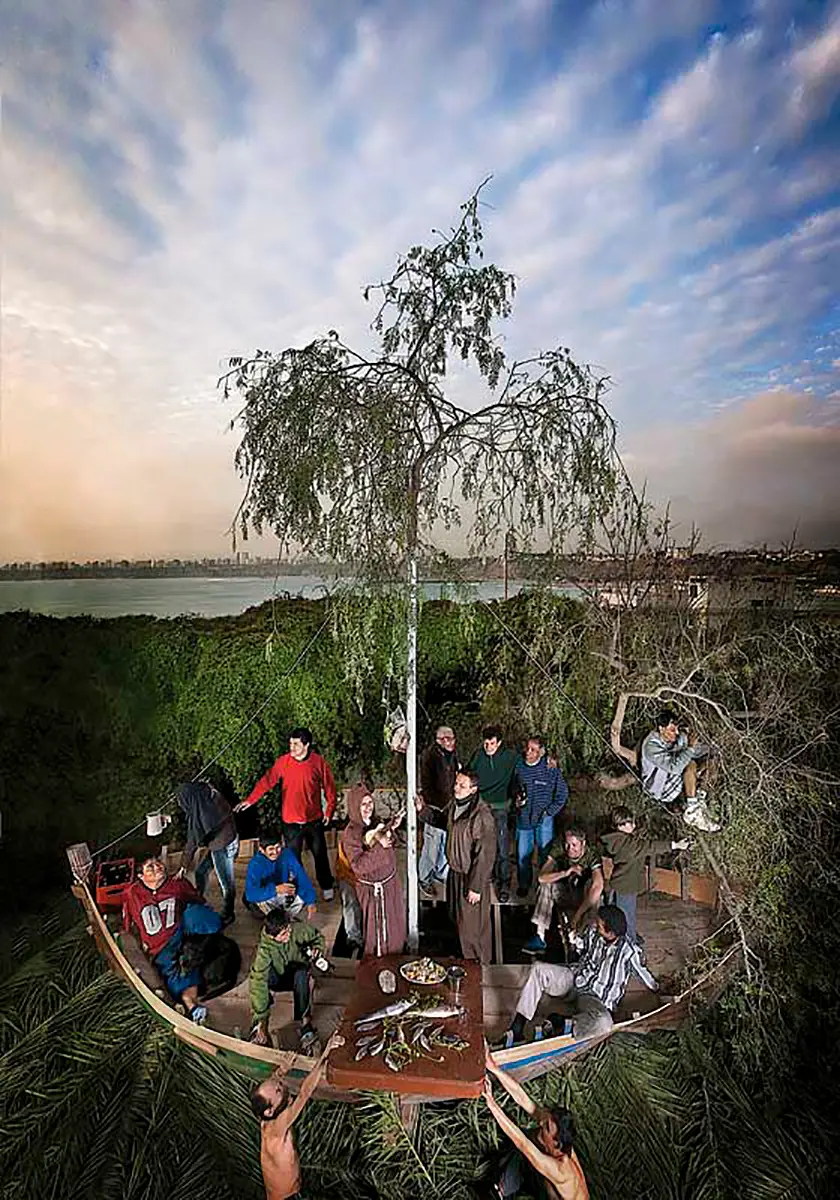
The image and the process to create the work entitled La Nave del Alto Perú (After la Nef des Fous by Bosch)(The Ship of Upper Peru [After the Ship of Fools by Bosch]) are revealing. This work not only reveals a very eclectic use of the visual archive of the word—from Bosch to Surrealism, by way of bakhtinian associations about the carnivalesque, or the echo of Herzog’s Fitzcarraldo—but also the collective nature of the creation process as well. Huarcaya—who lives in Chorrillos, a fishermen neighborhood in Lima’s bay—planned the image with his neighbors in a collaborative effort that turned into a festive event. This is clearly conveyed in a video recording of the event. Several fishermen wives assumed the role of art directors. Carrying the boat from the Bay’s shore all the way to the tree where the image was to be staged became a story in itself that culminated within the wild beer party captured in the image. The series reveals the carnivalesque transgressive spirit that allowed everyone to assume a particular role, as personal identities disappeared. It is a series that erases hegemonic borders and reveals the supreme enjoyment of what is one’s own and the free appropriation of what is not.
ADRIANA HERRERA