
El deseo nace del derrumbe is a totalizing exhibition. There are several reasons for that. First, because it reveals, without any surfeit or design or museography, the density of an aesthetic discourse that always gambled in favor of the quality of ideas, thanks to its sociological connotations and its impact on collective consciousness as much as on the furtive back-and-forth of politics. It also makes abundantly clear to any visitor that the work of Roberto Jacoby is not an intellectual exercise in search of an object as its ultimate end, but, on the contrary, a robust epistemological operation that generates new ways of knowing and new social relationships with the aesthetic event in itself.
In a different but no less important sense, the show responds to the need to document the more characteristic features of this kind of work, where the generation of social networks, research, technological experimentation, and literary writing are essential rather than incidental elements for the consummation of the event. This is why the exhibition suddenly seems to become a text, a written narrative of the adventures of some models of aesthetic and discursive articulation that escape the logic of the system and test the institutional side of art and its mechanisms for the fetishization of conceptualism, dematerialization, and action art.
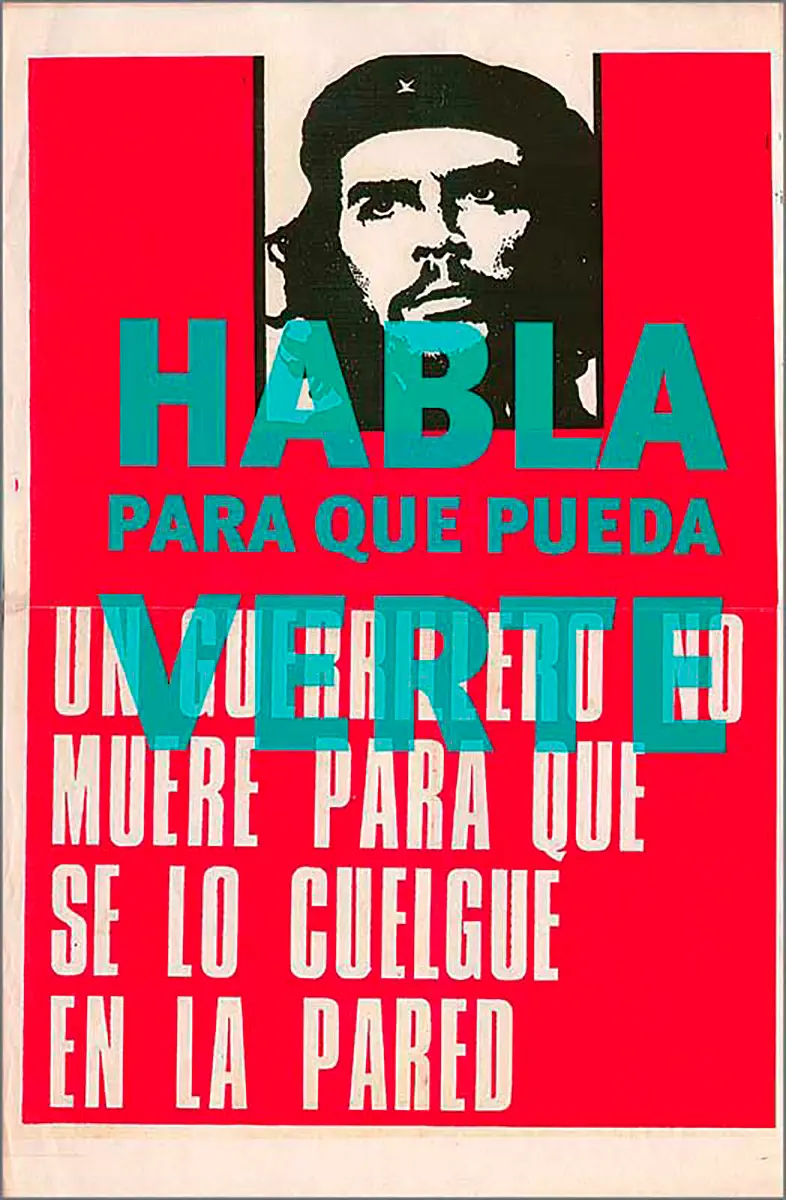
Collaborative actions are the source of inspiration for almost all of his work, based, as is known, on actions of participation and negotiation that seek to fill a collective need instead of giving greater semantic thickness to the structures of the ego. His apparent audacity is lived as a political act, and thus his “strategy of joy” is nothing but a robust expression of strength in the face of the depression, discouragement, and fear that expanded through Argentinean society during the most recent dictatorial regime (1976-1983).
Perhaps unwittingly, or perhaps with full awareness. It is difficult to ascribe innocence when we see and hear him act; Roberto Jacoby’s work anticipates a large number of rhetorical, linguistic, and discursive procedures that later were to take place in the domain of aesthetic discourse, its production, and circulation. Bola de Nieve, Internos, Venus, La revista Ramona the convivial project La Castidad with Krochmalny, or the Centro de Investigaciones artísticas are some examples (all documented in the show) of the cooperative character of art as a sphere of knowledge that makes it possible to forge new designs for enacting and coordinating efforts. Authorship, transformed into one of the modern discourse’s most sophisticated emblems, is interpellated, its legitimacy and pertinence questioned on the basis of the new paths followed by contemporary discourse after so many deaths and buryings of the author. This explains, to a great degree, Jacoby’s impenitent nomadism between so many languages and discursive operations, which denote a certain inconstancy but are at the same time a rich and extremely vital way of enacting his initiatives. Key in that sense was his project Área Sociedades Experimentales, housed since 2004 at the University of Buenos Aires. In this case, Jacoby convoked a variegated group of researches to reflect on Charles Fourier’s philosophy on the basis of a series of experimental meetings in the Zona autónoma temporaria. Thus, new links of interaction were established between people, and a space for speculating about possible new social relationships was created. The criteria of authorship as an oppressive modern system, then, is disarticulated in the outlining of a new grid for participation and speculation, where what matters most is a choral exercise and the multiplication of voices over and above a single central voice that could be understood as The Voice.
Questioning and investigating relationships of power (their structure and semiotics) and the vulnerability of the mechanisms of control is another one of the artist’s great interests. Jacoby provokes thoughts about why and how those relationships are articulated, and about the cultural weight that determines them. His Darkroom project, orchestrated on a map of dark booths, follows that idea. There, perceptual certainties were greatly reduced while the paradoxical sensation of being under surveillance, controlled by an abstract entity that overtakes the order of consciousness and intervenes in the elaboration of fear as an expression of control and punishment, was exponentially emphasized. Subjectivity is tensioned to the edge of collapse. The idea of a limit, a horizon that demarcates and tests our very ontology, unfolds on the perimeter of this work, inasmuch as the subject interacts there with the other from the feelings of anguish and loneliness generated by being deprived of sight and having only a tentative tactile recognition of the other’ physical limits.
The thesis across Jacoby’s work has to do with a reflection about placing the figure of the artist at the center of the debate, rather than the art itself (exhausted speculation.) An example of this was the plans for La manzana loca (1986,) where Jacoby outlined the diagram for an area of Buenos Aires, a topography of institutions, public squares, galleries, bookstores, bars, and even hair salons in the city where the essential spaces of artistic socialization emerged in the 1960s and encounters between artists and intellectuals of different generations, age groups, tribes, genders, and classes actually took place. From that perspective, the definition of the artist acquires a territorial dimension: it occupies specific sites and coordinates, and identifying them is, for Jacoby, one of the forms taken by the contemporary practice of art.
Another possible example is the project Bola de Nieve: a network of artist-curators that reveals the relationships between creators on their basis of mutual recognition, and attempts to renew the grid of art in the conditions that open up through new technologies. Thus, in the midst of the overexposure and instantaneousness of the current scene, Jacoby’s work reformulates its own proposal: “where will there be an artist?” 1
I believe that one of the great virtues and achievements of this exhibition is the documentation of the aesthetic experience of one artist who not only built works of art but managed the mechanisms of programmatic articulation that made it possible for thoughts—and works of art as a consequence—to be generated.
NOTE
1. Ricardo Piglia. ”Retrato del artista invisible.” In: www.salonkritik.net
ANDRÉS ISAAC SANTANA