The first time I saw the work of Saidel Brito in the late 1990s—when I still did not know him personally—I felt I was witnessing the proposal of a completely uncompromising artist, one of those who take their creative process very seriously and who are constantly transgressing the boundaries of the artistic status quo. In recent years his production has reached other contexts, such as the U.S., Spain, and Germany—among many others. He was awarded in the last edition of the Cuenca Biennial; a recognition that has permitted Brito to consolidate his intellectually oriented poetic. Brito has been a teacher for the thirteen years he has been living in Ecuador. His artistic production has been persistently challenging conventions found in a diversity of mediums—including political, historical, cultural, and economic—as he includes the findings of these inquiries in the creative act.
Brito’s most recent individual exhibition titled Ruins of Storytelling showcases twenty works—twelve of which have been shown in the countries mentioned earlier, while eight others have never been exhibited—that include drawings and paintings created between 1998 and 2011. They represent an uninhibited commentary on the relajo (lax attitude) that prevails in our Latin American societies, as seen through the perspective of the destructuring of the artistic genres. This is usually in the Ecuadorian context, it is a symptom of adversity that is approached with humor and disenchantment, and in Brito’s discourse also turns into a commentary on the stubbornness and stupidity in the art world.
Once again, it was possible to enjoy Brito’s creole brand of sarcasm in the series titled La Historia es una gata que se defiende boca arriba(History is a Female Cat that Defends Itself on its Back). Here, the artist uses cartoons found in periodicals from the countries involved in the Spanish-Cuban-U.S. war and, as if it were a palimpsest, constructs a different version of the story that is entertaining, populated by twists and turns, and innuendos; a story reconstructed with new layers of meaning, and subtly proposed from apparently antithetical elements (cat and mouse), in order to blur the lines of other stereotyped versions concerning a critical theme. It is worth mentioning that each of the pieces in the series includes in its title, like a colophon, a word in parenthesis—their usage in Spanish is always masculine and point to positions for having sex that, according to the horoscope, are ideal during the twelve months of the year—such as (brave), (creative), (intrepid). To Brito, there are no victims or victimizers, only dialectic and compensatory relationships, as if he wanted to elude sexist criteria and, instead, was playing at dismantling malicious genre constructions and redefining individual and social components as independent manifestations. The hybrid nature of the drawings and paintings combined with the recurrent utilization—in all of his work—of the superimposition of images, texts, translucencies, and transparencies that are not altogether clear and that result in a non-linear reading of the narrative and lead the observer into a transversal inquiry, proposed by an author that reveals himself as discontinuous, irregular, incomplete, and dissolved in the narrative.
Intertext, quote, appropriation, carnival, and parody are usual tools, in Brito’s versatile endeavor, that derive from thoughtful research that is never influenced by trends or a predisposition toward the commercial; but are rather the result of an incisive personality that scrutinizes every possible historical, artistic, and propagandistic aspect. He has deconstructed the artistic disciplines of painting, sculpture, ceramic, video, installation, performance—I believe only net art is left to include in his agenda. Some years ago, Brito began a process of reconversion, regarding the incorrectly-called smaller genres, subject to their degree of minimization by the legitimizing discourse (drawing, cartoon and comic strip). The artist created pieces that emphasize drawing overpainting and vice versa, in what represented an alteration of the figure-background obsolete pattern that disarticulated the concepts of painting and historical narrator.
This exhibition also presents titles that construct highly allegorical pronouncements that evoke the non-place and indecisiveness, as is the case of the 2010 piece titled Sierra roja (julio ya no confía) (Red Mountain Range [Julio does not trust anymore]). It is part of a recently commenced series in which Brito proposes formal subterfuges in common geographical references from Andean countries that he always renders in red tones.
His most recent proposals—Salón de recibo en Carrera de Córdova (Receiving Hall in Córdova Race), ¿A quién le importa la vida de Ricardo Miró? (Who Cares About Ricardo Miró’s Life?), Panama Hat and Restinga de Taboga (Escucha el rugir) (Restinga of Taboga [Listen to the Roar])—also resort to the appropriation of the photographic and pictorial repertoire of Ecuadorian artist, based in Panama, Carlos Endara-Andrade (1867-1954). He became known for the prominence with which he portrayed the Panamanian society of his time through the representation of characters and scenes of social progress—like the construction of the Panama Canal. Endara founded the first photographic studio of that Central American nation and, in 2006, while visiting Panama, Brito was able to appreciate the true relevance of an artist that until then he had underrated. He then decided to use Endara’s images in interplays in which he integrates a variety of chronotopes into the same story: the Panamanian visual repertoire and the political history of Ecuador.
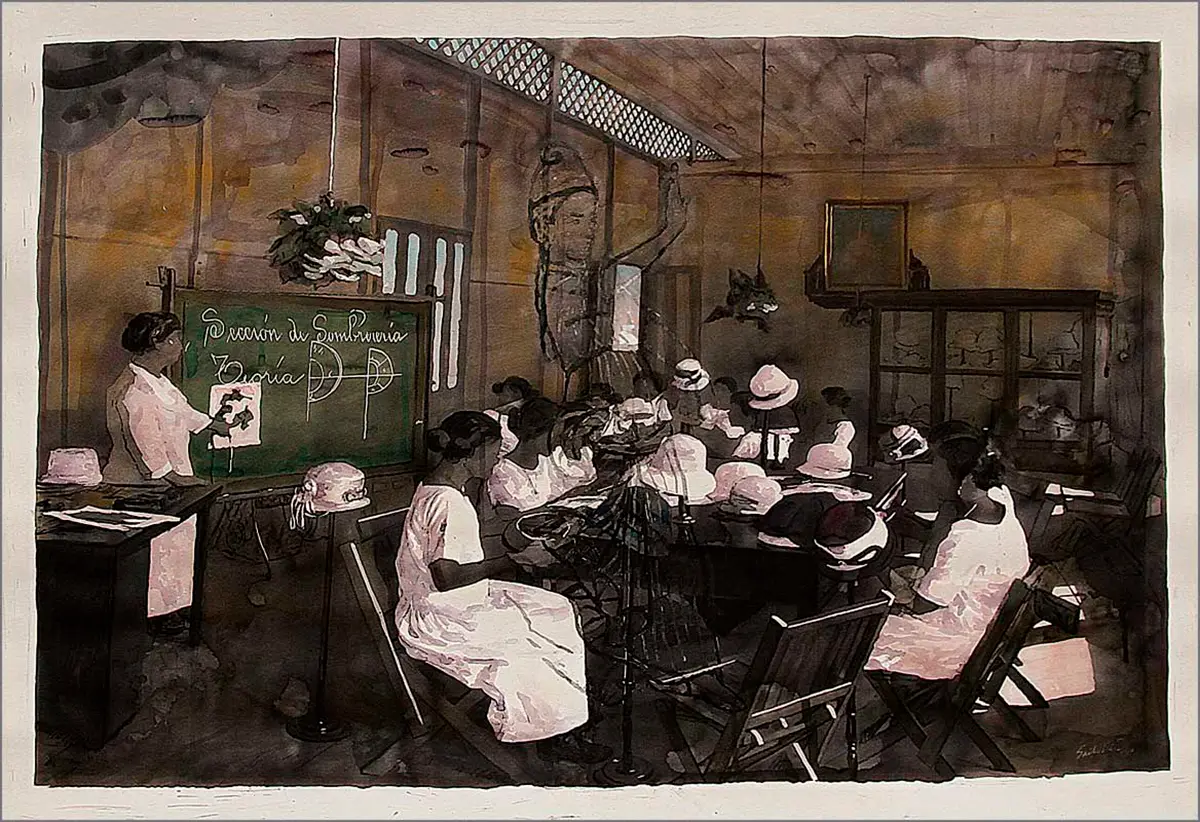
Brito appropriates Panamanian photographic records and reformulates them as he superimposes relevant details extracted from Endara’s drawings, cartoons, and paintings about the Panama of the 1900s; approaches that presented the nation’s political life and its prevalent corrupt environment as latent issues. For example, a proposal like Panama Hat, based on a photograph of a hat-making class on which Brito superimposed the phantasmagorical image of a female figure that personifies the motherland in a defensive posture as if she were ordering a stop with her hand. Internationally renowned, the Panama Hat actually originated in Ecuador, but it became well-known when Panama made projected it into the world after the construction of the Panama Canal.
The fact that Ecuadorian political leaders end up seeking asylum in Panama, and that this neighboring country also happens to be one of Ecuador’s most important economic partners, are some of the variables used in Brito’s intertextual discourse to plant a seed of doubt in our hermeneutical attempts. This artist rejoices in the dismantling of symbolic referents in order to generate perceptive associations that fix the digital visuality on behalf of his extemporaneous playfulness.
Ruins of Storytelling leaves us with an uncertain, ethereal sensation in all the possible levels. The plurality of the systems of signification that this artist violently upsets through its intertextual dialogism, represents an excellent exercise to exorcize, from the perspective of art, any fears associated with change.
AMALINA BOMNIN