
Amid this haze that appears to dissolve the intangible memory of an entire period, there are at times some sparkles—saving flashes—that (re)arrange events and give them back their meaning. Such light is present in the exhibition titled Two impulses of the Erotic: Santiago Armada and Umberto Peña, curated by Liana Ríos at the Museo Nacional de Bellas Artes, in Havana. The organizers took advantage of the institution’s recent acquisition of works by these two artists to favor an approach that underscored the projection and distinctiveness with which sex is presented in the discourses of these two emblematic— but still not sufficiently recognized—Cuban artists. A few tense moments that involved these artists occurred as a result of the revolutionary nature of their creations. And such manifestations, in response to their innovative, irreverent, and transgressive art had in each of them a different effect.
Filled with relevant events—political, economic, technical-scientific, and cultural—the 1960s, called by some the “decade of the ideologies,” entered the fray of Santiago Armada (a.k.a. Chago, Palma Soriano 1937-Havana, 1995) and Umberto Peña (Havana, 1937). The transformation of Cuban society brought about by the Cuban Revolution, was also expressed through the changes that occurred in art. Chago and Umberto were two of the protagonists of such changes. The freedom with which they were able to express themselves through their work, revealed a parallel narrative about the complex context they lived in. Their fearlessness—that went beyond their approach to the taboo subject of sex—was received with a hostility that would greatly hinder their artistic careers.
By uniting their works under the theme in question—along with other coincidences generated through their respective expressive searches—the two artists are reinserted into the contemporary arena, while the public is offered the opportunity to rediscover these artists’ place in Cuban visual culture, as well as their standing as predecessors of the profound transformations that occurred during the 1980s. To the preeminence of sexual symbols in their discourses—each with a different meaning—is added the critical component that offers a fresh and reinvigorating look at their proposals, their particular use of humor, the use or assimilation of comics, the scatological; as well as poetry and vernacular themes. The conceptual in Chago is set in contrast to the visceral expressionism of Umberto.
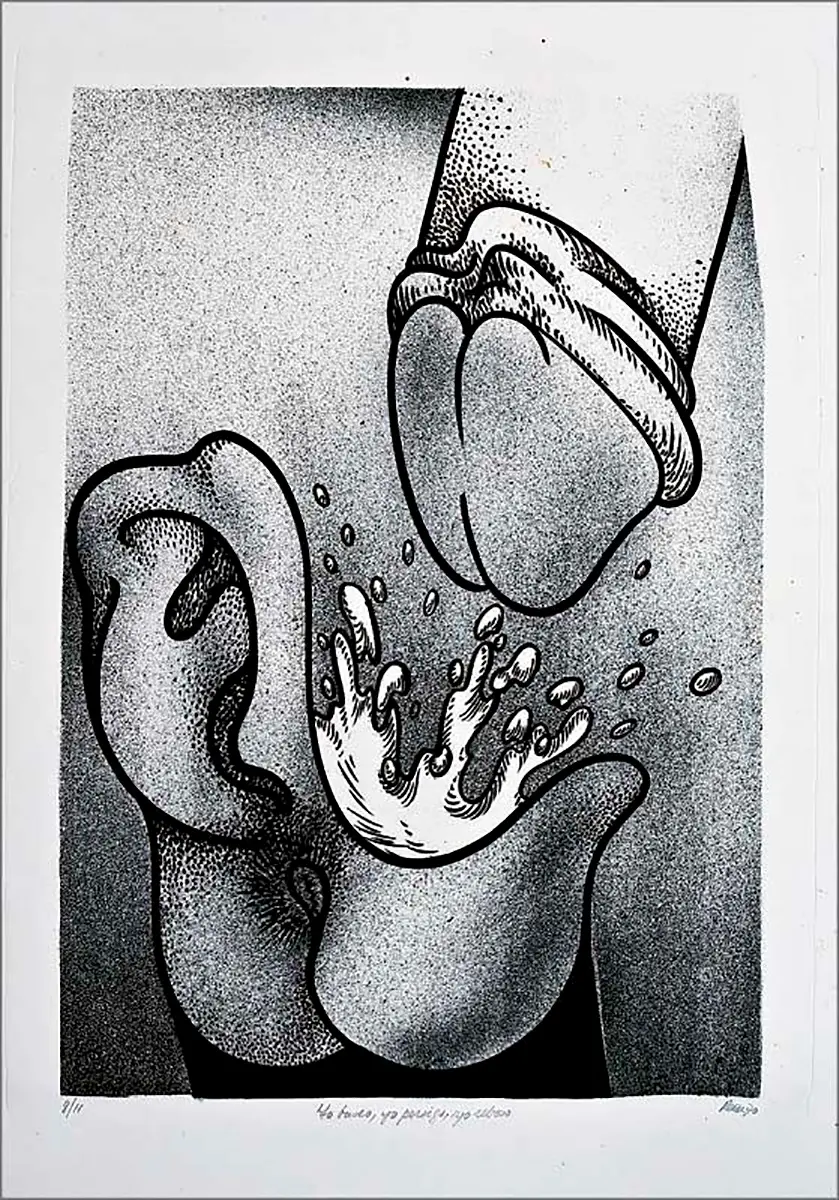
Their works reach beyond eroticism. The sex they present is pure sublimation. It is a restlessness in the face of oppression and corsets. The ideology behind the forms they conceived—without concern for temporal subjections—was unsettling at the very least, but also uncomfortable and upsetting. Umberto Peña—who had an anthological exhibition at the same museum in 1998—presented twelve lithographs created between 1968 and 1971, along with one of his enormous trapices (a combination of the Spanish words trapo [rag] and tapiz [tapestry]) from 1976. For his part, this is the first time—not counting the works by him included in the permanent collection dedicated to the 1960s—that Chago exhibited his work at the Museo Nacional de Bellas Artes. The 23 works by him—part of a larger group of works housed in this institution—contributed to illustrate to some degree his artistic evolution and the various resources he put at play, mostly from the aforementioned decade, including some pertinent examples of his evolution during the 1970s and 1980s. He ended his participation with small scale paintings from 1990 and 1991.
Peña’s lithographs convey the ironic elegance of the phallic. They are celebrations in which semen, saliva, and multiple orifices also participate. There is in them an enjoyment of the masculine, as the line traces the architecture of anger, the graphism of a violent and vociferous carnality, even as the poetry names, almost delicately on occasions, each of the scenes where the power and ferocity of battle could be observed.
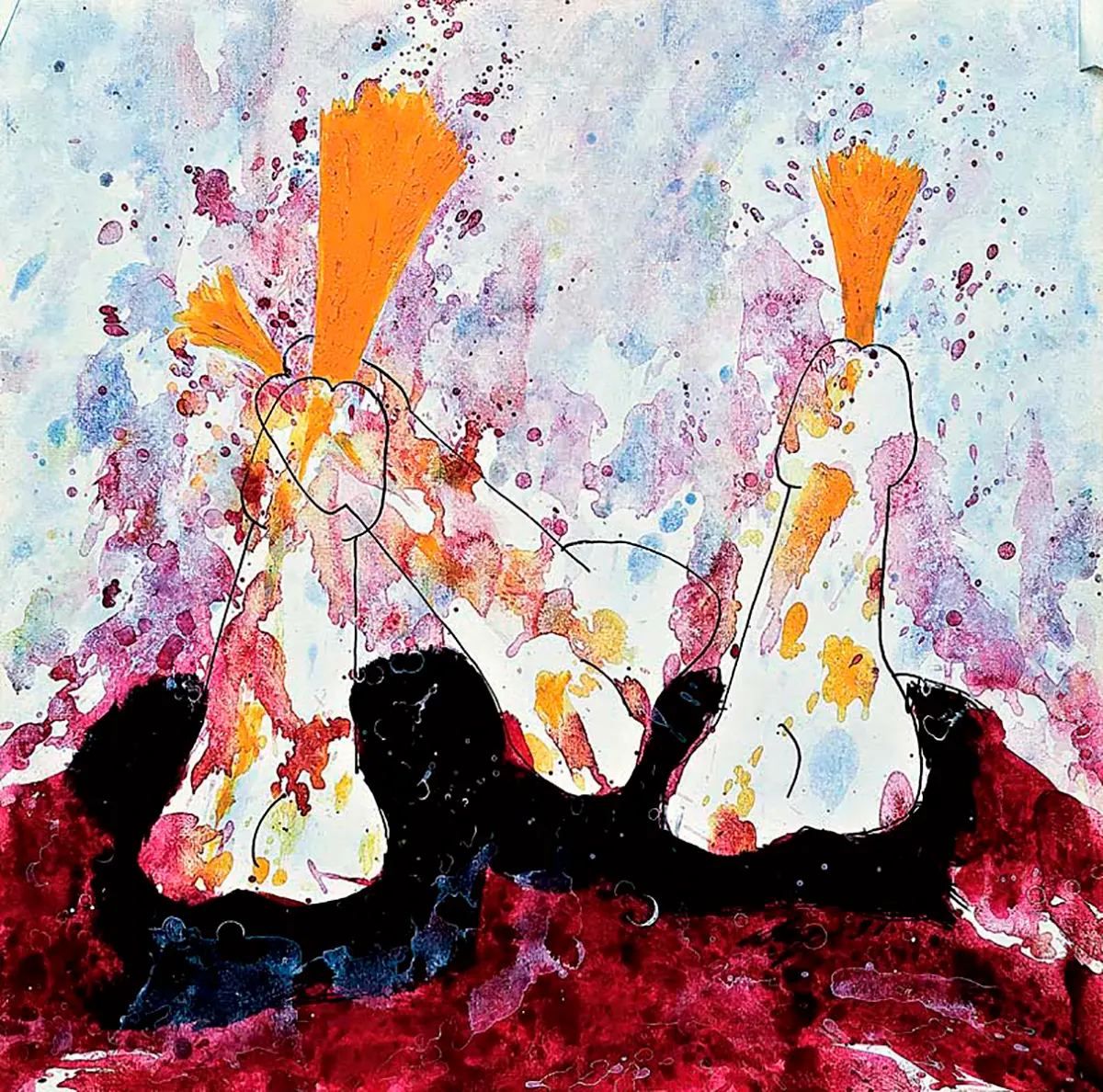
Sex in Chago’s work has another purpose and his approach is anything but subtle. The penis is definitely the center of the world; a male-dominated world. It represents an entire universe of power and its symbolic function reflects a political, philosophical, existential, and aesthetic ideology. When inquiring—with a critical sense—events, history, or society, Chago did so from a humorous place, as he reaffirmed cartoons—comic strips—as part of an art form that gave ideas the leading role. Conceptual art, the grotesque, and poetry, inhabit the strips of his controversial Salomón, dialogues between condoms, and the phallic cosmology of his paintings.
Two impulses of the Erotic represented a unique opportunity to looks at the work by Chago and Peña. Once these doors have been opened, it is necessary to thank the will of those who have contributed to moments like this, and the Museo, the place that saw the emergence of some of these submerged faces from the 1960s.
CARIDAD BLANCO DE LA CRUZ