Armando Rosales won the Without a Record competition organized in 2009 by Oficina #1 and by Venezuelan artist Jaime Gili. The event aimed at offering a unique opportunity to creators to develop coherent visual and conceptual proposals –based on research– to exhibit in the spaces of that gallery. The project by the young Rosales (Cabimas, Zulia 1987) was chosen from among 49 other proposals submitted to a jury panel formed by Jaime Gili, Suwon Lee, and Luis Romero, the last two, Directors of the Oficina #1.
Based on ideas by Lacan and Deleuze, Rosales elaborates a proposal in which the works become objectual paraphrases of remote psychic models that –being individual– are mobilized during the interaction with the "other" and as a result they find themselves permeating the buried structures of social behavior.
The idea of "inertia" is essential to understand Rosales' work. Inertia is a mechanical concept that defines the way in which "the property of any physical body to a change in its state of motion or rest, unless such change is elicited by the action of a force." According to this definition, inertia can only be evaluated in the presence of "another" force that attempts the modification of the state of the body.
In terms of the mind, inertia is an impossible state, as persons are social beings and, thus, are continuously impacted by "others." And desire –which is always the desire of the "other"– strengthens this gregarious condition of human beings.
Parody on Escape included eight mechanical installations, assemblages with diverse materials and objects created with paper and resin that were presented as metaphors of some individual psychic mechanisms that can only be mobilized by the presence of the "other." This way, most of the pieces are "complemented" by the activation performed by spectators through light switches, pedals, or sensors.
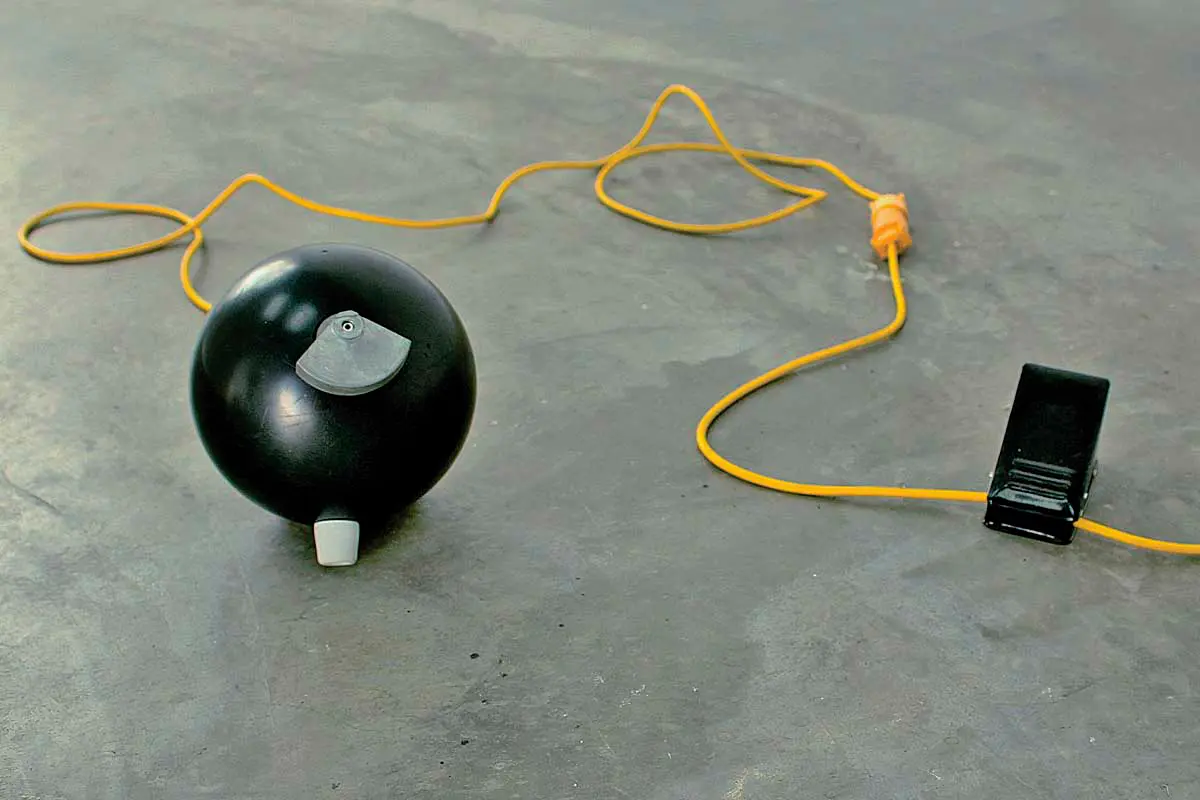
Bola Mortífera (Deathly Ball), for instance, consists of a black sphere surrounded by three-speed bumps that limit its mobility. Attached to a cable the ball is "powered" by a pedal. When the pedal is pressed, the sphere begins to roll, but it is immediately stopped by the speed bumps. This generates an objectual situation that alludes to the anguish of an impossible escape, a frustrated desire.
Danza (Dance) is one of the most unsettling works in the exhibition. It is an assemblage that includes the body of a toy animal mutilated and suspended in the center of a small pyramidal structure. When set in motion through a switch, it briefly twists and turns and then goes back to a latent state –only in appearance as it is hanging and, therefore, subjected to exterior forces. The work points to everyday processes of motivation –that set in motion movement that is only deceivingly free– and limiting mechanisms that are part of the same structure that aims at motivating change and created a metaphor from a psycho-social situation with no plausible exit.
Escape del Triángulo (Escape from the Triangle) captures the essential meaning of the exhibition. It consists of a filled sack with a depression on top in the form of a small triangular area outlined by the sack's borders. It is activated with a pedal. There is a Ping-Pong ball inside the triangle that jumps out of the sack when the work is turned on. The intervention of the "other" favors the liberation of the ball from the contextualized space of the piece –which represents the social space– toward a diverse space without the rules found in the other it has replaced. In the context of the exhibition, viewers will be likely to put the ball back inside the triangle. To Rosales, this piece is a "simplified parody in which that body is freed from the structure that contains it, while the context –the exhibition room or gallery– that contain the representation of the work, has the conditions and laws that make it more likely for the piece to return to its original position."
Rosales successfully channels each of the works into that which we internally and unconsciously generate after being certain we are immersed in social mechanisms that are structured from a constitutive psychic state: anguish. And it is precisely because of the expressive restraint in this work –as it relies on mechanical materials without connecting it to any human emotion– that the pathetic nature of some inquiries on psychism as the mechanics of existence is magnified.
The exhibition Parody on Escape is clearly an interesting proposal based on a dense conceptual approach: to objectually comment on the possibility of dismantling the hidden psycho-social mechanisms that block our escape toward the illusory objective of individual freedom.
KATHERINE CHACÓN