Newman Popiashvili Gallery was recently the home to the first dual exhibition in New York City by the Mexican artists Artemio and Rubén Gutiérrez. Entitled Sic Transit Gloria Mundi the show was comprised of individual works by each artist as well as two collaborative projects, one recent and one a bit older.
The largest work in the exhibition is the piece from which the entire show derives its name. This work, created specifically for the show, is a mural-scaled digital photomontage. Vast and surreal in its scope and fused images, the mural evokes a landscape that has been described as “post-apocalyptic.” The source images that form the mural are taken from various films. This work establishes the major theme and tone of the exhibition by combining images of destruction violence and waste with references to cinema and mass media. These concepts are reinforced by an earlier video project by the two artists that are located on the wall opposite the mural. Titled From A to B this video is 120 minutes long and is composed of a series of isolated scenes from various movies that have been spliced and repeated with a rhythmic background to emphasize the repeated moment of action being shown. This technique, reminiscent of Joan Jonas’s classic Vertical Roll, makes even the most innocuous gesture seem more violent and engaging, and the sound repetitions can become abrasive and irritating.
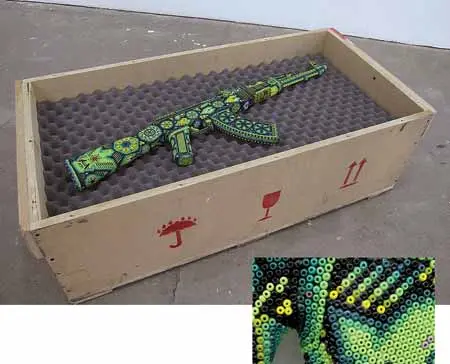
Connecting the two collaborations on either side of the gallery is solo works by each artist. The more engaging works are the sculptural projects by Artemio. Continuing a theme he began last year in conjunction with LAND/LA, the artist has fabricated cast resin AK47s, a particular gun of choice among the Mexican drug cartels, and has covered them with traditional Huichol figurines made from acrylic beads. This combination of an indigenous Mexican cultural tradition mapped onto the form of what Mexico has increasingly become known for males a powerful statement, one that is torn between cultural pride and socio-political critique. There has been much contemporary Mexican art of late that has employed similar strategies in one way or another, much of which has been seen in exhibitions like the Americas Society’s So Far, So Close.
The other wall displays photo works by Gutiérrez. Once again appropriating from the cinema, each photo is an isolated film still that is then given an evocative caption. Among the most poetic of these is an image of two figures in a boat captioned We Are Eaten Up by Nothing and the image of blooming flowers and leaves with the more ominous title Between Resistance and Surrender. More open-ended than Artemio’s more direct pieces, these works still carry with them the contradiction between beauty and violence, peace, and destruction.
By combining themes of mass media, tradition, and apocalyptic violence there is the suggestion that either society at large or Mexico specifically is increasingly complicit in its own demise and that violence is becoming the new natural standard. By evoking the mass media there is perhaps the suggestion that the spectacle of mass entertainment helps to glorify or mythologize this violence, and the repeated ubiquity of such images helps to desensitize us to its impact in reality. Although the individual works lack a unifying cohesion and the mural is more successful as an idea than in actual execution, these are strong and necessary ideas that have been approached creatively. One looks forward to seeing more work from each of these artists—collaboratively as well as individually—in the future.
JOHN ANGELINE