
Les Noces (The Wedding) is the title of the installation by artist Arturo Herrera presented in his solo exhibition at the Americas Society, in New York City. Curated by Gabriela Rangel, the exhibition remained open from February through April of this year.
To Arturo Herrera, abstraction is a language that involves assembling, mounting, and composting—practices he approaches in collages that are always accompanied by a random process. Nonetheless, in the exhibition at the Americas Society—where one could observe three different approaches to doing collage—Herrera uses more than just scissors, glue, or paint to cut, glue, and superimpose.
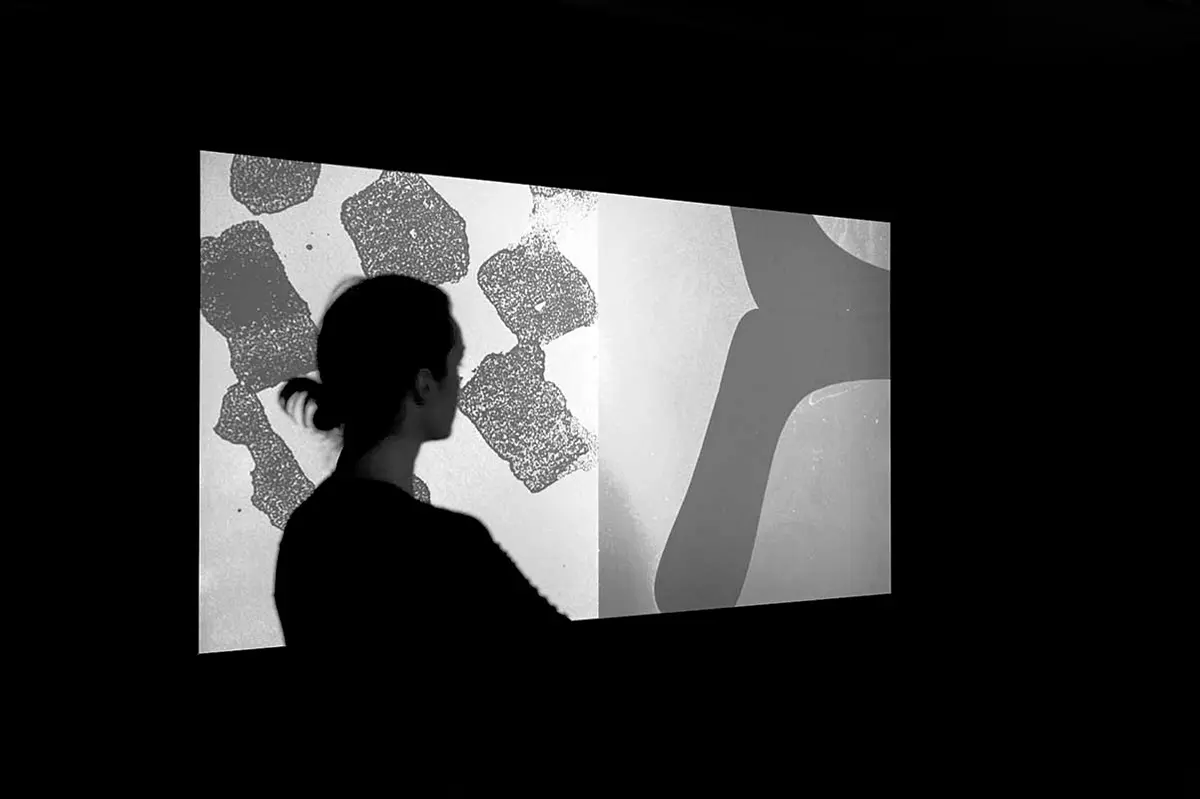
First of all, there is the element that could be regarded as the first step toward abstraction involved in the creation of Les Noces. The first part of the exhibition includes collages made in a traditional manner, in other words, constructed with clippings from illustrated books, comics, fragmented drawings, watercolors, and forms created through the application of drip paint; all of which were applied to works that were created at the same time Herrera created Les Noces—some works or fragments appear in some of the photographs used in the projection.
The second part of the exhibition includes a series of 80 black and white photographs: Untitled (2005). Herrera created these in a project in which he wanted to use both the still camera and the developing process as a machine to cut, ensemble, and glue. With the help of several lenses, the artist took random photographs of things inside and around his studio to create the second element that in 2007 would lead to Les Noces.
These work with photographs represented a project that allowed Herrera to capture abstract images for a series of collages without having to glue or cut anything in a traditional manner. This way, he was able to take the process of abstraction one step further as he photographed fragments of his collages and played with the process of photographic development. Because the photographs allowed for the element of randomness in the process, the curator of the exhibition thought it important to include the photos in the show as an element that helped arrive.
The third part of the exhibition involves the main work: Les Noces. It is a piece that has been placed so viewers can observe it frontally as soon as they enter the space. There, two videos projected in parallel show images in a consecutive manner. Once Herrera obtained the photographs through the aforementioned process, he continued looking for new ways of working the collage, but now through the manifestation of a personal fascination of his for Stravinsky’s ballet Les Noces; a musical piece created in 1923 that Herrera associates with his way of thinking while immersed in his working process. He takes the music as an element that offers no solutions and that is highly subjective.
Based on these interests and fascinations, Arturo Herrera decided to appropriate that musical piece and, with the help of his photographs, create an abstract series by combining both elements into a sort of animation. This new project was possible thanks to the creation of a software program whose function was to randomly mix the photographs with the music, with the peculiarity that the rhythm in the projection of the images was autonomous.
Herrera’s work aims at subtly entering the viewer’s subconscious through abstraction, with pieces of images that in most cases are not defined but instead tend to evoke memories. All the pieces in the exhibition make references to dance, musical notes, and dancing steps. This way, the artist offers viewers several approaches to establish a sort of dialogue with the piece, whether such is part of the collage in the three-dimensional space, or happens to occur in the spectator’s mind.
DIANA MARCELA CÁRDENAS