In his third exhibition at the Galería Elba Benítez, Cuban artist Carlos Garaicoa (Havana, 1967), presents a series of recently created works that are a continuation of his explorations concerning the language of architecture as a symbolic body subjected to the effects that political ideologies impose on the social order and on the individual. But this particular series also brings to the forefront representations that propose other approaches to the research of formal linguistics; ones whose receptiveness to the complexity of meanings is also in tune with the intertwining of the objects and devices included in the same space.
Apparently disconnected, the works are brought together under the meaningful title—that alludes to recent U.S. politics—of Party! Not Tea Party. Nonetheless, once viewers have the opportunity to walk through the entire exhibition, it becomes evident that the proposal actually refers to local themes that find an echo in global political tendencies. The centers of attention originate in a sculptural object located by the gallery’s entrance titled El Árbol de la Abundancia (The Tree of Plenty), and in an installation in the central space titled Pret-a-Porter (Ready-to-Wear). Both works, in combination with the series Cara o Cruz (Heads or Tails), create the leitmotiv for a large part of the exhibition. Their underlying narratives allude to controversies between personalities from the political world, in the context of one of the worst economic crisis of this century. Through Garaicoa’s ironic gaze, both left-wing and right-wing tendencies are shown as total failures, amid the apparent game of political negotiations that, in the end, ensure the permanence in the power of both political currents.
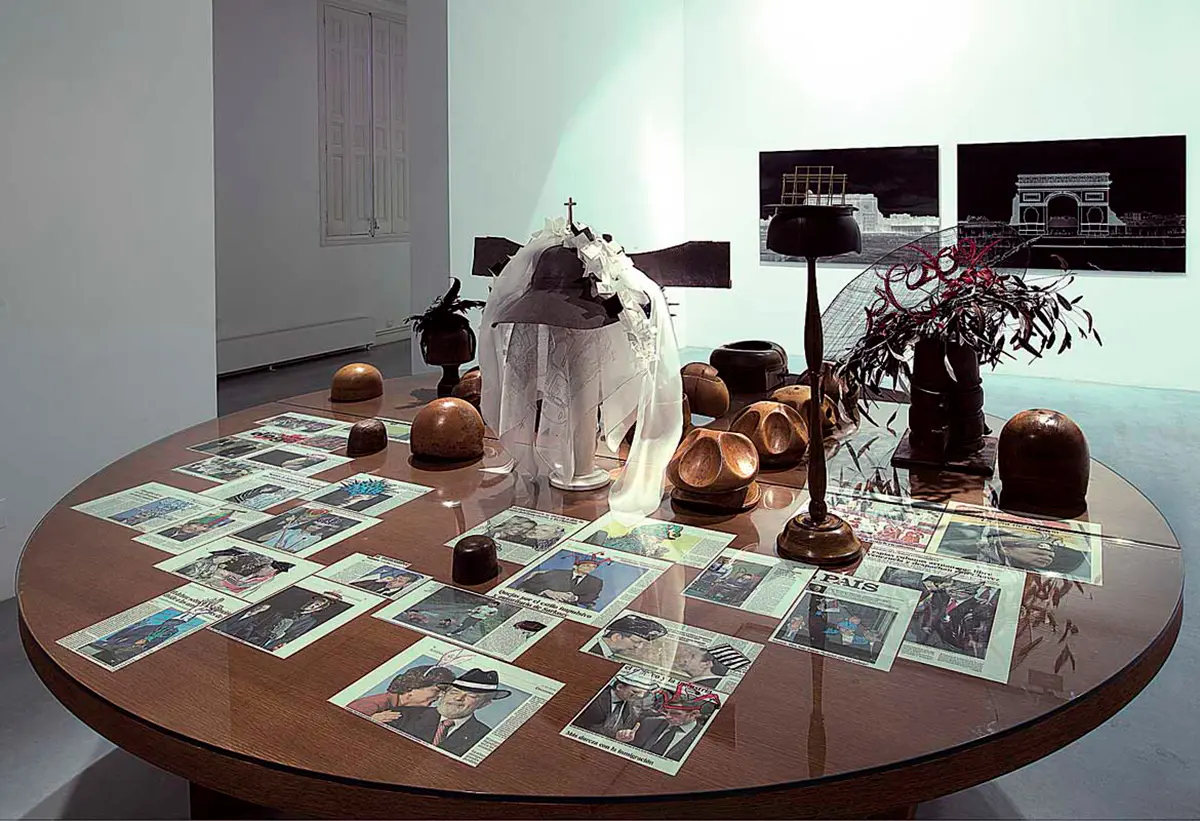
At the expense of risking a simplistic reading of his work, Garaicoa places the on the central round table. It consists of a group of objects that include found objects, antique wooden molds for hats, periodicals that contain photographs of political leaders intervened with drawings; as well as sophisticated and meaningful hats created by the Mabel Sanz fashion Atelier. The artist appears to be referring to the trivialization of politics in the media, as it shares the same space with glamour and show-business. The intervened newspapers show photos of Rodríguez Zapatero and Mariano Rajoy, Fidel Castro, Evo Morales, Mahmud Ahmadinejad, Sarah Palin, and Nicolas Sarkozy, among other international figures who are constantly in the news and who have an influence in the course of events with their opinions. None of them escape the symbolic artifacts added on their heads—that in most cases look ridiculous. The hats are objects designed to cover the head and to bestow power and distinction in those who wear it; but they also serve as the semantic structures of the architecture of language, or as supports for some emblematic building, like the one in the mockup of the Abadía de la Santa Cruz (Santa Cruz Abbey). The glamorous three-cornered hat has been replaced by the silhouette of the controversial Valle de los caídos (Valley of the Fallen) monument, commissioned by Franco and the place where he was buried next to José Antonio Primo de Rivera—founder of the Falange Española Party—together with other 33,872 combatants who fought in both sides of the Spanish Civil War.
The interaction of several “mechanisms” of significance, language, and discourses, structured in a network of meanings as part of a structural and strategic operation—and I quote Okwui Enwezor’s analysis of Garaicoa’s work, based on the terminology of Foucault, for the catalog Noticias recientes or Recent News—is a good way to describe the surrealist-styled “gathering” found in Prêt-à-Porter. The opposite can be said of El Árbol de la Abundancia, an impeccably rendered object created with magnetized metal in the schematic form of a tree, and that, placed on a very high metallic table, would appear to be the elegant design of a futurist building. The public was invited to throw a coin—that would stick to the branches—and make a wish. The contrast between the reality principle and the wish became paradoxically evident during the course of the exhibition: almost all the coins thrown were five cents coins.
On the other hand, Cara o Cruz, a group of silver coins specially designed for the exhibition, created a tautological game with two figures or phrases that, although apparently contradictory, deep-down were the same thing. The simplification of the political discourse, and the manipulative attitudes that increasingly characterize the political classes, only demonstrate an exercise in banality and an interest in power plays.
While lacking a discourse or curatorial thread to successfully associate the morphological aspect of the works, the exhibition nevertheless achieves continuity and successful exploration within the same preoccupations that have characterized Garaicoa’s productive career. The most relevant aspect of the exhibition were the forms and devices put into play, as well as the dialogue between the works and narratives in the context of present-day Spain, a country that, after all, is Garaicoa’s second home.
DERMIS PÉREZ