
Carlos Ginzburg (Buenos Aires, 1946) has lived and worked in Paris for more than twenty years. To show his two recent performances, the Parisian gallery that represents the artist organized two distinct and successive but complementary exhibitions.1 From his first actions in Argentina (Buenos Aires, Instituto di Tella y Cayc, 1969, and 1970), Ginzburg made the questioning of society, often by means of the absurd, the center of his intellectual and artistic concerns. One of his most important projects (because of its duration and documentary amplitude) was that of questioning himself about mass tourism, the behavior, and the status of the tourist. The artist-interpreter “who traveled as a true-false tourist” went on many trips to four continents between 1972 and 1982 and, in an impressive “travel card”, brought together photographs, transportation tickets, and hotel bills, achieving the production of a proteoform work in which an infinitesimal part was lost during the 1973 Yom Kippur War. Thus, by means of photography, and, in this case, pseudo-touristic photography – playing the tourist and having himself photographed in front of tourist monuments – he approached the theme of the relation with the other, the simultaneous superposition of fictitious and real identities, playing in critical perspective and paraphrasing the function and nature of the curious tourist, the staring tourist, the aware and unaware tourist, as occurs in the majority of cases. The encounter, the confrontation, the complexity of the relationship with the other, and with the society and, above all, the problematic of the status of art form the center of his reflections. His work has always been articulated in weighty fashion with several conceptual resources such as repetition, the text as sign and object, “normality” questioned, the textual citation, and, sometimes, citation of the textual citation. The mirror effect of the images as well as the senses create the perceptible and tangible material of a “work in progress” without intellectual breaks and constitutes a work of art in itself, within the purest affiliation of the “attitudes that become form”.
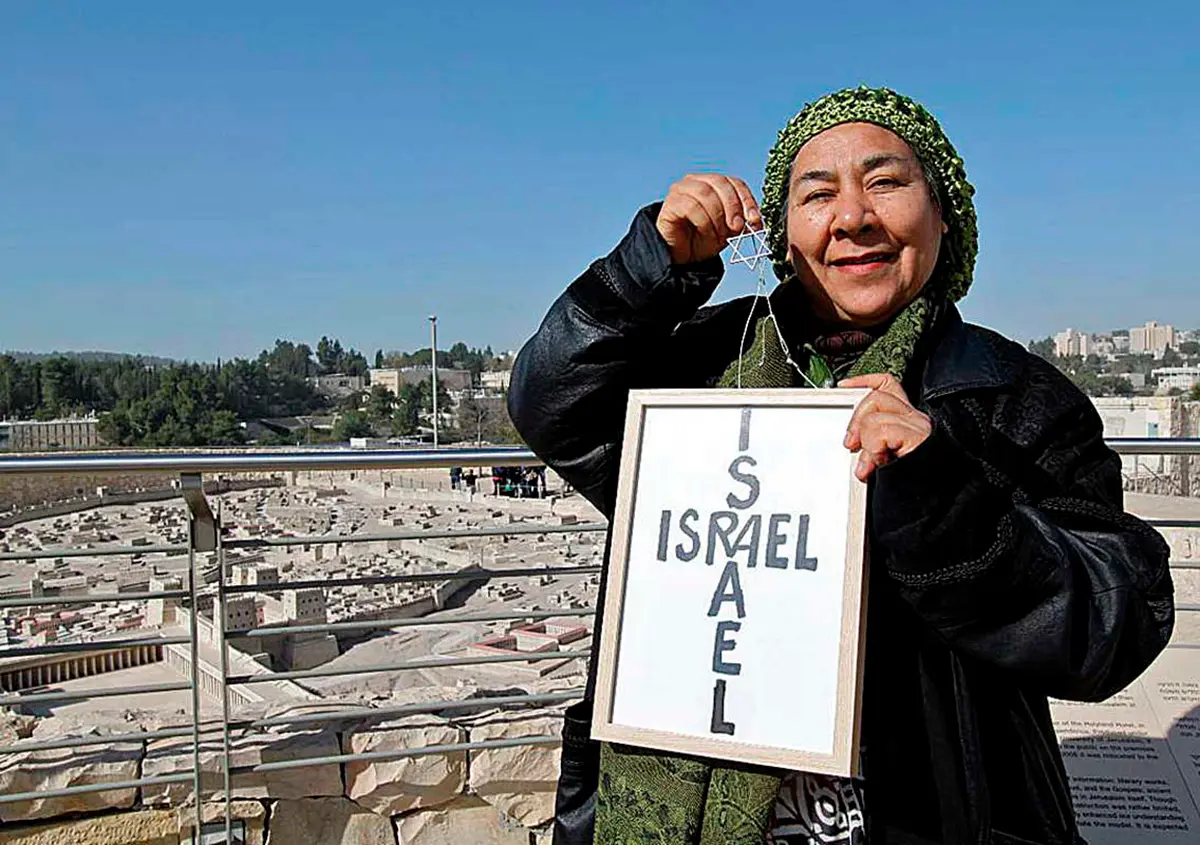
His last exhibition in Paris was not about a tourist trip, and nor was it about a pilgrimage. Notwithstanding this, it is in Jerusalem, the pilgrimage city par excellence, where, on placing his photographic camera in a perspective in which the political and religious dimensions intersect and encounter each other, he initiated an act at once provocative and in total interphase with the present. Thus, this is a conscious artistic action that touches upon an existential problematic, both cultural and social, through an attitude that is not only a caricature or a mockery of his reflection on tourism but also an act of participative implanting in the reality that surrounds and concerns with him.
We shall first address Jerusalem Cross and Bis before approaching the second phase of the artist’s exhibition, in the course of which he presented his Manifesto Guillemeter Art Service, “The service of textual citations (In parenthesis) that transfigures Art, Man, the World.” In Jerusalem Cross and Bis, Ginzburg proposes a theme of the dialog among the three monotheisms, united in birth and anew, in the war of today. During the week that he spent in diverse Jerusalem districts, the artist photographed, in front of the most emblematic building of The Holy City, anyone who accepted to pose with a placard, chosen by them, on which the word ISRAEL was written vertically and horizontally by Ginzburg, with no esthetics, with an M that formed the point at which the two Rs crossed. As we can see, this was an intersection, both material as well as symbolic, of the three religions and the three cultures: Jewish, Christian, and Muslim, within a scenario charged with feeling. Each placard, the size of an A4 sheet of paper, was suspended on a rosary that had the symbols of identity. This was followed by a series of portraits and a slide show that was presented in an exhibition. Ginzburg is inscribed in an orbit of open pathways due to the American Conceptual Art of the sixties – art is a theoretical object at the service of conceptual thought and “language is an object in itself” – as well as in a trail of an “esthetic situation” in which the primary message on the material and where the commitment lies is situated in the choice of language.
The Guillemeter Art Service Manifesto was present in a luminous drawer that occupied the entire showcase; an armchair, crowned with a pair of black aluminum fangs on a white background invited the visitor to place himself between the fangs. This staging of the textual citation “Change Yourself Into a Work of Art,” should appear, according to Ginzburg, as a “true-false” fictitious plagiarism of their life, of their friends, of you yourself, a universal-esthetic applicable anywhere, in any space, any epoch, and any culture,” “because the ‘in parentheses’ should add extra esthetic value.” Art, objects, our own existence are observed as “relativized” according to our desires. Inside this pseudo-disappearance that he proposes to us, we possess all of the freedom for reconstructing the world, because the “in parentheses” created by Ginzburg offers us an existential and intellectually vertiginous abstraction for imagining, without preconceived ideas and without limits, our unfolding into the infinite.
NOTE
1. In Paris, space comprises a sole salon. The gallery has another space in Marseilles at Radieuse de Le Corbusier (3er floor).
CHRISTINE FRÈROT