There is a surface in a society which Dr. Lakra uses preferentially in his drawings: skin. From the beginning of his career, he has created tattoos. Scratching or marking ink on skin and on a variety of surfaces is his constant endeavor. Pencil, acrylic ink, and the cutting of vellum are the constitutive elements of his work. Known as calf-skin in antiquity, vellum1 has always been a unique medium, contradictorily organic and durable at the same time after a careful prepping process. The topic of tattooing is also evident when he presents characters in installations. And the issues he deals with in his drawings are popular culture, rebelliousness, aspects of Mexican history, certain Eastern and African influences, Dada and expressionist art, eroticism, and the grotesque, jesting haze that envelops contemporary society.
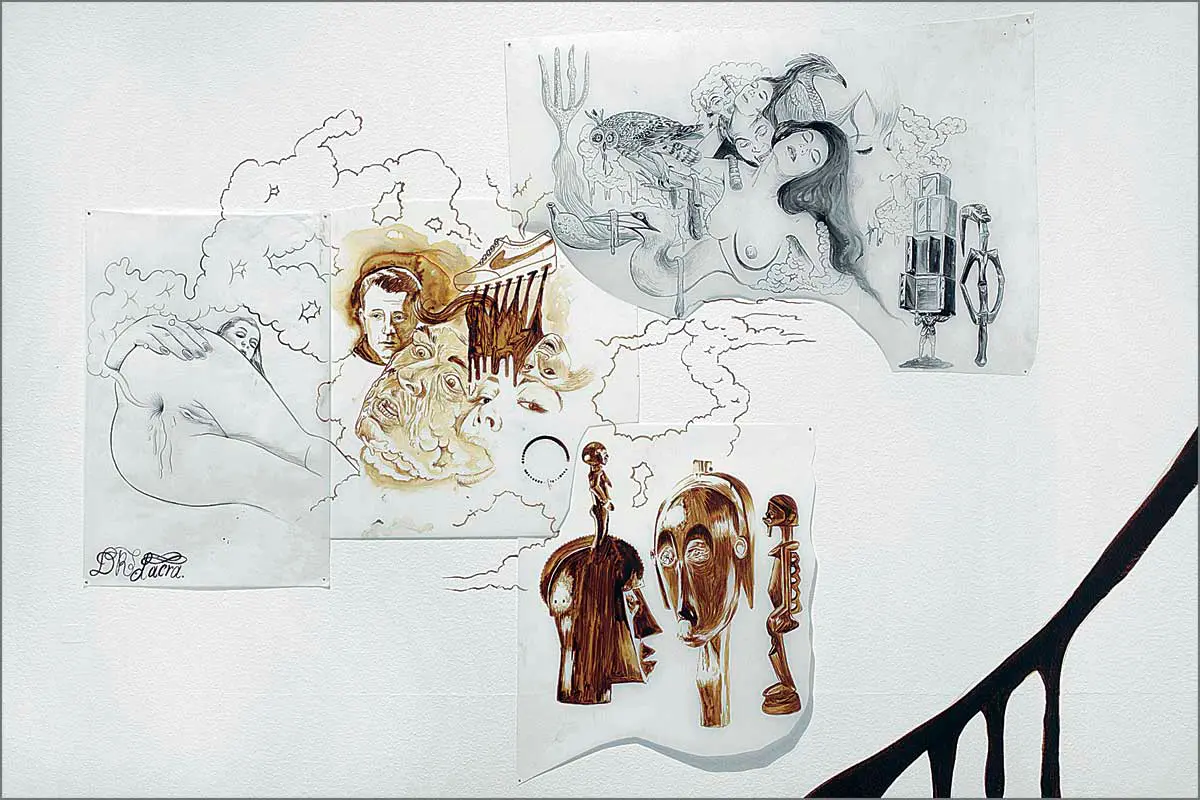
The borders between public and private spaces have been lost, just like those between what was formerly known as popular arts and fine arts, which artists today traverse indiscriminately. The cross-pollination between these two rivers of creativity is constant and enriching. It emerges from society’s own flows. In that context, Dr. Lakra himself gets involved with his images. Large skins equivalent to bodies intervened by many drawings, by drawings-paintings that allude to tattoos, and by the interaction of individual scenes that integrate themselves into a shrouding whole, as in this first individual exhibition of his work in New York City. Tattooing and drawing are a unit in the large body, i.e. this site-specific installation. The superposition of drawings on certain areas of the installation-body is a parallelism to the drawing for a tattoo that approaches the skin and is transcribed. The transparency of the support is not a coincidence. Various associations could be established with the irregular borders of the paper—this is noted and left open for the viewer to judge.
The artist was born Jerónimo López Ramírez in Mexico, in 1972 (those are his mother’s surnames, something not at all unusual in Mexico, much less among visual artists, for a number of reasons). His mother is a consistent translator and writer, and his father is the artist Francisco Toledo. The name under which he works and signs ratify his own rebelliousness. More than two decades ago, as an adolescent in Mexico City, he became interested in tattooing and turned himself into a tattoo artist, and at the same time, alongside a group of young artists, participated in a workshop on new drawing techniques given by Gabriel Orozco. He had decided to use “lacra” (a word that can be translated as “blight” or “curse,” and which in many Latin American countries is used colloquially to refer to “the bottom of society”) as his pseudonym. Because he carried a black bag with his equipment, his companions started calling him “Doctor.” It is interesting to note that in his works the name is retained as a drawn signature that occasionally reverberates. He signs each drawing one or more times using the “c” of the word’s proper spelling (“lacra”), but “lakra” dominates the signatures and presentations.
As well as drawings, the artist creates wall and whole-space installations, as was the case with his exhibitions at the Institute of Contemporary art in Boston last year, and at the Drawing Center in New York in 2011. These site-specific installations rebel against both easel painting and muralism. Confronted with the option of painting or drawing for the bourgeoisie or for intellectuals, or following the path of Muralism, Dr. Lakra mirrors contemporary life.
As though creating a now concave, now convex mirror. Large in size, his variously proportioned drawings are incorporated in a variety of ways: superimposed, grouped, or directly traced. Dr. Lakra’s opaque hues add turbulence to the scenes, confirming the primitive, abrupt character of his approach. This is not a mark of authorship but of globalism, it is the history of the world from its beginnings to the present day, in different versions. When presented in a different way, what is familiar becomes strange; this is part of the expression that characterizes Dr. Lakra’s work. Rachel Liebowitz, the curatorial assistant at the Drawing Center, collaborated with Dr. Lakra, but the artist functions as co-curator; he studies the vast material at his disposal, contextualizing and situating it, following his own script, like a tattoo. The topic of tattoo art has been analyzed by a variety of specialists. All I want to say here is that those who carry tattoos are mirroring in the outward surface of their bodies their own internal lacerations, due to the aggressions that humanity constantly imposes on itself.
NOTE
1. Imitation vellum, with similar characteristics, became available in the 1990s.
GRACIELA KARTOFEL