
Focused on the configuration of an alternative reality inspired by our surrounding, Enrique Moreno relies on those impersonal and anonymous "everyday accompaniments" that is always there; artifacts –and even furniture– that become essential, and available to fulfill the utilitarian role for which they were created. Moreno produces new forms based on them that have a functional resource of their own his earlier works did not have; namely, the autonomy of movement.
His objects incorporate the type of state-of-the-art motors that ensure the functionality of a "domestic arsenal": other mechanical pieces and wires of various calibers. The former is responsible for the mechanical manifestation –without variations or alterations– that functions at the level required to ensure permanent mobility; an essential purpose of this artist, and at the same time ludic, meccanoes.
In the piece titled S/T, the artist proposes four vertical structures. They are parallelepipeds solely configured with ridges and tying elements similar to the metallic components of a basic concrete column, only that, in this case, one that is not constructed to guarantee rigidity. Moreno's work relies on mobility, a functional concept opposed to constructive stability. Installed on small wheels, the "columns" move around, change places, arrhythmically move forward toward the viewer to then go back to their original positions, in a back-and-forth cycle.
Other constructions that generate hollow volumes are affixed but rotate on their centers or on one of their elements, while others yet, systematically repeat an ascending-descending counterpoising. In some others, the artist's intention would appear to rely on the possibilities of random encounters elicited among the elements of the piece as a result of the movement. In most cases, the works are structured using orthogonality as their base. Despite their fragility, these "constructions" have precise intentionality because the concept behind each of them –and the need to convey it– justifies the formal aspect of such objects: unstoppable activity; continuous just like professed in the title of the exhibition.
While the wires attest to the second important component in Enrique Moreno's work, they also facilitate another phase of the creative process. Because of their inherent malleability, the wires can be knotted, coiled, articulated through nipples and nodes, and expanded across the space to construct autonomous structures. With these, Moreno articulates nets, or metallic warps that he uses to connect, support, and guide the positioning of other components. These "threads" have the purpose of configuring the organizational –if that term can be applied here– aspects of the works created by Moreno.
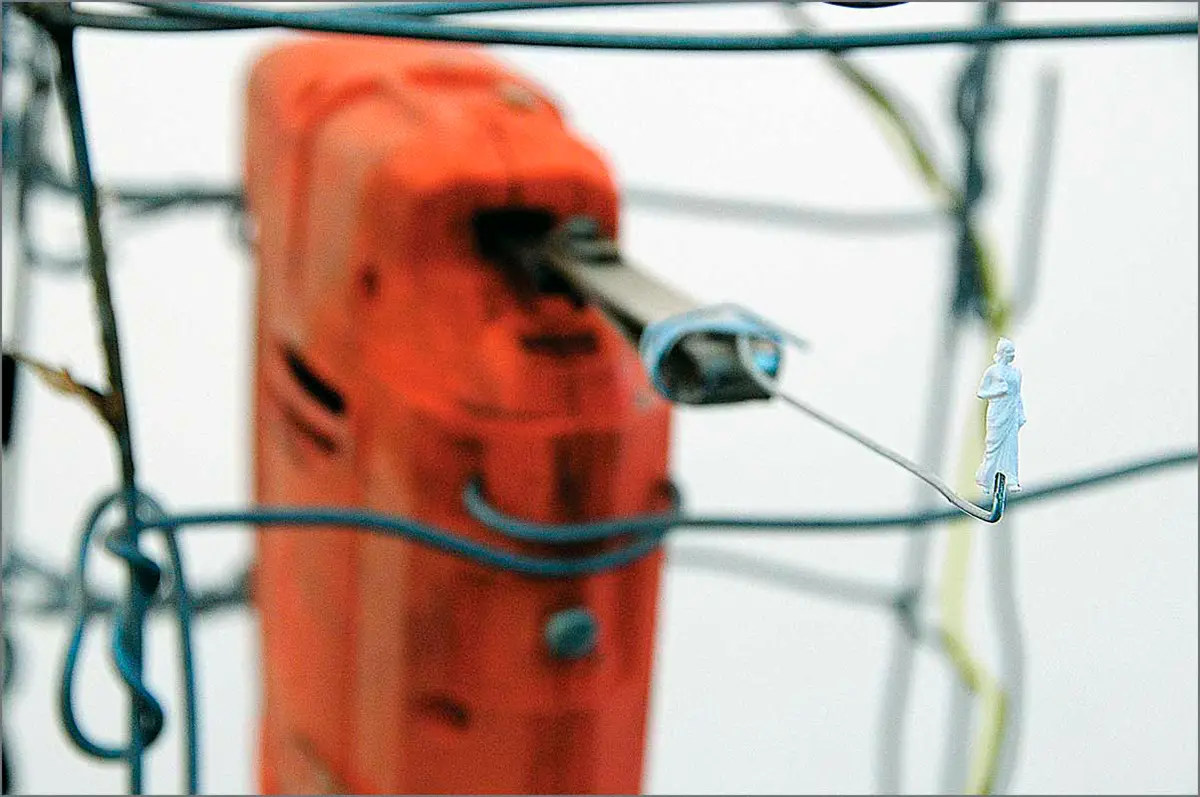
In other instances, they become extensions in which tiny beings –small dolls as we colloquially refer to them as– are either the stars of the cast or simple pieces of the gear, amid a complex network that allows them to act but never to go free. In Corriendo Mujer (Running Woman), Moreno creates with wire a schematic sketch, a silhouette that resembles a feminine figure like those Alexander Calder created for his circus. A small motor is the small head of this strange figure with metallic filaments who is accompanied by another wired figurine that also runs as if trying to escape, in spite of being irremediably tied to a system.
In Mujer Camina (Woman Walks) the figure integrates to the warp that rhythmically expands and contracts to facilitate an understanding of the idea behind it. Nonetheless, the relationship established between components and movement varies according to each of these works filled with minuscule beings. These actors somehow become anthropomorphized subjects despite the small plastic pieces they are made of. They are beings whose existence depends on the mechanical and insensitive scenario that surrounds them; a dynamic world that never rests that is ruled by its own laws, and yet, one that represents for its inhabitants the only hope of life. Without it, they could not exist. Is this perhaps an omen of the future?
In spite of their material precariousness, structural fragility, and functionalist dependence in the notion of movement, Moreno's "robots" are ludic characters first and foremost; something evident, for instance, in the work El Rescate de la Princesa (Rescue of the Princess), an old LP record that plays on a turntable without producing any sound. On the other hand, Moreno's work also reveals a poetic and suggestive side, a sensitive property that makes it observable, and that helps its projection beyond the mechanical persistence accompanying it.
FREDDY CARREÑO