
Originally meant as a public library, the Centro Cultural São Paulo was inaugurated in 1982 in the image of what at the time represented the Parisian Beaubourg. Constructed between two avenues, the building—fenced, sectioned, and surrounded by gardens—has none of the asepsis or monumentality expected from a museum—especially an art museum—or from any other great public building for that matter. Instead of having to climb imposing stairs, visitors almost fall into space, as they uneventfully transition from the street into the building. And this is perhaps one of the secrets behind the diverse public that visits the venue and what makes it different from other spaces where contemporary art is shown. The glass walls, visible pipes, the omnipresent blue metallic columns, the formerly green tile floors now painted with a high-gloss grey, the low ceiling, and the scarce lighting are hardly what one would expect to find in a so-called white cube. Quite the contrary, this space is usually referred to as “a complicated space.”
With this in mind, it is the only enclosed exhibition space that can get close to the ideal conditions of humidity and temperature required for the monographic exhibition by Fernanda Gomes. The exhibition expands beyond the space trapped by the glass walls that are there to contain it. Papers of various grammages and tones—from white to yellowish—cover a great part of the transparent wall and create a surface that dialogues both with the monochromatic painting and its history, as well as with the tactics to hide display windows in stores undergoing a revamp or that are going out of business. The erasing of the dividing lines between interior and exterior is even clearer in a floor piece in which two wood structures inhabit both sides of the glass as if these represented a real structure and its imperfect reflection. Depending on which side of the glass the viewer is, the object in the viewer’s side always appears to be the real thing, while the object on the other side appears to be its reflection. This leads visitors to repeatedly try looking at the objects from both sides of the glass without ever feeling they have found the ideal point of view.
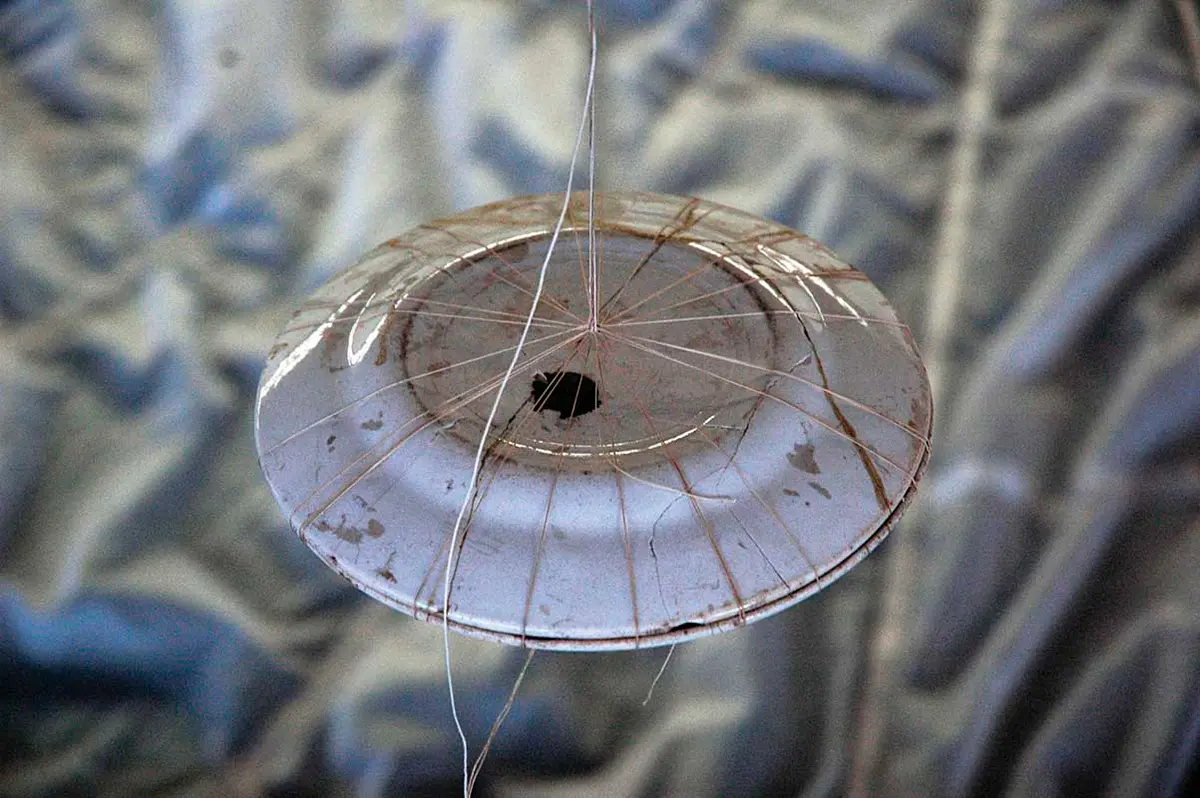
This ideal side for the viewer, or the point from where everything can be seen and explained, where the pieces make sense and a clearly outlined shape is formed, does not exist here. The fragments, remnants, and details—grouped, piled up, or aligned—continue to be what they are: bricks, lamps, pieces of wood, paper, thread or glass; ground coffee, or dirt. There are few works whose parts are condensed or solidified in a contained manner. An open parachute on the floor forms a circle over which several pairs of plates tied with thread float. There are cigarette papers, smoked or glued together to form a new unresolved and disarmed surface. A two-point pencil hangs from the ceiling by a thread that envelopes it and then extends further down. A cylindrical cup standing on a mirror of the same diameter has been completely filled with water, as such abundant content renders the liquid invisible.
Even in these works, the forms continue to be faint, tremulous, incomplete, and fragile. In other pieces—hard to describe—the tension between the individuality of each material and their reading as a group becomes even more present. Never able to find the best angle, the observer gets lost between a desire to understand these fragments scattered like vortices of a familiar figure—to join into a logical or definable composition the repeated elements—and the attention given to each element, its subtle color variations, and the actions and balances that maintain them in their position.
Perception becomes oscillatory, uncertain, and agitated. It is impossible to walk through the exhibition without asking when does the artistic gesture end; whether or not the grey square foam that hangs over the guard’s stool or the upside-down plastic cup that sits on a piece of wood adjacent to a column, are actually part of the exhibition; or if the boxes with works piled up beyond the panels that demarcate the main space of the exhibition area are also displays for the exhibition, more so than a reflector that illuminates the glass to transform it into a mirror. Or even more importantly, one should perhaps ask what changes—provided that anything does—as a result of this gesture.
We leave the glassed space seeing things in a new way, as we search in other places for a similar suspension, for that unfinished drawing. A can left by a ladder that rests on the wall, the circumstantial organization of garbage in a trash basket, a crumpled piece of paper found in a pocket, are transformed into potential elements for interpretation. And it is perhaps right in that other place and moment where a change is produced.
CARLA ZACCAGNINI