The contemporary misconception of the Age of Enlightenment, as a rational and coherent century, traveled fast through the mind of the spectator that attended Fin de Siècle(March 16 - April 23), the latest exhibition by Hugo Bastidas (Ecuador, 1956) at Nohra Haime Gallery. The re-appropriation of works by some of the master artists in the history of art such as Bernini, Da Vinci, Fragonard, and Goya, among others, seemed to be at first glimpse the leitmotiv of this exhibition. Bastidas’ masterful rational execution in the creation of beauty contrasts highly with the simplicity of the selected imagery and technique used. Thirteen paintings of oil on linen, done solely with his usual restrictive palette of black and white colors, composed this exhibition, which was undoubtedly commanded by some large-scale works.
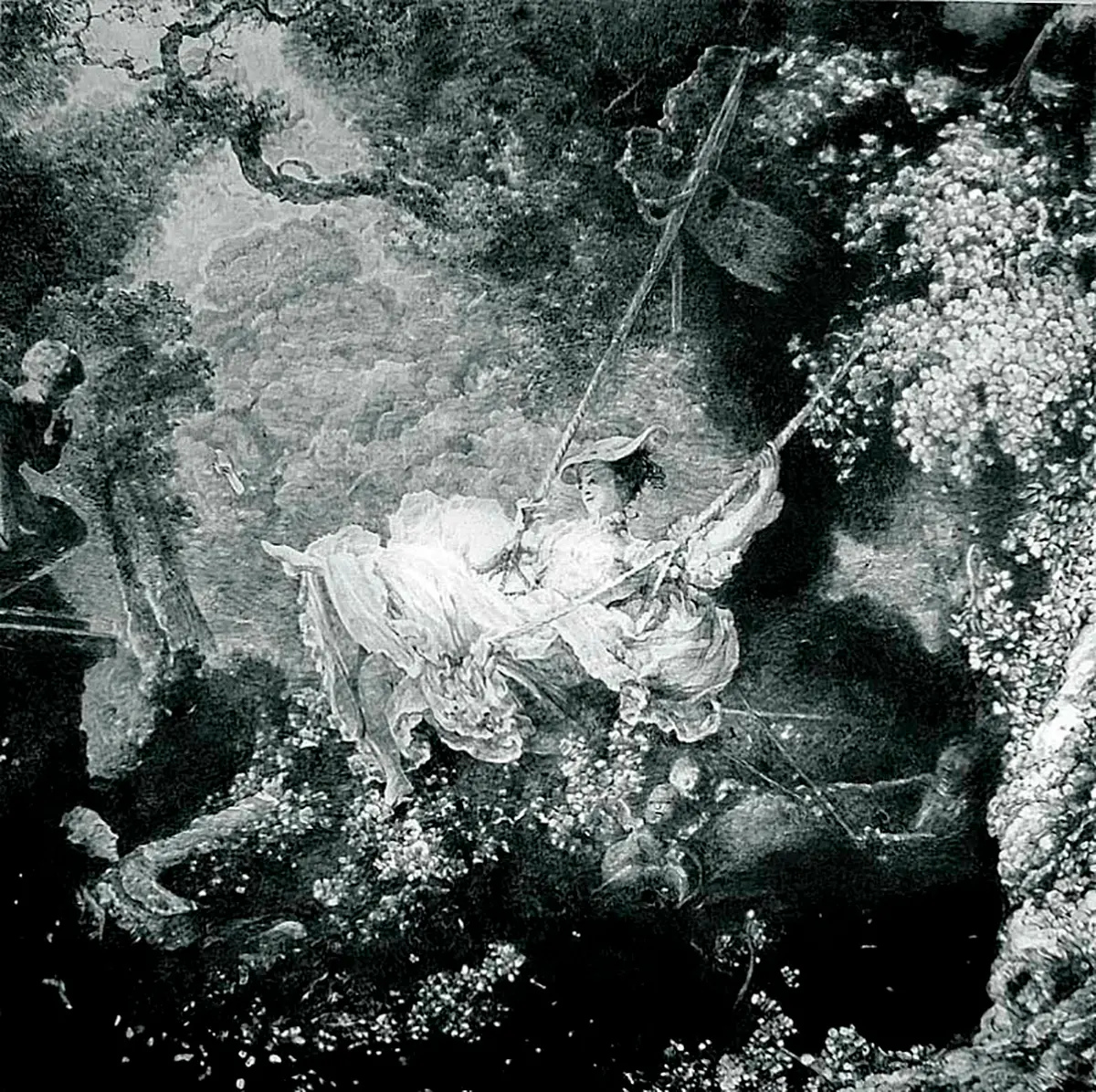
Perhaps the Age of Enlightenment’s ontological dichotomous discussion between and gravitated as a possible master theme in Fin de Siècle. In Where there’s smoke(2010), Bastidas appropriated The Swing(1767) by Jean-Honoré Fragonard to comment on the irony of today’s social values and concerns. The elegant woman with a billowing fancy dress that flies in the air is observed by her lover as she swings, allowing her to slip to fling off in a reference to virginity long gone. The mischievous careless scene repainted in the twenty-first century becomes a statement fully charged with social commentary and carries multileveled connotations. The uncanny beauty of the image is infused today with a conclusively different reality; a world at war, the proliferation of multiple popular social uprisings in middle-eastern countries, and one of the worst economic recessions in capitalist history.
The lost “virginity” in the minds of homeowners that have seen the recent drastic crash of the housing market around the globe is suggested in The Missing Mona Lisa(2009), in which a large canvas tent in the dilapidated condition is depicted with a reproduction of the famous Leonardo Da Vinci painting standing on an easel. The main character is gone, perhaps in search of a more stable and solid dwelling. This is a direct reference to the life of the artist and his personal battle, negotiating his family’s living space at the time of his last-born child.
Five dollars a dozen(2009), a very large-scale diptych, is one of the pieces of force at the exhibition. The overwhelming beauty of a wild garden of roses in full bloom (it might well be an oversized detail of the Fragonard painting) is defiant and provocative, attaining the realistic quality of a massive black and white photographic impression. The quiet and overpowering nature of the landscape creates a disturbing feeling, generating anxiety about something that is waiting to happen. The scene is haunting, rich with visual illusions in which the multitudinous layers of the realistic representation play with abstract forms. Abstraction is in fact the implicit technical resource in Inside looking out(2011) and The object of desire(2010). Both pieces are joyful and playful mental visual games that invite the spectator to take a defined position. In Inside looking out a somehow aged fence is seen in front of a cloudy-moody sky, making it “inaccessible.” The human-built artifact established the limited from the natural order. Metaphorically referring to the capitalist illusion in which “the sky is the limit,” it is convoluted and tormenting at the same time. In The object of desire, another boundary marker is the guardian of a series of growing plants, a future harvest. This is an unquestionable reference to a subsequent humanistic and positivistic thinking, an act of faith in the rational order of natural life. The two works complement one another, paraphrasing the cycle of the socio-economic system’s expected development.
Hugo Bastidas is able to decompose and recompose the imagery of landscapes using and creating mesmerizing surfaces that metaphorically bridge past and present. His reasons and sensibility are conducted by his knowledge and wisdom in art history. Moreover, they are the engine and base of his independent thinking and creation. His work combines an indirect, fine social commentary with a realistic language. He builds on the dialectic of beauty as described by Jean-Jacques Rousseau in 1761: good is none other than beauty in action, the one is inextricably bound up with the other and both have a common source in well-ordered nature. We are trained to see and to feel; or rather, an exquisite landscape is none other than a delicate and fine sentiment. In Fin de Siècle Hugo Bastidas does just that, exposing his independent feelings and philosophy of beauty, embodying history and art at the same time.
RAFAEL DÍAZ CASAS