
Ícaro Zorbar was born in Bogotá in 1977. He studied film and television at Universidad Nacional, and later obtained a Masters Degree in Art from the same institution. That is where we met. His workshop was a collection of technological junk, reconfigured. Out of it came precarious artifacts that needed to be manually wound up or otherwise set in motion, machines that moaned of ranchera songs and boleros, machines that returned to traverse sentimental and melodramatic spaces. At the time, as I remember it, they made me think of the technology of disillusion.
At the 40th National Artist's Salon, in 2005, at Bogotá's Colón Theater, Ícaro Zorbar presented a concert: La época de oro – somos el uno para otro. Broken turntables and recorders were installed on tables or on the corners of the theater, reconfigured as if Zorbar were giving them a second chance. And they demanded constant care. So much so, that more than an operator, they required a concertmaster to finally make such capricious machines work. The result was that the machines became the performers of eight agonizing sound interventions: the protagonists were suicides and cycles of repetition and clamorings. Thus, for example, eleven small windup mechanisms from music boxes waltzed atop a table and, after reaching the edge, fell into the void as if committing suicide one after the other. Another machine was comprised of three conjoined turntables playing an LP with the lyrics (by Los Panchos) "oh, my love, don't love me so much / oh, my love, don't suffer for me," a strange imploration. In charge of displaying the cycles of repetition was a motor "in love" that literally dragged a tape recorder playing a song by Carlos Gardel, which reminded us that "Returning" is a kind of fate.
In reality, these junked machines were setting in motion a hidden, almost embarrassing emotional material, because melodrama is not considered appropriate in everyday life. We can say, then, that on that occasion the work of Ícaro Zorbar interrogated, and continues to do so now, emotional concepts expressed in subjective times, such as repetition, remembrance, and re-elaboration. Concepts of time remain despite the evolution of machines and of the logic for their use. Interestingly, new technologies are vehicles for the transmission of old demands: where are you? Call me. Why haven't you come back?
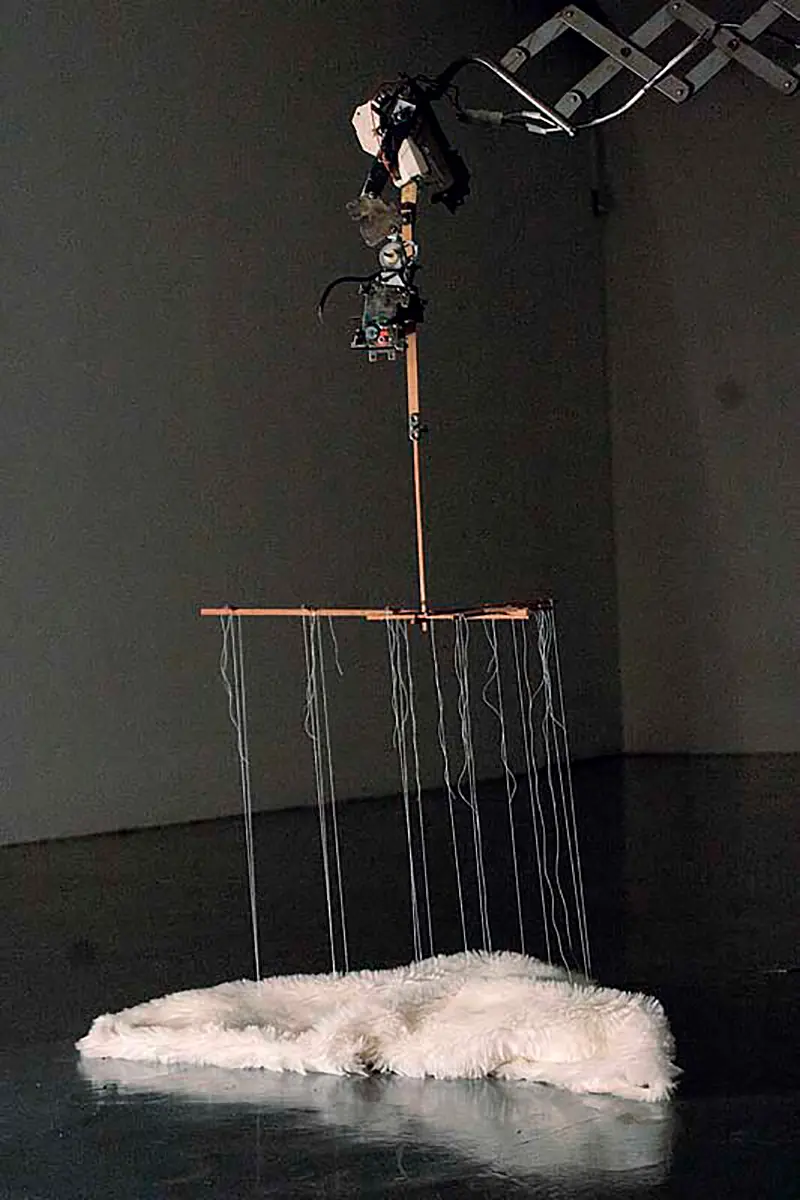
In this new exhibition, El sueño de (A), I perceived a reference to the relationship between fragility and junk; a relationship between fragility and technological intervention. I perceive a critique of the light that invades processes of vital incubation.
The idea was presented in seven "works" put together from the remainders of technological devices and the traces of a living being. The impertinent light interrupted the darkness in order to intervene in processes that occur in intimate spaces, under cover of night, in nests that need to be protected from the content exposure of "outside." I remember one work that for me summarized the spirit of the show as a whole: the carcass of a TV set with a large light bulb of an intense white light illuminating a series of threads that were beginning to weave a small organic space, almost a nest. It confronted technology with fragility. It is no secret that the Earth is a planet without the right to obscurity or to the shadows under which life processes take place and are cared for. Walking by a crowded city, a writer asks: where do birds live? El sueño de (A) could be a history of bewildered urban birds searching for their nests. Ultimately, it is the story of unnoticed and brittle living beings. And who isn't? At this point in history, intimacy is threatened by the mandates of exhibitionism, and the uniformity of cities rejects a diversity of ways of inhabiting them.
In this exhibition, Zorbar took effective advantage of the space, important when displaying objects so small that also make reference to birth and death; the entire available space needs to be used to support and emphasize them, without recourse to unnecessary prostheses such as tables or museum elements. Zorbar, for instance, used the walls to reinforce the idea: in one of them, he installed many surveillance cameras, each with an insistent light bulb that rendered them blind –inhospitable terrain– and pointed towards the viewer. He used the floor, from where some machines threatened flight or the construction of an individualized habitat. He used the borderline spaces between the ceiling and the central void to hang images that resembled small windows and underscored the idea of a framed, distant nature.
What I mean is that Zorbar organized his material within a system that gave it meaning and direction to each element (a concept of form as an emotional system, based on Beuys). Such an organization of space allowed for all the works in the show to point towards a different interpretation of the same idea: the demand for space for the fragile. And also asked viewers to be aware of the border between technology and an imperceptible, slow death.
NATALIA GUTIÉRREZ