In one of the notebooks where Aby Warburg wrote down the preparatory notes for his famous seminars at the University of Hamburg, under the heading About the Method, we read the following fragment (to be precise, in the Winter Seminar 1927-1928 notebook):
“The issue is to find a new formulation for the eternal question of why fate drives artists to the region of permanent interrogation, leaving them unable to decide whether his form will be found in Hell, Purgatory, or Paradise.”
José Alejandro Restrepo’s current exhibition at the Museo de Arte of the National University of Colombia, Variaciones sobre el Purgatorio, may have established its most deeply significant coordinates in the fact, so rare in the current contemporary art scene, of bringing to light the genesis—I want to call it historical—of its own form. Variaciones sobre el purgatorio would thus be a contextualized and highly pertinent reformulation (the good God resides in the details) of Warburg’s question: Why was it that the artists found, from the region of permanent interrogation, his own form in Purgatory?
In this way, Jose Antonio Restrepo’s Purgatory would be initially indicative, in its origin if you will, of a specific space for the construction of a form of his own. In its origin, an interstitial space between that region of permanent interrogation and an affective, rain-filled purgatorial territory—Purgatory is a place where images rain down. 1
Perhaps this is the meaning of the first three “variations” (which effectively occupy and determine a single exhibition space): 2 to outline a space of necessity of form, to establish the need of a form of its own. The first three variations would be, rigorously speaking, a path to Purgatory (the seed of a form that is no longer infernal or paradisiacal.) The issue here is one of destiny—a proscenium—for an ailing body, a body suspended and in waiting, exasperated by guilt and the horizon of forgiveness. A historical, present body. A body carved by force by divine law, a somber body infected by the naturalness of that same law: “the body is covered in boils. Around the anus, in the armpits, in precious places where active glands faithfully carry out their mission, boils appear; and through them, the organism discharges its inner rot, and sometimes its life. In most cases, a violent but limited conflagration indicates that the central life has not lost its force and that it is possible to expect a remission and even a cure.” 3
It should be sensibly clear that this is not hell or any hellish form since remission and cure are to be expected. As in Artaud’s Plague, this is a law-bound illness. In principle, an interstitial space between a certain exacerbation and exasperation of the bodies (Warburg calls it a “passional kinetics”) and the need for a horizon to contain them (precisely there where it is possible to expect a remission of the illness, and even a cure).
And if the first three “variations” present the origin, the need for a form that is neither infernal nor paradisiacal, the fourth and fifth “variations” will be the finding of such form: the effective, rain-soaked purgatorial realm.
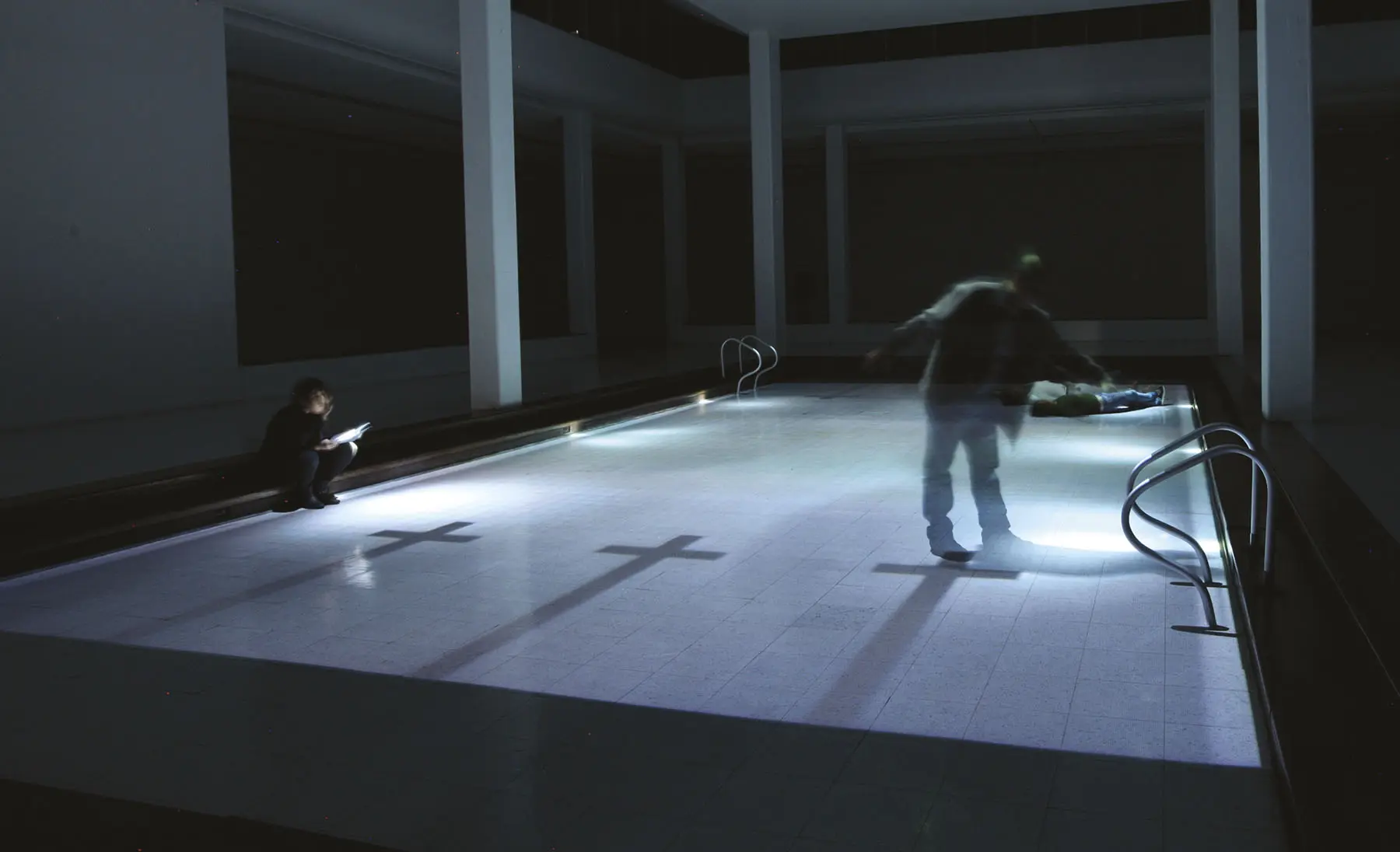
José Alejandro Restrepo’s purgatory thus has the shape of a swimming pool—the sole source of liquid light in a space of darkness. Over those waters, feeding into them, there rain images of recent history in the shape of voices asking forgiveness for crimes committed, but never accounted for injustice. We distinguish the voice of a former President of the Republic, a military commander, a high figure in the Catholic Church. Images of the remission of an unnamable illness rain down; images in the shape of voices through which the request for forgiveness becomes the cure. Visitors must traverse the pool, an ailing, exasperated body as if wading through a baptismal river—yet there is no baptism, no cure, no punishment, no forgiveness.
José Alejandro Restrepo’s Purgatory is shaped like a space of transition, of mutation, yet not as one of expiation. The body of the viewer is forged in fire by the illness of the real (like the body of Dante is marked in the flesh by the sword of an angel, marked in the forehead with the names of reality, of contingency, of sin, before crossing the threshold of Purgatory) and the gesture of traversing the pool is the desperate gesture of opening our eyes to see in the dark: the brusque transition from a thought image to a real image. The real, true image of the word in a given epoch that is configured in the atrocious relationship that waking up establishes with the present. A historical, and thus symbolic image, “beats of silence, pauses, intermittencies of the heart, excitement of the lymph, inflammatory images that abruptly invade the waking mind.“4
Traversing the pool should mean to place oneself above the grammatical pantomime of the penitents asking for forgiveness in a rhetorical theater of theology; it should mean to cross the threshold of a historical Purgatory just like the afflicted body of Dante did, only to find on the other, carved on the rock (and more real than reality), the images of the history of unredeemed humanity. It should mean “to place oneself above crime through another crime, indescribable and passionate; above threat, above horror, with an even greater horror that confounds at once the law and morality”: 5 it is living darkness.
Why, then, did the artist find, from the region of permanent interrogation, his form in Purgatory? Perhaps it is possible to attempt an answer now: because the purgatorial form assumes or requires the illness of form—time—in order to assert its imperium, its fate; because in purgatory, “the survivor slowly becomes a giant, overwhelming being.” 6
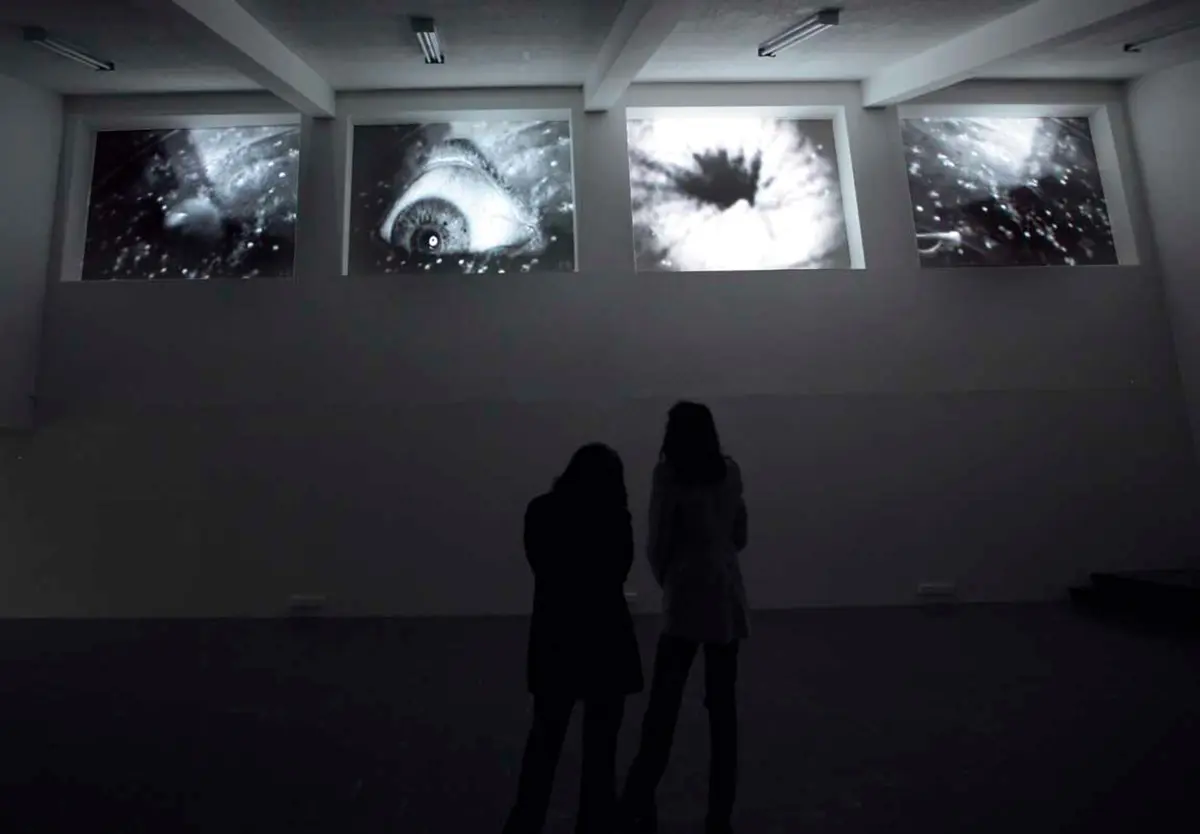
An unexpected confirmation of such genesis of form is given in the unsettling video installation Annus Mundi. There, the remains of a fragmented body gathered in glass reliquaries, generate a cosmology by means of figured causality. Figured causality, Warburg explains in one of his letters, is the way in which what we call symbol offers us an understanding of ungraspable events. It is the way in which the mortal human body would inhabit time. We once again encounter Artaud’s defeated body: “Those blood-shot, inflamed, glassy eyes; that bloated panting tongue, first white, then red, then black, as if carbonized and caved-in, all proclaim an unprecedented organic disturbance. Very soon the humor of the body, traversed like the earth by lightning, like lava stirred by subterranean storms, seek an escape. At the center of the blots there appear more fiery spots, and around them, the skin rises into boils like air bubbles under the surface of the lava, and those bubbles are surrounded by circles, and the outer circle, like the ring around an incandescent Saturn, marks the edge of a boil.” 7
The fragments of an unredeemed body, like the images so far asleep, become inflamed to their limit in order to rediscover the immense, sickly power of the symbol. Reliquaries of the universe. A pool where images rain down.
NOTES
1. “Poi piovve dentro all’alta fantasia.” Dante Alighieri. Purgatorio, XVII, 25.
2. José Alejandro Restrepo’s Variaciones sobre el purgatorio was commissioned and produced by the Museo de Arte of the National Directorate for Cultural Outreach at the National University of Colombia. The exhibition comprises five video installations, one video, six photographs, and four silkscreens. At the Museo de Arte’s Gallery 1 are Variación 1 (video-installation), Variación 2 (video-installation), and Variación 3 (video-installation); at the Gallery 2, Variación 4 (video-installation) and Variación 5 (video); at Gallery 3, Annus Mundi (video-installation); at Gallery 4, the photographs and silkscreens.
3. A. Artaud. El teatro y su doble. Ed. Sudamericana, Buenos Aires, 1964. p. 19.
4. Ibid., p. 27
5. Ibid., p. 29
6. Ibid., p. 30
7. Ibid., p. 19
ALEJANDRO BURGOS BERNAL
Curator, Projects Director-Post-office Cowboys Corporation.