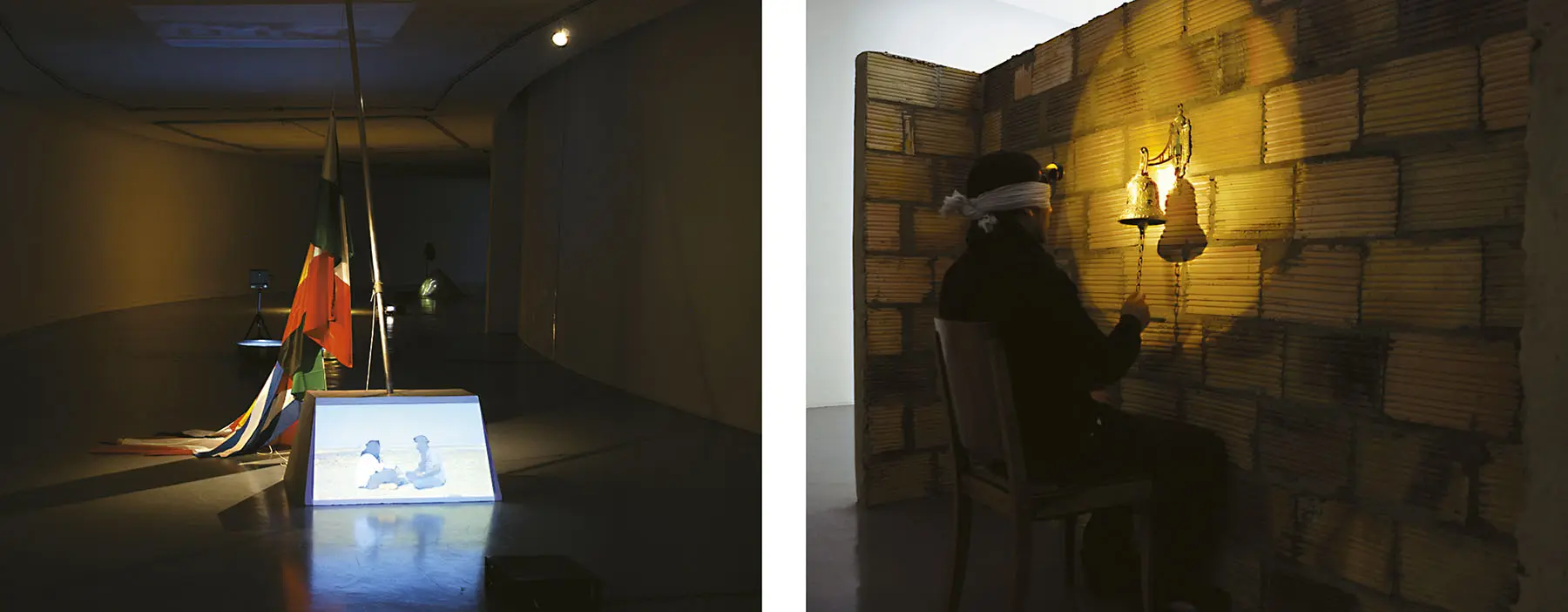
Bogotá, 2009. La expulsión del paraíso. A work by Mario Opazo with references to the attics found in oceanfront homes in Chilean towns. A work in “stations” of memory, travels, and remembrances transformed into video-objects. A work that makes reference to dead union members whose bodies were thrown to the Patagonian seas. In my view, this is also a work that encompasses the oblivion into which so many victims of Colombia’s political violence are cast. Here, Opazo remains seated for an entire day, blindfolded, his back to the public, facing a brick wall. Intermittently, he rings a bell. The artist as a blind captain who gathers with his gestures the souls of the dead.
The presence of the artist in the gallery, the sound of the bell, and the video-objects were all intended to awaken an image of personal memories, one that is not quite precise and lies asleep or secret within the viewer. The text did specify what the artist wanted to do: to cite a massacre, the disappearance of Chilean union members in the Patagonian Sea, and to present it to Colombian viewers along with personal remembrances, but with a memory of the disappeared that is not only obliterated but placed outside the very possibility of being imagined or believed true. A foreclosed memory that is an act beyond oblivion. 1 To foreclose is to take out of the imaginary the possibility that something, in this case, murders and massacres, has actually happened.
After twenty years of continued work, Mario Opazo has found a place for everything. For example, a place for the image and a place for the text. A vanishing image, because—as he puts it—it was born far from the realm of photography, in Patagonia, and because the dictatorship exterminated his family. There is more information in his memory that in any photographic record. “The truth of a photo album is not in the photographs but in its blank pages and empty spaces, in its absent images.” 2 Opazo authored one of the key books about art written in Colombia, a book of short paragraphs devoid of images, small descriptions of his emotions, paragraphs that are “the photographs I never took.” A book that explores, then, the place of the image, a liminal space that appears between those not-so-distinct lived experiences jumbled with absences and emptiness. The liminal is perceived by the senses, yet it is at the outside edge of what can be perceived consciously. I must say that this is how I have perceived the artist’s most recent works; ultimately, the image is not in the video or the object, but in a region of myself as a viewer trying to wake up.
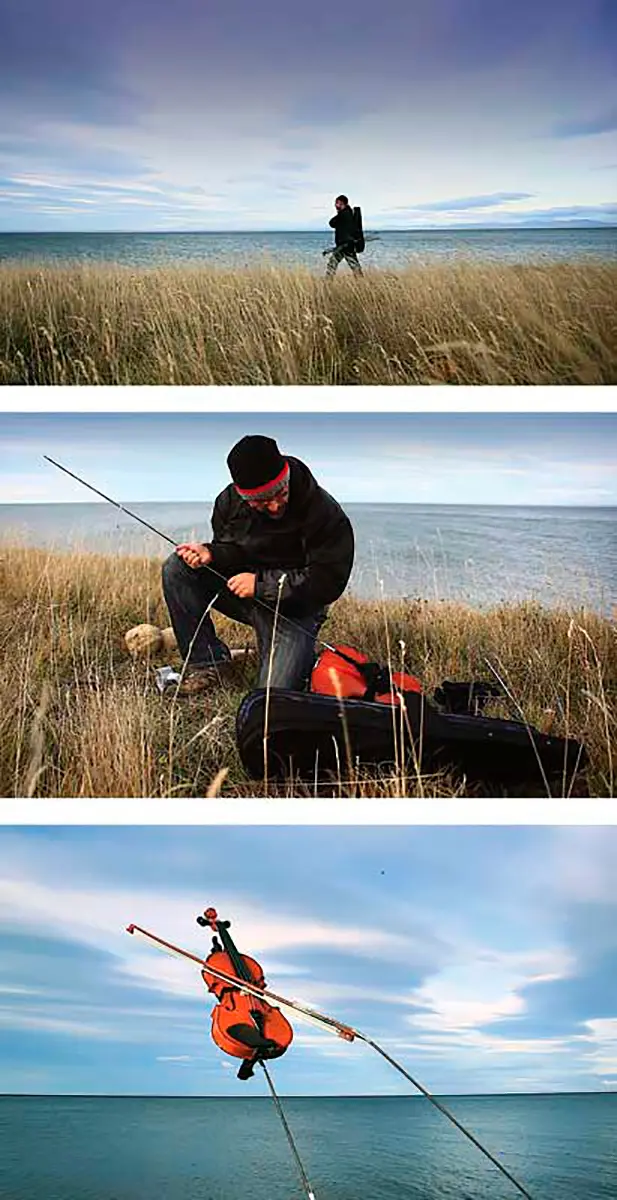
Solo de violín, Mario Opazo, 2010. A year after the previous work, Mario Opazo travels all the way to the lighthouse at the top of the world in a shipping vessel. The Islands of the Top of the World are located south of Chile and Argentina and have been the scene of conflicts between the two countries. Place names there are filled with meaning: the Gulf of Sorrows, the Bay of Last Hope, Dead Man Island, the Peninsula of Disillusion.
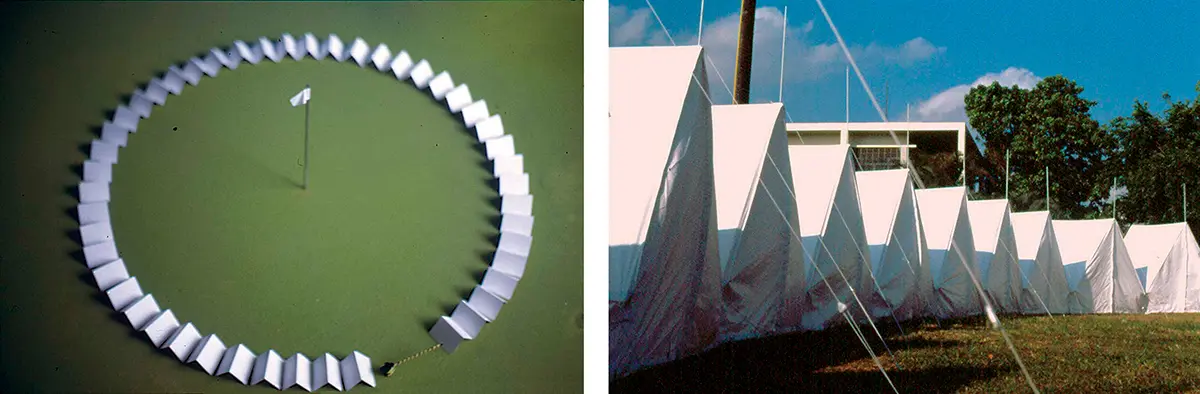
Mario Opazo spent several months there and carried out actions “that activate sound devices in the Patagonian landscape as a metaphor for the voices of the disappeared.” Actions such as lifting a violin to be hit by the bow. And one of the texts on the wall: “And the wind said: I want to reach the Lighthouse of the Top of the World and from there call out to the disappeared.”
The artist’s self-displacement to extreme geographical conditions and his minimalist actions seem to respond to a certain unprotected state, to Opazo being hostage to the community that inhabits him and forces him to speak.
A community that inhabits him: childhood. Deprived of speech, unresponsive to common reason, and in the midst of adults, the child. Childhood will leave traces of indeterminacy that persist through our adult age. 3 The problem of childhood as the builder of allegorical images, images without an instantaneous totality but rather like a progressing series of moments, involving myths, failure, pain, tempestuousness, the unnamable, the human as an enigma. An enigma that belongs to each person’s biography but, rather than being revealed under the light like the photographic image, is constituted in layers unveiled through a physical, almost medical examination on the part of the subject and the viewer.
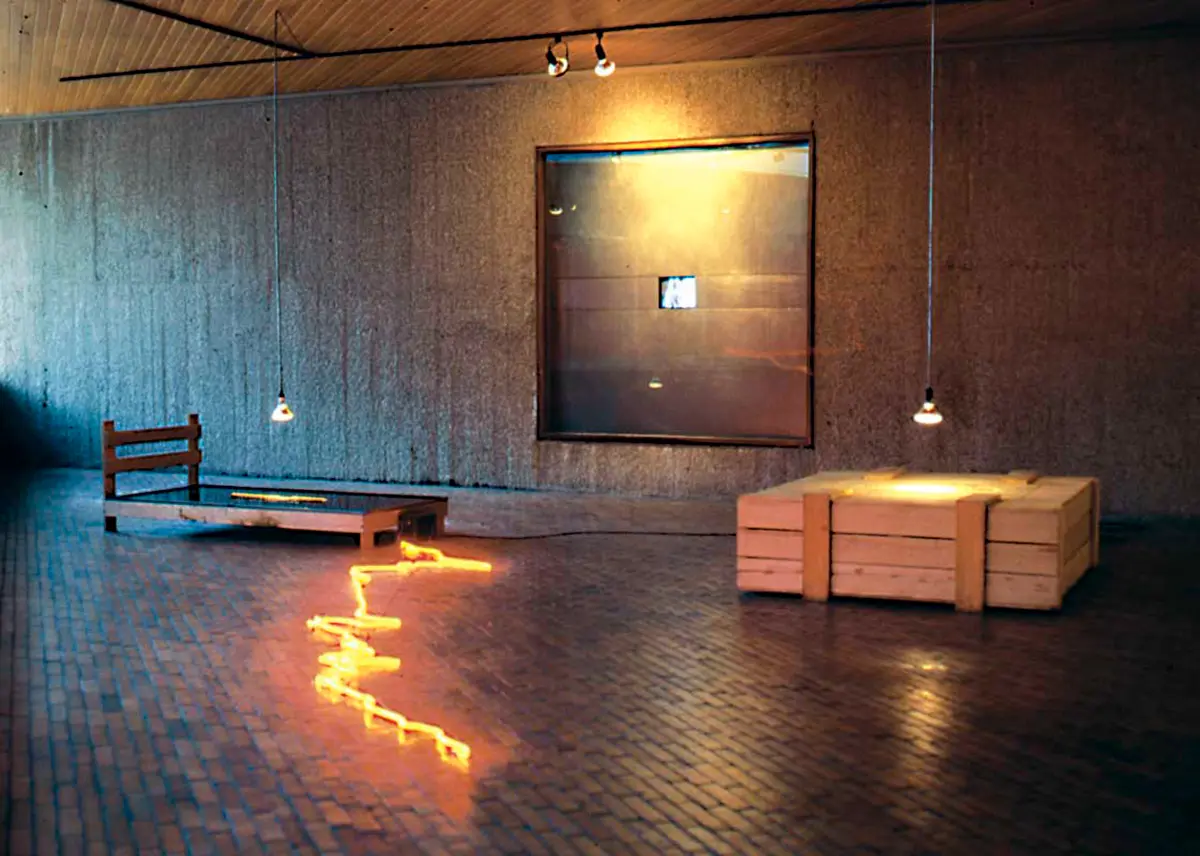
Mario Opazo’s work, then, seems to be indebted in a complex way to childhood, to every childhood. Opazo was born in 1969 in Tomé, Chile, an oceanside town populated by textile workers with a tradition of social protest. His father fled to Colombia escaping persecution, disappearance, or even death after the fall of Salvador Allende. He reached Colombia in 1979 to work as a sociologist and ecologist. Mario Opazo tells that his father’s early letters from the new country expressed the hope that his son would one day know public squares where people could debate ideas without risking their lives. In 1986, at the age of 17, Mario Opazo moved to “that promising country,” Colombia, along with his mother. Three years later, Luis Carlos Galán, a front-running candidate for President, was assassinated, and the Drug War started. Mario Opazo became a quiet art student in a university in central Bogotá, who expressed himself through graphite and salt water objects that were rather unusual for the city. His father decided to devote himself to ecological issues and to involve his son in his travels in order to show him the geography of Colombia, and especially its rivers, so different from those in Chile. Long and plentiful, the Magdalena, the Amazon, the Cauca were another thing entirely.
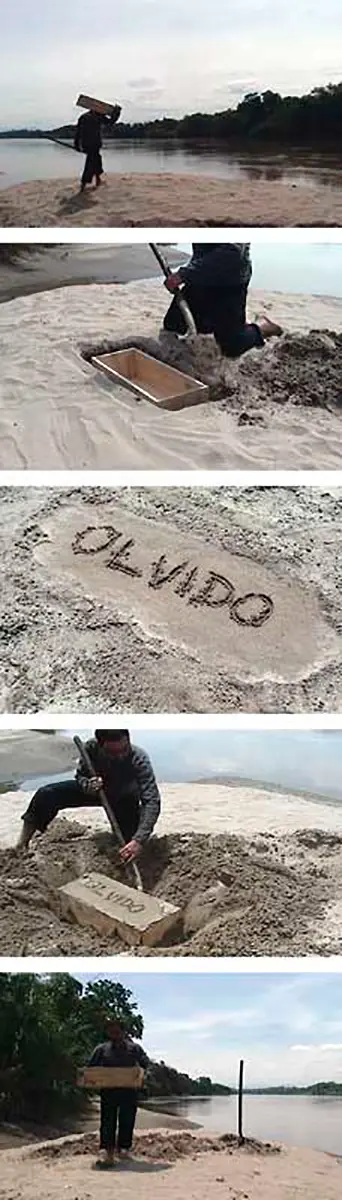
Opazo’s indebtedness to childhood and to Colombia’s geography was translated into two works about rivers. The first one, more cartographic, was Magdalena llora (1996); the second one, Olvido de arena (2005). Living on the banks of the river, with his back to the waters and facing a video camera, the artist dug out a hole to repeatedly bury and unearth a box containing the word olvido (oblivion). This is the work of someone who is concerned with the country’s large-scale ecological and political problems, yet refuses to play the role of hero and devotes himself to simple and repetitive actions. Extremely individualistic gestures that nonetheless are micro-political acts.
In this video, its sound amplified and slowed down in the editing process, the rumble of the river became an expressive protagonist, an exaggerated sentence that forced our ears to remember Nature, which we seldom keep in mind. The artist says: “Absolute gestures, such as digging, writing on the sand, throwing rocks to the water or against a wall, are sometimes fugitive substances filtering through time. Although archaic, these gestures point to the origin of technology, the pure beginning of everything. They are primitive actions that connect us to the world like hanging bridges of memory. To write a million words on sand is simply to write The Word.”
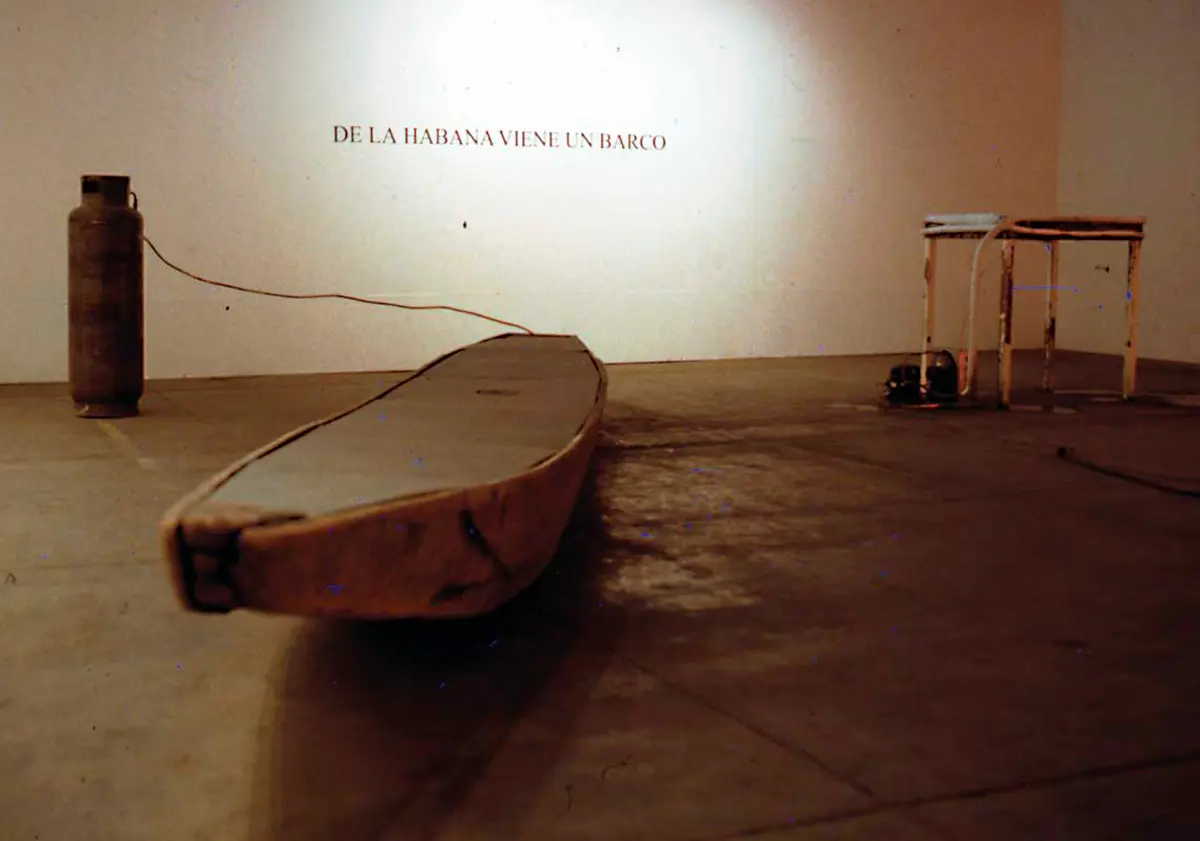
This very short presentation of Mario Opazo’s work, which leaves aside the majority of his production, attempts to propose, as I said, the idea that this artist has put things in their place: image, text, objects, and anecdote. And this is because the entire history of contemporary art has been located in a space of transit, traversed by tales of travel and childhood debts. The object that carried such weight at the beginning of Opazo’s career, as in his national salon winner De La Habana ha venido un barco (1996), were intended to retell the story of an anonymous subject, in that case, Ícaro González, a Cuban balsero (boat emigrant) with whom the artist lived and from whom he learned the meaning of leaving in Cuba in the 1990s.
Very quickly those objects became even more fleeting, for instance in Move home (1999), a series of open tents to be inhabited by visitors to the Mercosur Biennial. Starting from there, Opazo has resolved to travel with an even lighter load, letting objects escape into the immaterial space of the video to finally install themselves in a place whence a timely and ethical image emerges. Bill Viola asks us to look at things from an open wound, and I see Mario Opazo’s work as always confronting that challenge. Today, setting aside the physical weight of objects and with the freedom granted by his own history, he has resolved to journey through all of us with those childhood wounds that are, ultimately, the wounds of Latin America as a whole.
NOTES
1. Jean-François Lyotard. The Inhuman: Reflections on Time. Stanford University Press, 1992
2. Mario Opazo. El perro estúpido y las fotos que nunca hice. Universidad Nacional de Bogotá, 2008.
3. Walter Benjamin.The Origin of German Tragic Drama. London: Verson, 2009.
NATALIA GUTIÉRREZ
Art critic and teacher.