Political Ecology
Uriburu is among the artists who, in the second half of the Twentieth Century, felt the need to speak up for the health of the planet. Thus, his ecological art is a form of public, extra-museum art that attempts to raise awareness about the current catastrophe. The goal is to denounce, through artistic actions, the antagonism between nature and civilization. “This is why,” he says, “I paint my body, my sex, and the waters of the world. The more developed countries are destroying our water, our land, our air, the future reserves of Latin American nations.”
Uriburu feels these ecological problems from the standpoint of his Latin American location and directs his barbs to the developed societies that are damaging or appropriating Latin America’s reserves. But Latin America is only a starting point. Given that the issue affects the world as a whole, his globalized actions are to take place everywhere. His is, in summary, a utopia from the South, rooted in the experience of marginality, but not one of the South.
We may be tempted to think that García Uriburu’s choosing of Venice for the start of his actions in 1968 was due to its closeness to Paris, where he lived. However, what was most important to him at the time was the “buzz” around the celebration of international art biennials. The excitement generated by the 34th Venice Biennale, held in a period of disorder and contestation, was especially intense: it forcefully shook the tranquility of the “Serene Republic of Venice”.
On June 19, 1968, at 8 A.M. in the morning, the most propitious high-tide time, Uriburu dyed green the waters of the Grand Canal. Acting spontaneously, uninvited by the Biennale’s organizers, the 31-year-old artist was expressing early in his career the ecological drive that would carry him to this day. That was one of the earliest expressions of land art, a year before Christo and Jeanne-Claude wrapped the Australian coast.
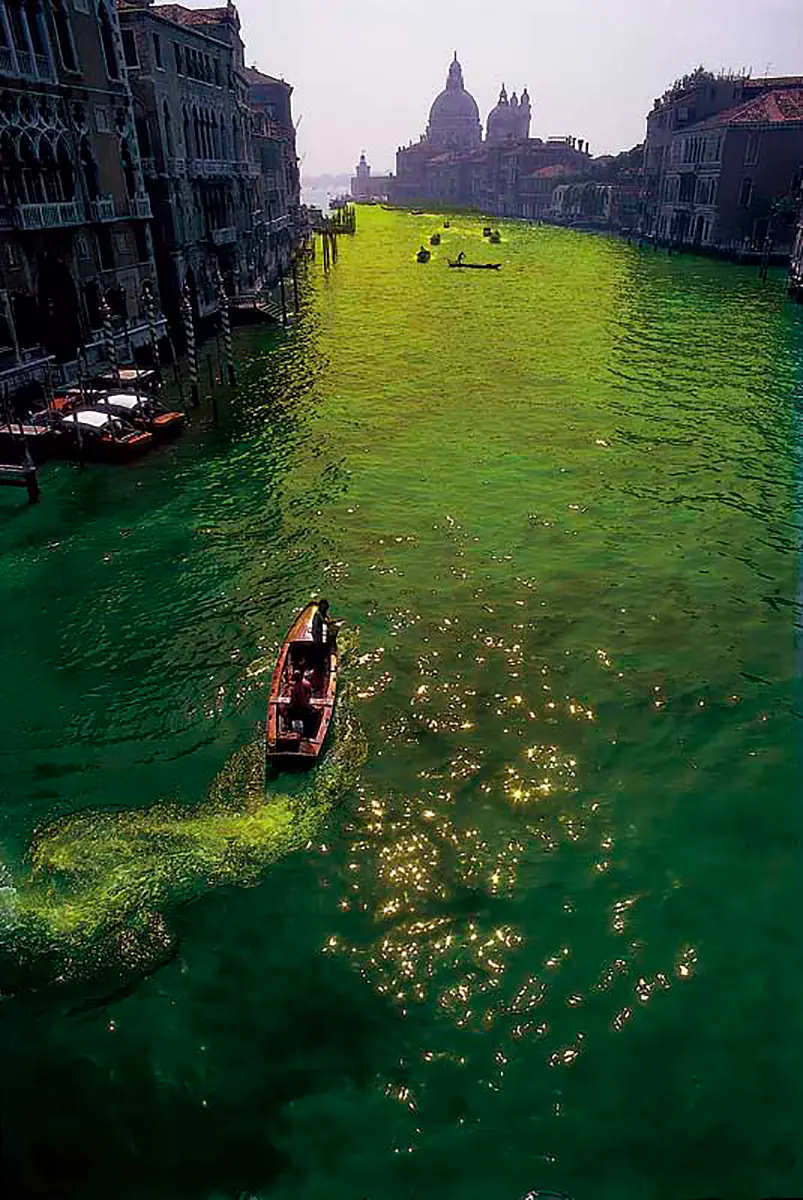
Pierre Restany, the critic who has most insistently studied and defended Uriburu’s work, deems this action a “masterstroke,” and describes it in the following terms:
“During the eight hours of the high tide, Venice found itself painted a fluorescent green from top to bottom, along the 3 kilometers of the Grand Canal. Vaporetti and gondola passengers were traveling on the green. Everybody was talking about that. Venice was grateful to Uriburu for a sumptuous and ephemeral enhancement he gifted the city for a single day.” 1
Perhaps it was the charm of the canals that provoked in Uriburu an anticipated nostalgia, emerged from imagining their disappearance. The beauty of Venice’s canals was highlighted by the introduction of a new hue, a luminous green that brought new life to the grayish waters. A symbol of nature, the color green has a direct relation, synecdoche-like (as a part of the whole) relationship with it. It is not by chance that in his abstract paintings, Mondrian abstained for using green.
Through his use of the color green, Uriburu brings to the fore a desire, a utopia shared with artists from all over the world, among them Joseph Beuys, Andy Goldsworthy, Alan Sonfist, Agnes Denes, and Huan Yong Ping.
Uriburu is not alone. In 1981 he worked in collaboration with Beuys to color the contaminated waters of the Rhine, in Düsseldorf. Afterward, he continued to work with the German artist in the planting of 7,000 oak trees during Documenta 7 at Kassel (1981). He is also a founding member of Grupo Bosque, with which he intervened in reforestation campaigns in the city of Maldonado, Uruguay. He participated in Greenpeace's actions, in Proyecto Yaguareté (1998), in Basta de contaminar (which took place on the Buenos Aires river in 1999) and in No a la Basura Nuclear in 2003. Also, he presided over a foundation named after him, devoted to the study of Latin America’s original peoples.
A Provocative Context
The earliest ecological actions were framed by a context of revolution and disturbance, from the events of May ‘68 to the Prague Spring. It was also the time of the hippies, flower power, Situationism, the sexual revolution, the society of the spectacle.
In Argentina, political, economic, and social crises generated a malaise in the democratizing sectors. The youth sector, mobilized by left-wing ideologies and by the figure of Che Guevara, was to express its rejection of dominant power by protesting against abuses, such as the Vietnam War. The country suffered since 1966 under the military dictatorship of General Onganía, which extended through 1970.
Events like Tucumán Arde—a documentary show about the situation in that province, presented in 1968 at the Rosario CGT (General Workers Confederation)—or the Experiencias 68 at Instituto Di Tella, were to question the authoritarianism exercised from the center of power. Among the most corrosive works presented as part of those experiences was El Baño, by Roberto Plate, a fake public bathroom with two doors, labeled with the typical outlines of a male and a female user. Members of the public wrote and drew on the walls all kinds of obscene inscriptions and images; some were directed against the government, which prompted the police to take it down. In solidarity, the artists retrieved their works, and some were even destroyed in Florida Street.
Another echoing case was that of Julio Le Parc. When, in 1968, he attempted to join the workers of the Renault plants confronting the C.R.S (Compagnies Républicaines de Securité), he was arrested and expelled from France.
We can say that the passions displayed by Uriburu in his ecological actions are the echo of such provocations of the 1960s. Without provocation, there is no vocation, and the latter is born of the impetus of a contestational impulse that emphasizes the right of art to participate in social praxis. There is no doubt that ecological activism was and is one of the most forceful modes of radical protest and political commitment. Aesthetics and ethics meld, while a feature that Theodor Adorno deemed essential to art, to counter the “managed world” that capitalist society offers up as the best of all possible worlds, is emphasized. Because of its negativity, ecological art brings to the fore the humanist vocation to deploy any and all resources able to question the “evolution” and “progress” that endanger human life.
The Uriburu Green
The action in Venice was for Uriburu the beginning of an international campaign. The color Uriburu green was to appear in the four corners of the world. In 1970, two years after Venice, he produced Hidrocromía intercontinental urbana, which consisted in coloring rivers in four cities, located in two continents: the East River (New York); the Seine (Paris); the Grand Canal (Venice); and the River Plate (Buenos Aires).
Uriburu’s hidrocromías have in common the use of a harmless product, fluorescein, a water-soluble substance that produces a fluorescent green hue and is used by the US Navy to identify, in the Pacific Ocean, the capsules used by astronauts as they return to Earth. It is also used in diagnostic studies of corneal damage.
Uriburu takes a few milligrams of fluorescein and dumps them in an isolated corner of the banks of the Seine. This trial is convincing and as a result, in June of 1968, he decides to board a train at the Gare de Lyon towards Venice, with his wife, Blanca Álvarez de Toledo, and Raquel Forner. Restany explains:
“The product is manufactured in France, by the Ugine-Ullman company, and is available commercially in three colors. Red is the color of blood, revolution, and communist. Blue is the color of the sky, of infinity, of Yves Klein’s work. Green is equidistant of these two extremes, the blue of the skies and the red of infernal violence (…). It represents nature in its most human aspect.” 2
But green fluorescein is also red when it is first put in water. It turns green upon contact. This transit, which undoubtedly captivated the artist, could be seen as a desirable passage from violence to respect for nature.
Beyond the connotations, the use of a non-contaminating substance makes it possible to achieve a seal of identity: the Uriburu green, added to any artist’s arsenal of colors, like Klein blue. Given the importance of color in his work, Uriburu could be considered a “painter”, not only because he paints canvases but also because, like a giant in a fairy tale, he slides his brush over the grand spaces of nature. In the Village Voice, John Perreault described the painting of the East River as “the most beautiful watercolor I have seen in a long time.”
Alongside color, there are two essential facts: space and time. The space chosen will no longer be the museum or the gallery, but the “site” of nature. Transformed according to meteorological variables, the new space ultimately disappears. It behaves like a living being. It is time.
Uriburu describes the Spatio-temporal particularities of his work in the following terms:
Space
The work of art has ceased to possess an autonomous form.
The work of art adopts the shape of nature: fluid, dynamic.
The work of art does not have a “place” (gallery, museum…) outside of nature; its place is in nature.
Time
The work of art does not exist until the time in which it becomes integrated into the real: red pigment becomes water in a green artwork. The work of art has a life, a beginning, and an end. It shifts places, shapes, dimensions; it dissipates (variable duration according to meteorology, tides, currents…). 3
The color Uriburu green is the symbol of nature as natura naturans rather than as natura naturata. These terms come from Aristotle and refer us to Spinoza. Natura naturata alludes to natural products already produced (a flower, a tree, the waves of the sea, the sun), while natura naturans—similar to what the Greeks called physis—is that from which all entities are born, as if from a common mother. It is the perpetual development by virtue of which all entities have the possibility of being.
More than speaking of the natural product, Uriburu speaks of the energy that nourishes everything that exists and highlights the fact that it is on the verge of being exhausted. It is the “non-renewable” energy that he helps flow, symbolically, in the color green.
Unlike Duchamp, Uriburu does not decontextualize but produces signals in situ. The work takes the shape of the site. Hence his inclusion within land art.
Uriburu’s ecological activism is also included within sociological conceptualism. Like any activism, it is connected to the need to communicate for the development of critical awareness. It is precisely the need to communicate what strategically multiplies Uriburu’s work into a wide variety of manifestations. The constant pull of this demand gives coherence to his multifaceted production, developed over more than fifty years. Painting, body art, objects, installations, direct action on nature: these are all possible strategies when it comes to making contact with others.
Career landmarks
While Uriburu’s international renown has been based on his interventions on nature, we must not forget other aspects of a career launched in the late 1950s.
Uriburu’s work gained critical acceptance early on. In 1960, at the age of 23, he exhibited at Lirolay, the mythic gallery helmed by Germaine Derbecq, which operated as the launching platform for the most important artists of the neo-avantgarde, many of whom will be seen later at the equally legendary Instituto Di Tella.
In 1965, Uriburu won the Braque prize and moved to Paris. There he left behind the informalist painting he had developed in Buenos Aires in the 1950s. It was a non-purist kind of informalism that also incorporated, derived from his education as an architect, rational elements, and structures. We note, on the other hand, that Uriburu’s interest in the matter, felt already in his early informalist paintings, remained in most of his later works.
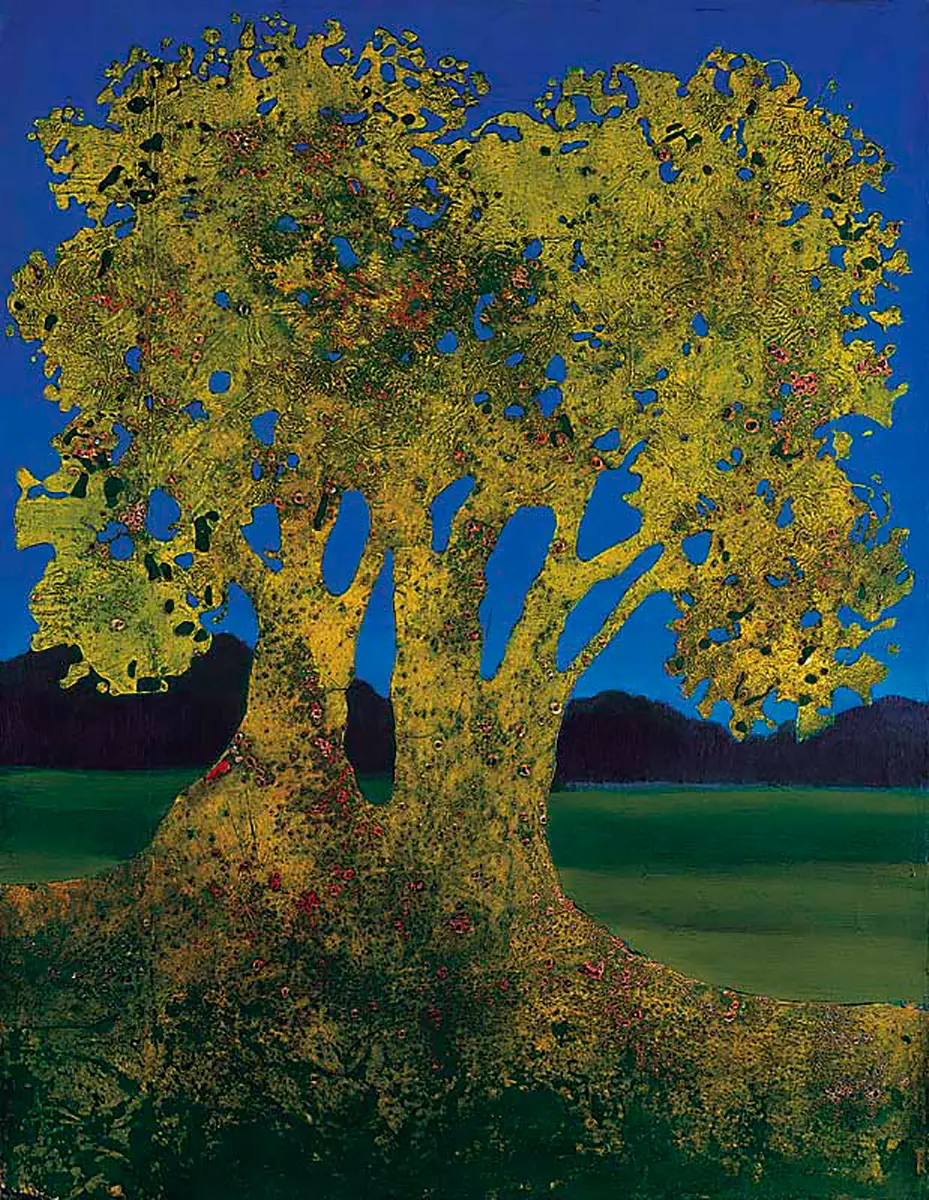
In the early 1960s, Uriburu introduced to nature as a topic in oils with divided planes and transversal cuts that suggest fragments of ground and sky; his synthesis of the Argentine landscape appeared in 1962 with representations of ombú trees and pampa flatlands. The rather uniform color of the sky in Ombú (1962) contrasts with the “decayed” appearance of the foliage, which prefigures the topic of damaged nature that will come to the forefront in the artist’s later works.
Uriburu’s (brief) adherence to Pop Art began in 1965. Among the main motifs, there appeared icons of the city of Buenos Aires, such as the colorful colectivos (public transport buses) seen from strange perspectives. These were followed later by a series of characters such as Evita, Carlos Gardel, and the Virgin of Luján, protector of the River Plate. Arriving in Paris in 1967, Uriburu moved from his localist themes and introduced new motifs, such as Marie Antoinette and the “three graces.”
With Las tres gracias—a large-scale oil where the three mythological figures appear surrounded by animals and flowers in an exultant atmosphere of Pop undertones—Uriburu won the Grand Prix at Argentina’s National Visual Arts Salon in 1968. That same year, at the Iris Clert Gallery in Paris, Uriburu presented the installation Prototipos para un jardín artificial, with acrylic plants and cut-outs of cows, bulls, sheep, clouds, and waterfalls, in an environment of perfumes and sounds. It is interesting to note that ten years before, the same gallery had hosted Yves Klein anthology show Le Vide. It consisted of a large empty room, painted white, accessed from a blue platform. An equally blue cocktail was offered to “color the visitor's bodily humors.” According to Klein, the empty space should serve a “pure sensibility,” a kind of degree-zero of pictorial sensibility. Klein and Uriburu coincide not only in having exhibited in the same space; both diversified the palette with the introduction of two new hues: Klein Blue and Uriburu green.
Towards the late 1960s, Uriburu went back to painting and adopted as his theme the opposition civilization-nature; he confronts animals and plants with emblems of progress, such as New York’s buildings. It is the case of Delfines sobre Nueva York (1961), a large-scale oil painting (230 x 200 cm) dominated by ochre and brown tones. The same theme will be translated later into the “green series,” with works like Cascada and Museo Guggenheim (1975).
Starting in 1971, Uriburu will take his own body as support, painting green his sex, face, and hair. These instances of body art remind us of Klein’s experiences with the painted bodies of models that functioned as supports for a pictorial process.
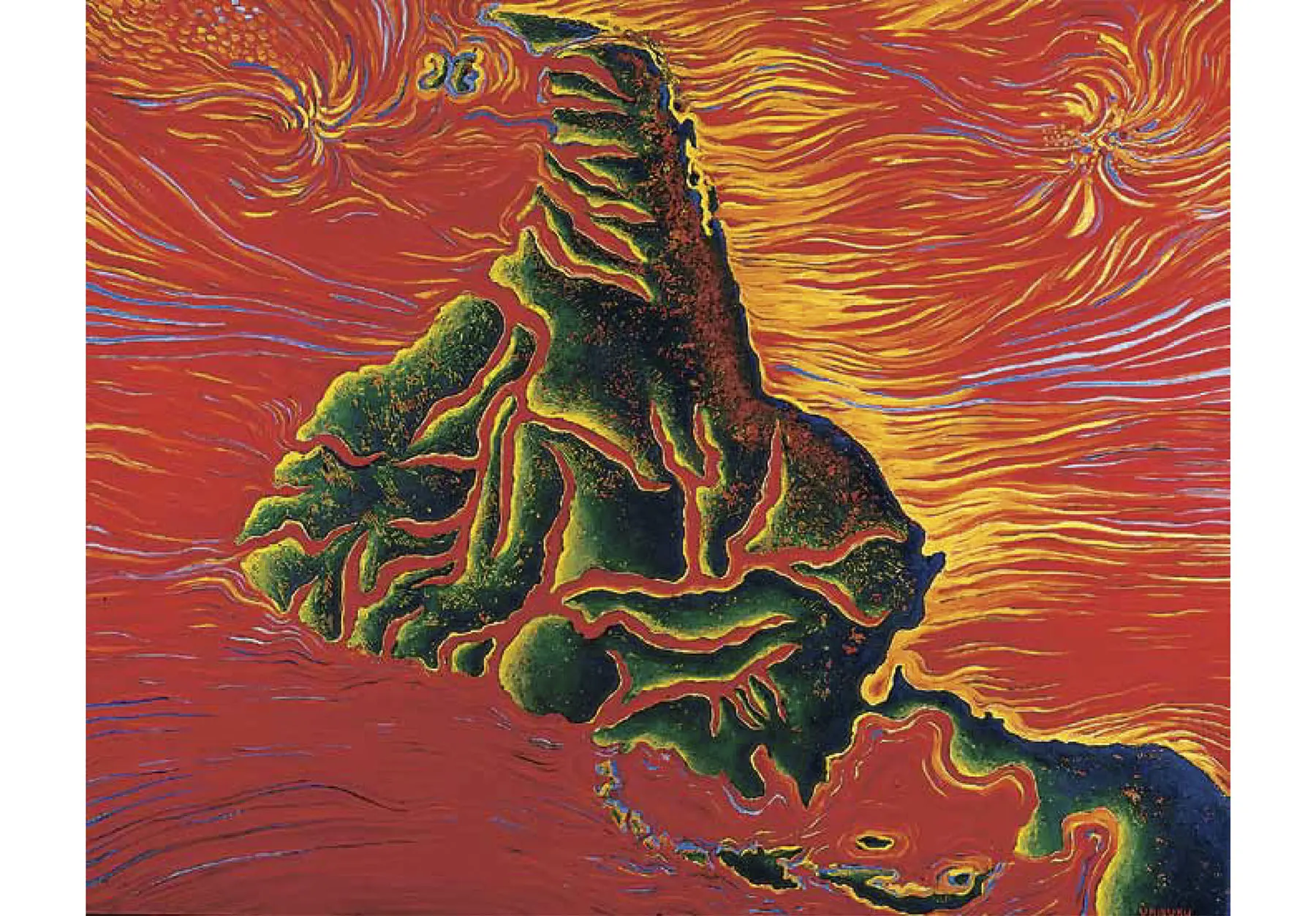
Cartography has been a source of inspiration since 1970. It derives from a desire to represent the potential of Latin American countries. In one of his paintings, which highlights the continent’s hydrography, we read: “Latin America United by its rivers.” At Documenta 7 in Kassel (1982), Uriburu exhibited his Mapamundi (1981), drawn from the southerly perspective: with the South on top and the North below. This large-format painting (180 x 200 cm), which references a similar map drawn by Torres García—responded to an invitation by Beuys to show at the International Free University. To emphasize the relationship between Art and Nature Uriburu created an unexpected performance in front of the Fridericianum Museum, the site of Documenta. Dressed in a fluorescent green suit, his body remained still, outlined against the sky among the statues in the building’s neoclassical façade, for an hour.
During the 1990s, Uriburu continued to work with maps inverting the traditional direction North-South. Among them are Sur energético (1990), Mapamundi concreto (1993), Granero del mundo (1993), Utopía del Sur (1995), and Rojo Sur (1997). In one of his oil works, he quotes the title of a work by Uruguayan writer Eduardo Galeano (1940), Las venas abiertas de América Latina. His southernmost extreme, located at the top, questions the power of the central nations; the intense red of oceans that extend into rivers traversing the continent is, metaphorically, the color of blood running through veins.
Another significant theme in Uriburu’s paintings is that of endangered species, such as the ant-eater, the guanaco, and the vicuña. He also highlights the cutting down of forests and the implacable consumerism that razes everything in its wake.
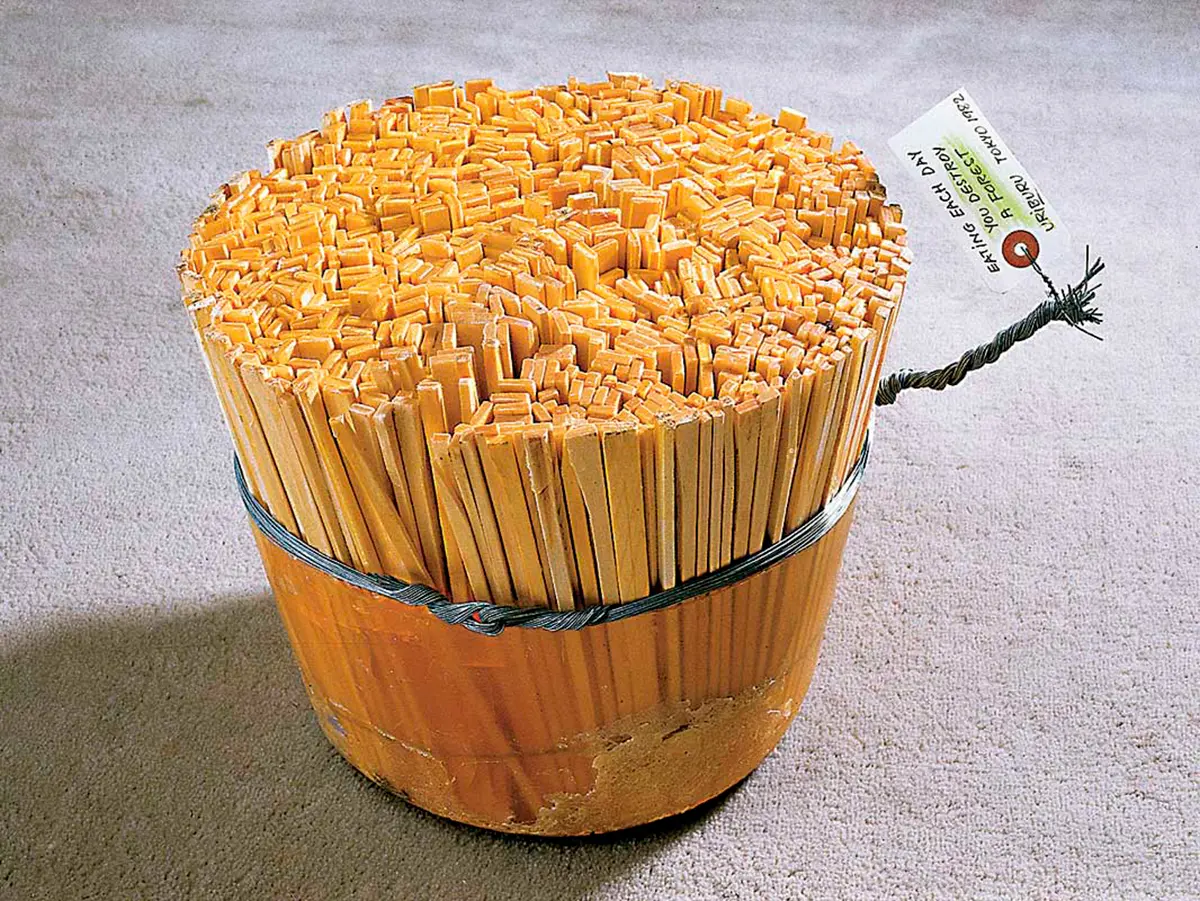
Visiting Tokyo in 1982, Uriburu was vividly impressed by the destruction of forests. This resulted in Comiendo cada día usted destruye un bosque, presented at the Hara Museum. The object was comprised of hundreds of small resin-coated wooden chopsticks, shaped like a tree trunk resembling the one that was destroyed to manufacture them. In this way, the artist was making reference to the fact that in 1982 Japan consumed14.3 billion pairs of chopsticks, equivalent to 240,000 cubic meters of wood. The direness of the situation from the Latin American point of view resides in the fact that this wood is extracted from the Amazon rain forest.
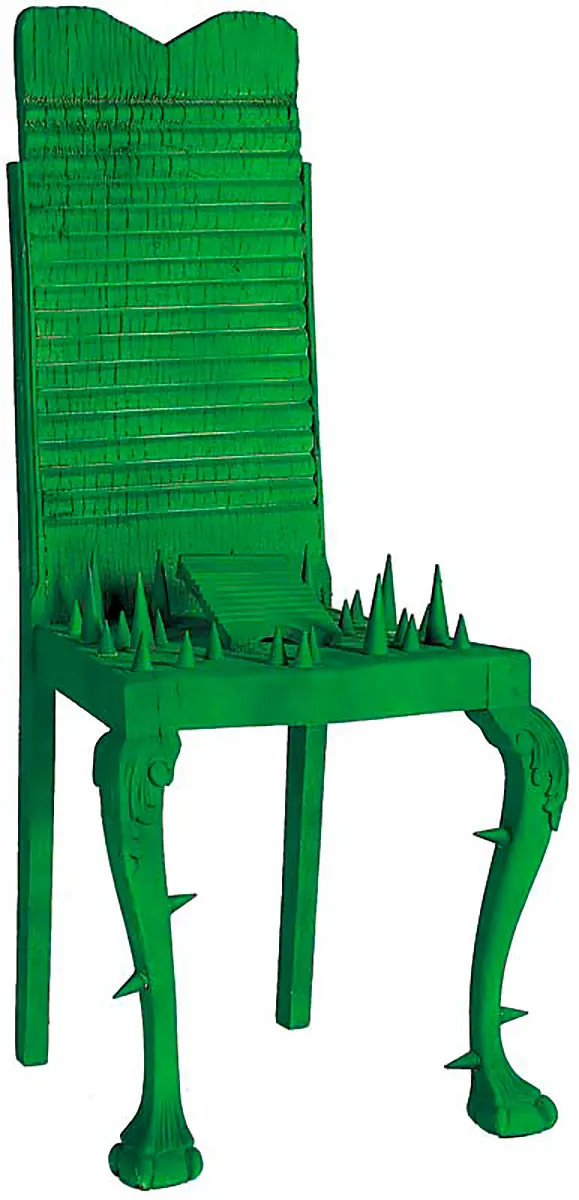
The series Uriburu began in 1996 and was exhibited in 2002 under the title of Víctimas y Victimarios, rescues the memory of furniture that was born from an act of aggression. “Man collects his green tribute by destroying entire forests and transforming them into furniture,” he says. This is why a chair or a table dreams of going back to being tree. They are victims, and their oppressors are human beings who, in their consumerist drive, interrupt the cycle of nature. The Silla del juez corrupto and the Silla del político corrupto signal that the ecological problem is directly linked to the question of power. Absolutely anti-functional, these items filled with threatening spikes phagocyte the color green, metaphorizing the indiscriminate way in which we torture nature.
In counterpoint to such destruction, Uriburu decides to act, undertaking the planting of trees. In 1970 he planted one hectare of trees in Uruguay, and four years later he planted a symbolic ombú (a species aboriginal to South America) at the Museo de Arte Latinoamericano in Maldonado, Uruguay. Starting in 1978, with a group of collaborators, he planted aboriginal trees at 9 de Julio Avenue, in Buenos Aires. His dream of “creating a green river of trees to join the north and the south” became a reality: today, a fresh green corridor enhances this well-trafficked street.
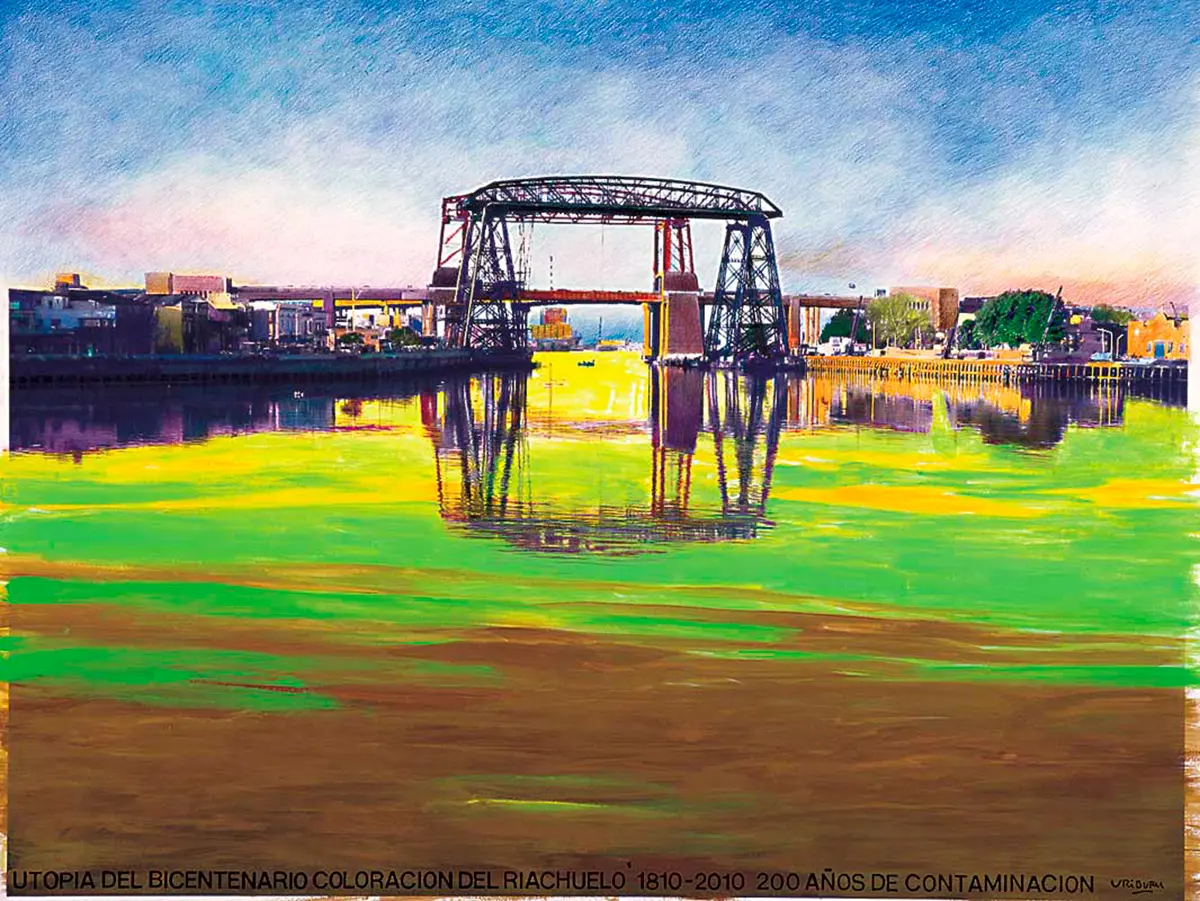
Among Uriburu’s most recent actions is the one carried out on March 22, 2010, between 10 am and noon, in tribute to the International Water Day. He once again located his work in Buenos Aires, painting green the riachuelo, a kind of odoriferous open sewer that no government, to this day, has been able to seriously confront. The Matanza-Riachuelo basin, inhabited by millions of people, has become one of the most highly polluted river complexes not only in Latin America but in the entire world. The mortality rates and the preponderance respiratory and intestinal ailments in this area are record-high. The action’s irony-laden title was Utopía del Bicentenario 1810-2010. The dates were in reference to a historical event since the original source of contamination for the riachuelo was the installation of the first salt mines on its banks in 1810, the same year Argentina started on the path to independence. Two centuries later, the problem has been compounded by population growth, requiring ever-larger quantities of water and sewer streams. Besides the sewers, the main sources of contamination in the Matanza-Riachuelo basin are industrial residues, mainly from the food sector, which includes toxic amounts of heavy metals (lead, mercury, zinc, cadmium, copper, manganese, nickel) and hydrocarbon derivatives.
Uriburu says: I have been trying to sound an alarm against the contamination of rivers and oceans for over forty years, and it is through my actions in different parts of the world that I have transformed my work into a kind of contestation, globalizing alert. Today, and with even more reasons than forty years ago, I continue to denounce the contamination of water and the savage destruction of our planet’s reserves. A planet that in our blind omnipotence we believe inexhaustible and indestructible (emphasis added).
Ephemeral art as a metaphor of the world
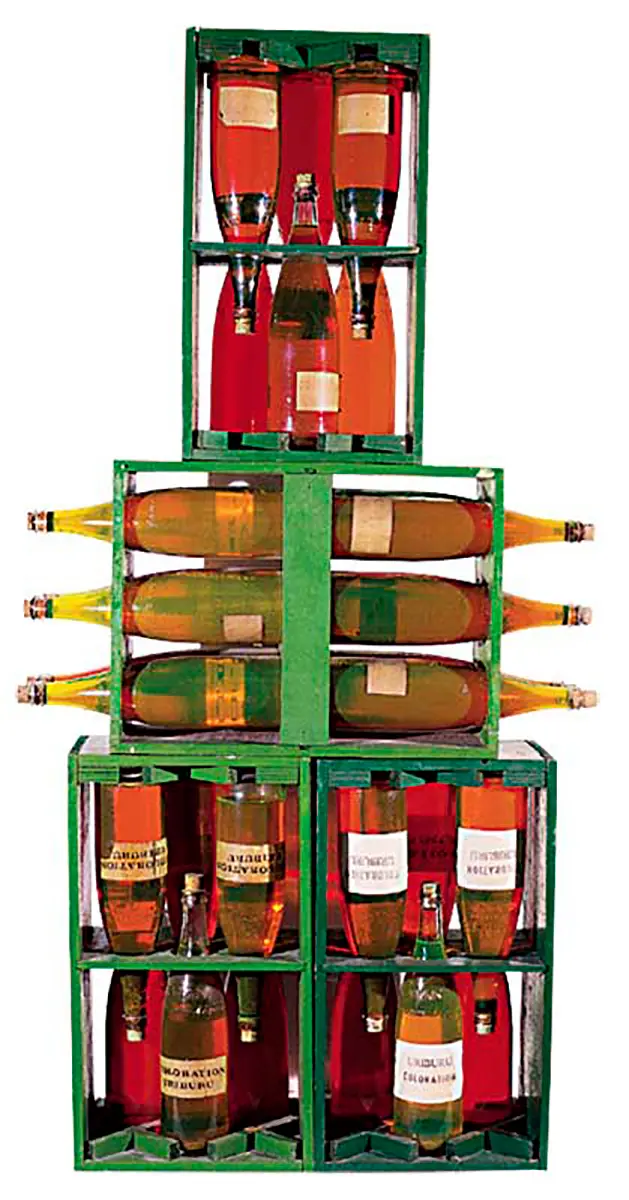
Uriburu works in different kinds of ephemeral art, which photography and video allow us to preserve over time. Like the bottles containing contaminated water taken in his actions, those media are witnesses to an art that is not made to be sold or collected. The work of art has become an idea.
Beyond beauty, although using it for his purposes, Uriburu renders the ephemeral work into “knowledge of lightness,” according to Buci-Glucksmann’s expression. It is the site of a lucid gaze, the privileged standpoint from where we can see the world. The symptom of our times, it reveals a new way of sensing space and time. An unstable space and a time that is experienced only as an instant.
At the same time, Uriburu deconstructs the terms of the “art” institution, discarding the usual locales of the exhibition (museum or gallery). By expanding his work into everyday spaces, he takes part in the general aestheticization of today’s world and expresses art’s heterotopic nature, this is to say, its location in places that exceed the borders of what is traditionally considered “artistic”.
Similarly, Uriburu’s work is at once critical and utopian. By making everything green (hair, face, sex, maps, rivers), he signals the utopia of a world inscribed in nature, as in the time before contaminating industries or the funnel of consumerism. In this way, sociology, politics, and anthropology are the theoretical framework of anesthetics that projects into ethics.
If we say that Uriburu’s vision is utopian—and not dystopian—it is because he continues to gamble in favor of a better world. Were he unaffected by such hope, it would be useless to speak. “We are still on time to rectify our errors, take care of our environment, and be deserving of life in this marvelous planet”, as he wrote in the 2002 preface to Víctimas y Victimarios. Uriburu’s is, in synthesis, a hopeful protest.
NOTES
1. Pierre Restany. Uriburu, Utopía del Sur. Buenos Aires, Fundación Nicolás García Uriburu, 2001. p. 62.
2. Ibid., p. 43.
3. Ibid., p. 63.
ELENA OLIVERAS
Ph.D. in Aesthetics from the University of Paris. She teaches Aesthetics at the University of Buenos Aires and is a member of the International Association of Art Critics and a Numerary Member of Argentina’s Academia Nacional de Bellas Artes.