
The human body has been used for art—paintings, tattoos, scars—since before we became the men and women of today, Homo sapiens sapiens, something that took place some 35,000 years ago. The human body was used as art in the Egypt of the pharaohs, three thousand years before Christ; it was used like that in Crete’s Minoan culture, which preceded classical Greece; according to Plutarch, body painting was used by Cleopatra (the one we all know, the seventh in the Ptolemaic dynasty) towards the end of the first century A.D.; and today, both body painting and tattoo art are seen by many as just one more means of artistic expression.
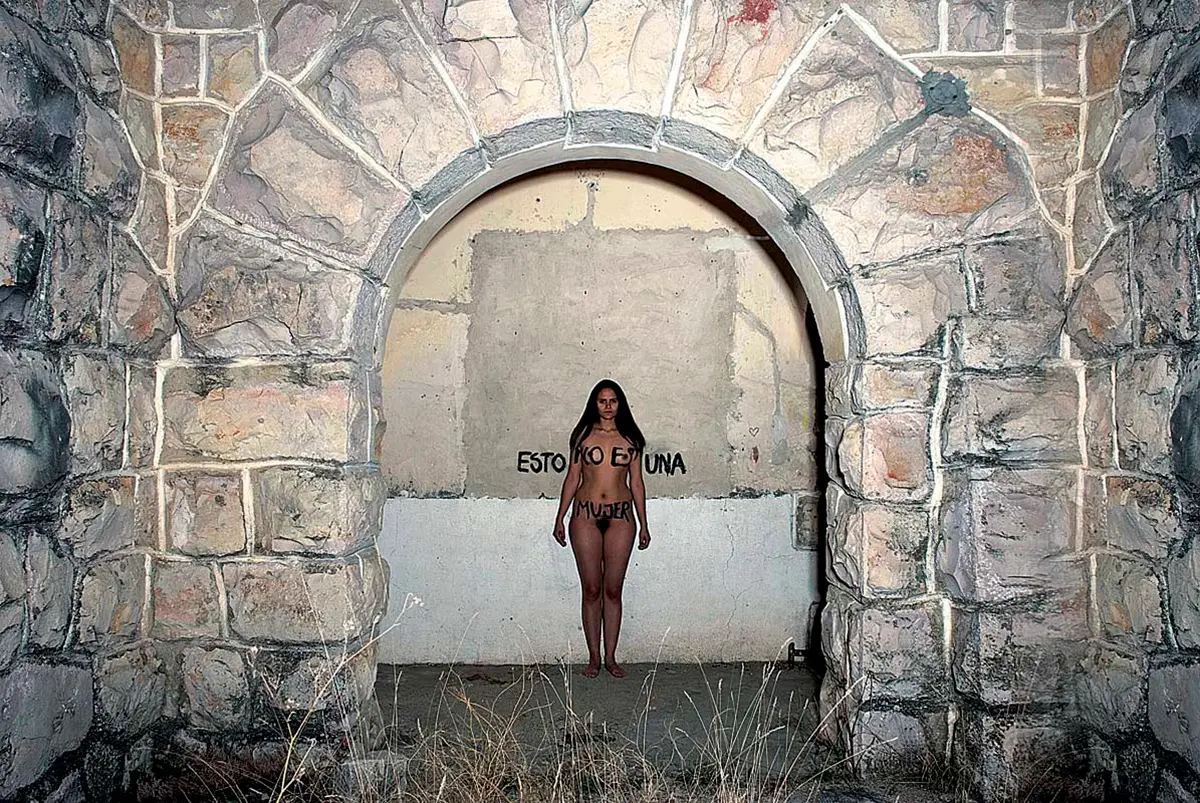
Like other artists of significance in the development of contemporary art who have used the body as their canvas or support—Ives Klein, Ana Mendieta, Marta María Pérez Bravo, Puerto Rico’s Freddy Mercado, to mention but a few—Nina Méndez Martí presented Raw/Crudo, her extraordinary exhibition at Yemayá Gallery in San Juan, 28 color photographs (from a series of 51 that have already been published in a magnificent volume) that use the nude bodies of men and women with provocative messages hand-painted on their skin to express their essence and physical, psychological, and existential insecurities. The visual/aesthetic and literary/existential message in each of these photographs, shot under natural light with a highly effective lyrical dynamism, is clear and rotund. Examples: ¿Podré darle todo? (a naked mother breastfeeding her baby, with the legend “Will I be able to give her everything?” written on her arms); Dolores de crecimiento (a lesbian couple expressing tenderness); Esto no es una Mujer (a Venezuelan photographer who wants to be seen as a person, not a woman, playing with Magritte’s painting Ceci n’est pas une pipe); Solo (a naked man with New York in the background); I am a wall (an overweight, unkempt individual in a room that seems perfect for an existential crisis); No soy una niña (the artist herself in a precise self-portrait, surrounded by plants with very seductive leaves, known as “beach grapes”); Mi tiempo es oro (a heavyset transvestite not devoid of a certain magnetic appeal, made up á la Divine Pink Flamingos in and posing in a rather shady Puerto Rican beach called Piñones); Me debo (a beautiful Puerto Rican mulatto male covering his sexual organs); etc. She challenges to a self-evaluation and an evaluation of what is it that worries and inhibits us, what makes us suffer, what makes us happy, what defines us.
Méndez Martí—born in San Juan in 1981, she obtained a BFA from Syracuse University and a Masters in Photography from the EFTI, in Madrid, Spain—has chosen for her corpus current photographic both friends and relatives and people from all over the world she has met in the course of her travels through Spain, the US (Santa Monica, California and New York, New York) and her native Puerto Rico. Her subjects (the artist dislikes the word “models”) represent the common folk and come in all kinds of body shapes (although it is obvious that the classical Greek canon is not paramount among her interests), ages (all adults, though; no children or adolescents are included), ethnicities, and sexual preferences (she registers their name, age, and nationality in the titles of each of her works); she has them open themselves up to become free and vulnerable and to announce that each one of us is also our fears, our frustrations, our weaknesses, our imperfections, and our dreams.
To achieve greater impact in her photographs, which are in different sizes, Méndez asks each of her subjects to construct a thought that defines their reality/complex/torment/dream, which she later writes down with the clarity and force of the rawest/roughest-hewn yet deepest graffiti on their/our bodies, as that which makes us what we are, good or bad. And what Méndez Martí presents in each one of her photographs is a story, a tale, that invites us to become co-authors and to imagine possible presents and possible futures.
If the invention of photography freed painting to follow paths different than those outlined by the Renaissance, Méndez Martí’s photographs—where nudity is always beauty—makes it possible for her subjects—raw, open, striving to be unafraid of fear—to be free whether for an instant or longer, to love themselves better, to be happier. In other words, the meaning of life!
MANUEL ÁLVAREZ LEZAMA