A gyroscopic, Dantesque, lyrical, and structured world was created by Perla Krauze, a subtle and powerful artist who approaches her artistic endeavor from multiple mediums. With these works, she inhabited the exhibition space, germinated it, sowed it, structured it, darkened it, and turned it translucent; connected it with the interior, and made it scalable. This occurrence—because it was not something stable, prepared, or fixed—could not have been in a better place than in the circular space of the Museo de Arte Moderno. There, Krauze spread many years of artistic work, without the rigorousness usually found in a retrospective, as she weaved the series—the relationships with the materials, and her fascination with the process—conceptually. It is improbable that this artist or this exhibition space could repeat such a perfect and mutually generous interaction.
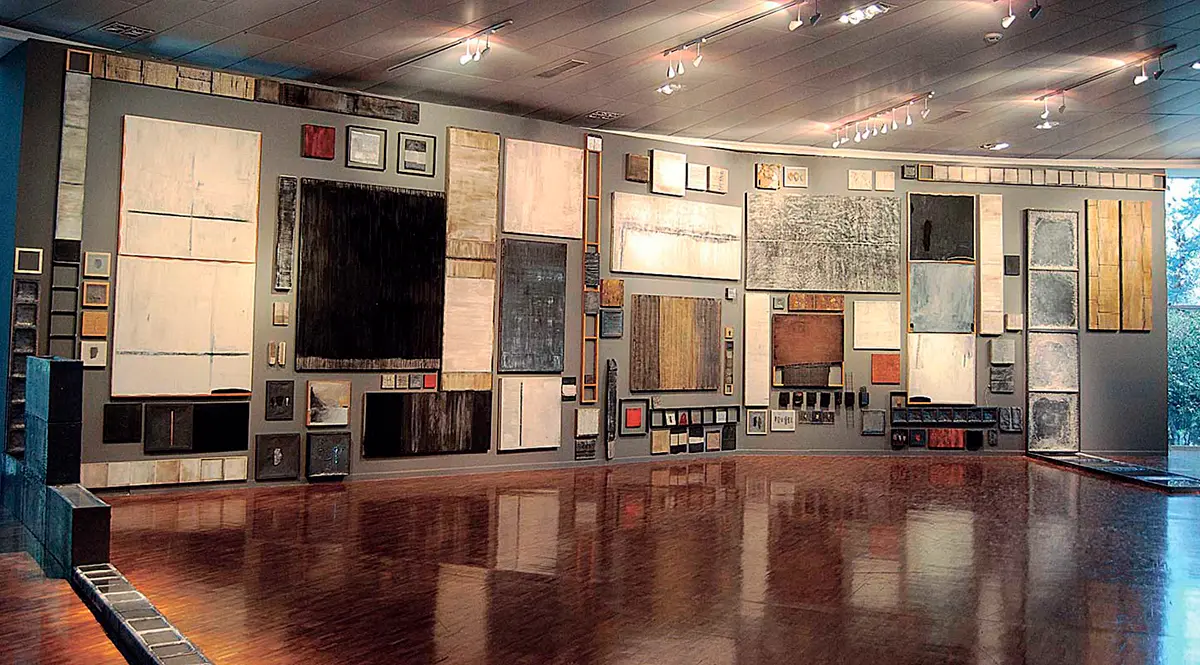
Traces and Trajectories embodied two different studios where Krauze worked during her artistic career. While studios have been recreated in other exhibitions, here it was not something clearly presented, but rather accessible as data that helped achieve a more interactive experience. One would find references to these workspaces and of the manner, Krauze usually creates/places her pieces. The artist-work identification is another aspect that does not escape the observer: transparent and veiled, luminous, and impenetrable; just like the experiences, one gathers from the exhibition. Krauze’s palette goes from mustards, blacks, browns, sands, and greys, to reds, pigmented blues, pinks, and many whites—eggshell—set against an opulent orange or emerald green. Metals are present in various finishes. Both structures and supports are important elements and Krauze intervenes these with paint, stains, by cutting or scraping them; in a triangle that she is part of, as she constructs and deconstructs. Little could be observed in this exhibition of her earlier pictorial gestures, although painting was undoubtedly present, especially through the stripping process that Perla Krauze learned in order to avoid becoming an offender. Being an artist does not mean to repeat oneself. Everything was present in minimalism that was revealing. Her stretchers/stairs with fragments of canvas on them and the persistent variety—in size and form—in spite of the respect for the module that characterizes her. There is within the abstraction one finds in her work, a relationship with the organic and skeletal that comes from nature and her interest in analyzing forms.
Going back to the gyroscopic Dantesque dance between life and death, the underworld and floating blue translucencies—glass, resin, water—between elements that appear to sink or be suspended as a result of an original visual, materic, compositional, and museographic lightness; the project appears as a musical box, as a glass castle through which one can observe the museum’s gardens, in what is a moderately urban reality, but a reality nonetheless. Perla Krauze acknowledged that Ovaldo Sánchez, the director of the institution, allowed her to construct respectfully as if she were in her own studio. It was a slow setup process that was not preconceived. On the contrary, Krauze developed a scheme once the works were already hanging. Besides the pieces suspended from the ceiling, the videos, and photographs, dreams and memories, the artist reminds us of her visits to the markets—she has always observed them with amazement—and proposes that phenomena in the floor, the tables, and the pieces laid out on the exhibition room. Speaking of the three stadiums—floor, wall, ceiling—there is the predominance of two saturated concave walls in front of the large windows almost, but not completely, empty. There is no denying the presence of a Mexican baroque style in the author’s construction that expands before the windows and combines the translucent with the semi-translucent. In the saturation of these two walls lives the concept of old-school collecting: works placed unevenly, with smaller ones filling the gaps created by the larger ones; here and there brought up to date forms and stairs everywhere.
Two resin casts—one of the profiles of the stairs from one of her studios, and the other of a gallery where she once presented an exhibition—insert in the narrative one of the themes that have been historically part of her artistic production. Sections of tall stretchers are also stairs, as are the intertwined pairs of branches and, possibly, even the stones suspended by a metallic thread that, rather than hanging, appear to be ascending.
Her stairs are diagonal, vertical, horizontal, flat, practical, unpractical, evident, hidden. What else could Freud add? They are stairs that lead to nowhere and end on the surface of a wall. They are in between Traces and Trajectories. They represent games, fantasies…are modestly ambitious, never ostentatious, peaceful, clear, dark…Those created out of stretchers are made with wood, a material Krauze rarely works with despite her admiration for it.
Shelves that contain stones, branches, papers, sculptures, leaves, frames, skin, pieces, found, and recreated forms. A maxi video is part of an installation with fragments that hang from the ceiling that corroborate lyricism and sublimation. Everything is tangible but appears intangible as if it were disposed of any material weight. Krauze has participated in many national and international exhibitions, especially with her paintings and installations. She still has not directly participated in photographs. In her work, the process is usually exposed, even under the overlapping layers of paint. This current proposal by Perla Krauze can be summarized as being a gigantic installation that demonstrates a devotion to nature, a predilection for constructing, and ascending. To summarize, Krauze has created an installation that is after sublimation.
GRACIELA KARTOFEL