
The exhibition by the Sub [Cooperativa de Fotógrafos] group titled Oxígeno Cero (Oxigen Zero) is one of the many –already commonplace– chapters that deal with the progress that culminates in catastrophe. What is the value of scientific, technological, and industrial progress when our quality of life is now at its lowest levels? Victoria Verlichak, the curator of the exhibition, asks precisely this question in her curatorial proposal, as she returns to curate another work by the group following her curatorship of the impressive installation titled San Darío del Andén (Saint Darío of the Platform) that represented Argentina –and received an award– in the 10th Cuenca Biennial, in Ecuador.
Since 2004, the members of the Sub [Cooperativa de Fotógrafos] have chosen collective creation over individual accomplishments. Indeed, Nicolás Pousthomis, Gisela Volá, Sebastián Hacher, Gabriela Mitidieri, Olmo Calvo Rodríguez, and Gerónimo Molina have chosen the anonymity on behalf of a collaborative endeavor. The recognition of their names does not appear to matter as they take on the urgent task of responding to very pressing social issues.
A common practice in their shows is to present stories of persons expressed through a sort of freely constructed "photographic essay." In the ample space at the Galería Arte x Arte, eight large-format photographs and a video operate as micro-narrations that, while conveying subjective personal situations, are supported by statistical data and rigorous research. Thus, the private lives of the individuals that inhabit these stories also represent collective tragedies. And such was the case of the 2002 murder by the police of social leader Darío Santillán during a demonstration. This violent act was an eloquent example of the pervasiveness of a repressive state during supposedly democratic times.
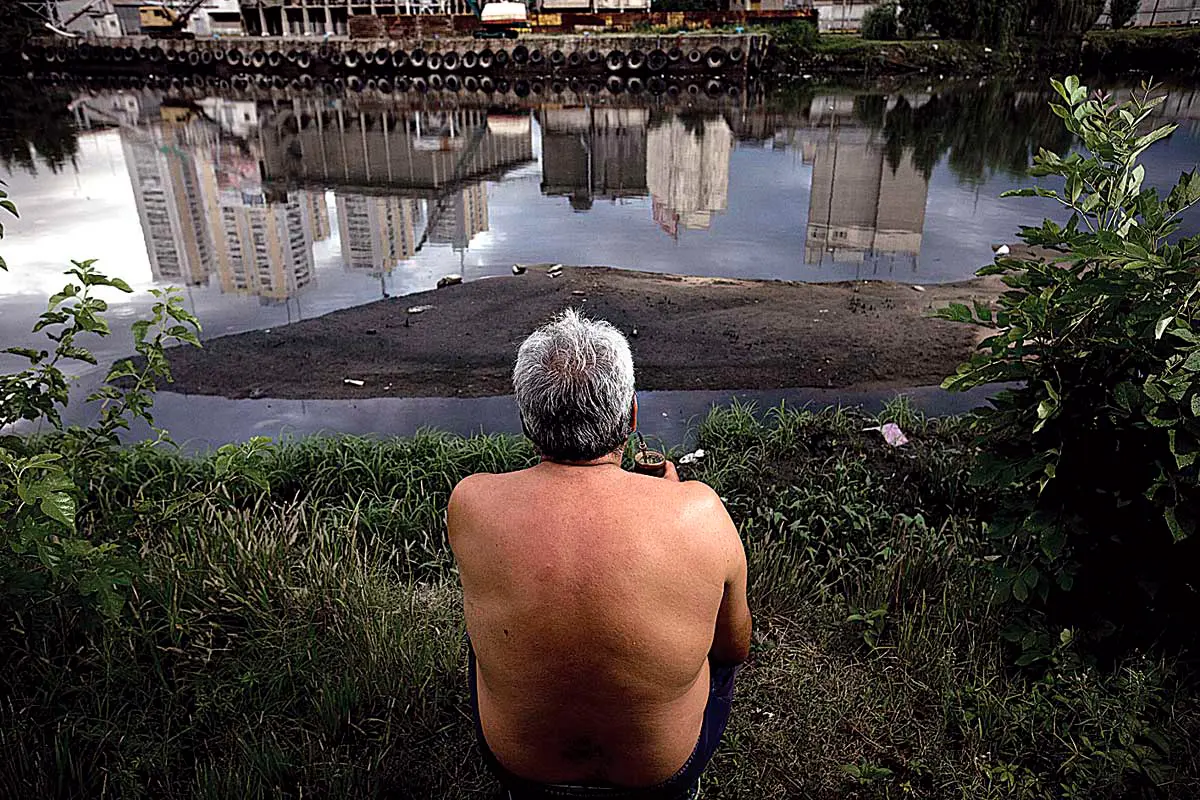
On this occasion, Sub [Cooperativa de Fotógrafos] focuses on an area that borders with the city of Buenos Aires: El Riachuelo. They also concentrate on the Matanza-Riachuelo basin, where five million people live. The place has become one of the most polluted fluvial complexes of Latin America and of the world as well. The rate of respiratory and gastrointestinal illnesses is at an all-time high. Besides sewer waste, the main source of contamination is industrial waste –mainly from the food sector– that contains heavy metals –lead, mercury, zinc, cadmium, copper, magnesium, or nickel– as well as hydrocarbons and their by-products.
As if it had drowned by its content, El Riachuelo lacks oxygen and has become what is perhaps Buenos Aires' most unwanted symbol. It is a social open wound that begs to be cured. Thus, the proposal by Sub [Cooperativa de Fotógrafos] addresses not solely knowledge in on itself, but also the need to transform. The group's objective is to generate social awareness that leads to collective change so the tragedy is not the "norm" any longer.
The group eloquently appeals to the "good conscience" of those who are used to looking the other way. Severo –who plays the leading role in the work of the same name– stands in radical opposition to that appeal, as he strikes an extravagant pose, while intently observing the polluted landscape with a pair of binoculars. He does so from the vantage point of his decorated department –he is surrounded by objects that, in their own way, celebrate a past full of respect– on the 11th floor of a building located across the industrial area known as the Polo Petroquímico Dock Sud.
The photographs and videos reflect the stories of people affected by the ecological and housing crisis. Fausto gazes at the image of high buildings reflected on the river. From this image's point of view, progress –symbolized by the buildings– appears to be pointing down toward the river rather than toward the sky. Sitting still and holding his mate's gourd, Fausto waits just like the mother-to-be who in another work titled Espera (Wait), places one of her hands on her belly as if she were protecting her pregnancy, fully aware of the many spontaneous abortions that occur in the neighborhood. Accentuated by very deliberate poses, these are highly intense images that become icons of the described situations. They activate a defiant memory free from nostalgic or resigned feelings. On the other hand, the images also convey happiness; an unquestionable indicator of vitality. It is poetically manifested in the woman who laughs while she lets her hair take off with the wind, as well as in the local cumbia, known as villera, which is included in the video that is part of the exhibition.
The strange beauty that emerges from the images is very impressive. It is present in the car that floats and is covered in plants, or in the rusted locks, sheets that hang like theatre curtains, and even in the humidity-ridden walls wallpapered with newspaper.
In a space adjacent to the enormous exhibition area that houses Oxígeno Cero, Juliana Ceci and Viviana Macías exhibit photographs that, too, attempt to rescue the beauty of a damaged, denaturalized, environment. Ceci nourishes it with beautiful artificial grass and multicolored plastic swans that, like lifesavers, swim across the murky waters. Macías for her part covers with threads of vibrant colors –and by doing so also protects– the branches brought to the shore. The nurturing works by these two artists establish a dialogue with the straightforward accounts by the Sub [Cooperativa de Fotógrafos] group. Without grandiloquence, Macías, and Ceci's actions in nature go beyond the damage it has endured. In the end, the element that unites their proposals to the one by the group of photographers is precisely that desire to see that the damage caused is repaired.
ELENA OLIVERAS