
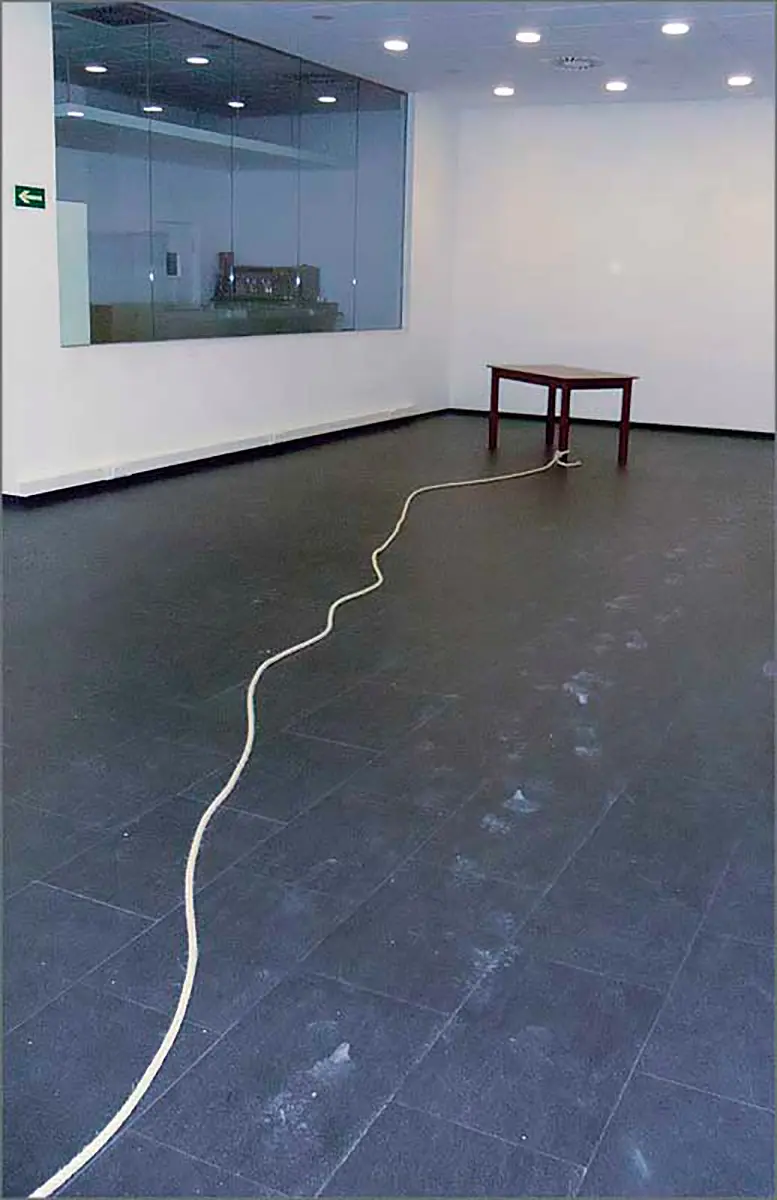
If among many other attributes, humor enables one to escape seemingly inescapable situations, then little doubt remains of the relevance and pertinence of Wilfredo Prieto’s work. A large number of his pieces were included in the exhibition titled Tied to the leg of the table, presented during the months of February and March of this year at the Centro 2 de Mayo in Móstoles, in the outskirts of Madrid. The inescapable situation Prieto’s humor offers an exit to is the same one that has led to the predominance—during this last decade—in the international art scene of a type of art that, under the vague and often confusing label of “conceptual art,” has been able to saturate such scene. So much so that the public and art aficionados receive with indifference—even with boredom—the endless successions of exhibitions of installations that attempt to redeem any number of moldy building from the urban periphery, or of video projections that once again document, with ever-increasing detail and no enthusiasm, the banality of an artist’s intimate life—as mundane as our own personal lives. Wilfredo Prieto has been taking care of such situations for a long time or, at the very least, has responded to them, not with a strategy of rupture or aggressive denial, but through an approach that smartly uses the adversary’s resources against him/herself—but without ever indulging in the clumsiness caused by angry or disdainful gestures. No, not at all, Prieto successfully delivers his criticisms in a fun and playful manner, in an approach that is the complete opposite of the intimidatingly serious one used by Joseph Kossuth or Hans Haacke—to name just two of the founding fathers of what is today the oversaturated universe of conceptualism. For many reasons I could not help but smile when I heard that the exhibition was named after one of the most important pieces included in it. Such a piece consisted of a table placed on the ground floor of the four-story Centro 2 de Mayo. The idea was to tie one of its legs to a brand new rope that would ascend through the stairs of the building all the way to the terrace. There, the other end of the rope would be tied to one of the skids of a helicopter that would then take off and hover over the terrace while maintaining the same altitude for the duration of the official inauguration of the exhibition. The idea seemed to me such an ingenious and yet farfetched way to connect a regular table to a helicopter—and vice versa—that I thought everyone would be laughing at the thought of it, just as I was. I did not even stop to consider the deadly serious posture—encapsulated in all the laws and security protocols governing our hopeless lives—that would prevent such an attempt from taking place. The same morning of the event, government authorities informed the organizers at the Centro that such performance would be against the regulations on flying over the town center, and therefore could not allow it. The directorate of the Centro reluctantly accepted the veto and reached an agreement with Prieto to relocate the table, the rope, and the helicopter to a nearby park in which the performance ended up taking place. I initially did not agree with the decision until I realized that my rejection implied defense of the authenticity and coherence that are necessary for the realization of an artistic project. But I took my resistance to a point of intransigence that had little to do with the humoristic strategy adopted by Prieto—and even less to do with his anti-solemn rejection of solemnity.
Nonetheless, my smile turns into downright laughter when confronted by work as emblematic—to qualify it somehow—as the work created by Prieto, like Limonada con dos pares de cojones(Lemonade With Two Pairs of Balls) of 2007, included in a collective exhibition that took place in 2009 at Casa Encendida, in Madrid. The piece consisted of a puddle of water, a pile of sugar, and two lemons; all of which were directly laid out on the floor of the exhibition space. The humoristic effect of the work is prompted by the irremediable impossibility of the lemonade invoked in the work’s title, as well as by the two pairs of cojones(testicles) that metaphorically replaced the two lemons. In Cuba, the word stands both for the male testicles as well as for the metonymic representation of courage and a paradigmatically masculine assertiveness. Other pieces that belong to this series are Café con Leche(Coffee with Milk) and Agua Bendita(Holy Water), both from 2009, and Cuba Libre (Free Cuba) from 2010, or Piedra con Sangre(Stone with Blood) of 2011. In my opinion, none of these last works have the ability to make one laugh like when observing. To conclude, I reassert my conviction that this exhibition represented a celebration of humor and intelligence.
CARLOS JIMÉNEZ