
Self-consistency is the mark of São Paulo artist Alex Cerveny’s career. He started learning his craft thirty years ago in workshops headed by experienced artists, and this education helped shape the uniqueness of his work, as attested by his recent show at São Paulo’s Casa Triângulo Gallery, Cadernos de Viagem. Unlike the large-format gesture paintings of the reckless 1980s generation, nurtured inside universities, Cerveny has created a restrained body of work, with the smallness of dimensions conferring lyrical force to intimate, always figurative narratives. Thus his preference for draftsmanship techniques to compose images that communicate personal memories and a critique of religious and artistic dogmas.
Cerveny’s poetics combines lyricism and ethics. His artistic vitality derives from that paradox, as is shown in the works exhibited at Casa Triângulo, most of them inspired by travel journals. “Many stories are just evocations that populate my mind. As an artist, I belong to the tradition of the storytellers,” Cerveny explains. In his opinion, narrative style can be present even in the most abstract of artworks, for instance, Malevitch’s Black Square. “Narrative will make itself present in the justification of even an expressly non-narrative experiment. So, the debate over the relevance of narrative in contemporary art is, for me, a false problem.”
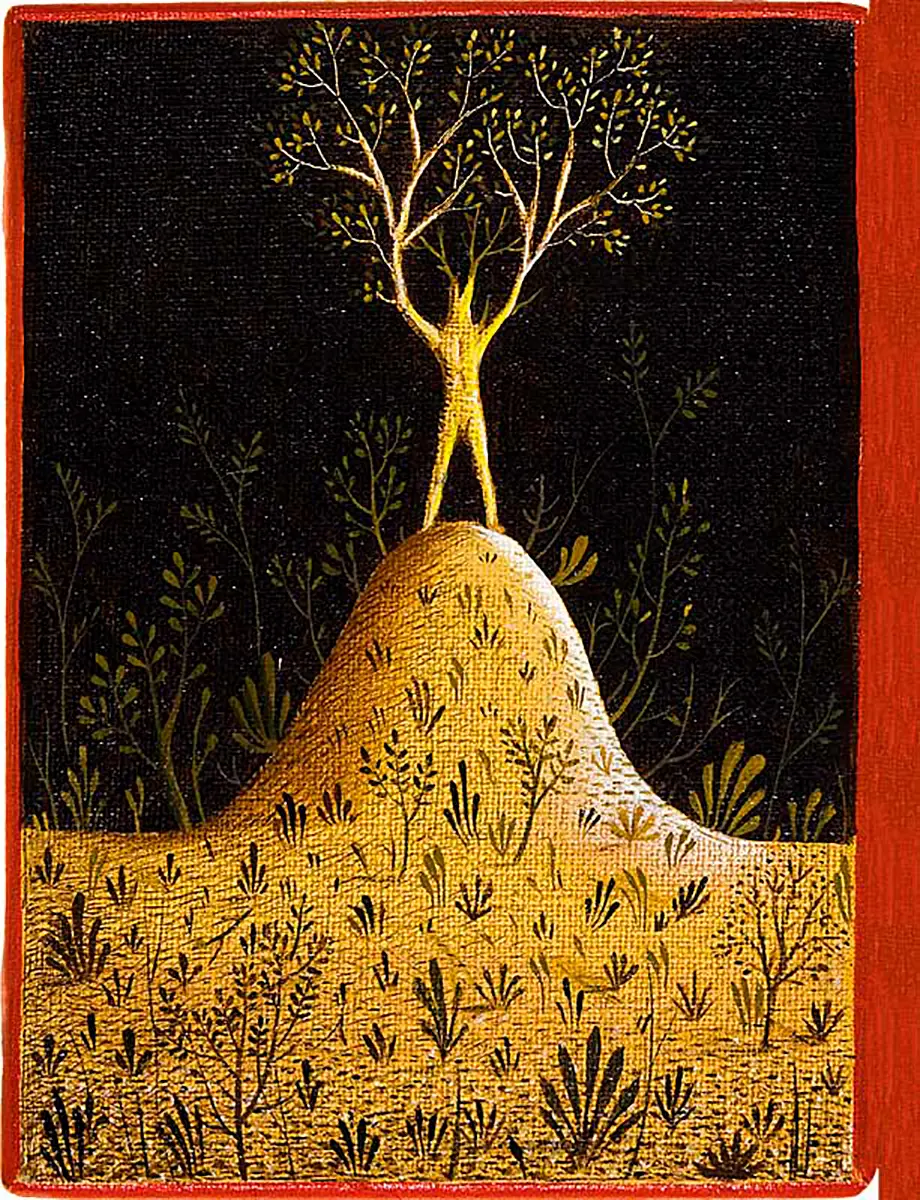
In Cerveny’s work, the narrative appears as a communicating thread. The variety of techniques (drawing, painting, printmaking, collage) and the figurative profusion compose a metamorphic art that invites the observer to split their gaze and make it simultaneously attentive to the unity of the whole and the plurality of the details. Each work by this artist-storyteller is at once the end of a story and the beginning of a new one. The elements are repeated: the human body, trees, snow leopards, and above all, fire. Organized into dreamscapes, they become mythical symbols. Trees transform into men whose hands rose to the heavens, as in Pinocchio (2010). Archetypal signs are joined by political references, as in Certitudes (2007), where airplanes and missiles fly over a burning city.
Cerveny’s syntax touches on the language of surrealism. His heaving heads and bodies bring to mind the anonymous characters floating in the skies painted by René Magritte. His desolate landscapes suggest De Chirico’s metaphysics. Even the surfeit of details circumscribed to small spaces alludes to Salvador Dalí, a great master of the form. Such figurative profusion also suggests the cosmogonies of Argentinean painter Xul Solar, who, like Cerveny, turned the word into an element of the work in creating a “pan-tongue.” Also, the relationship between the verbal and the part of the pictorial shape of Cerveny’s work, taking a clue from the word/image equation proposed by Joan Miró, who saw words as objects that compose the painting, as in college. Cerveny’s poetics is based on a confluence of ethics and aesthetics. The individual is not reconciled with the cosmos, and cultural and social taboos are subjected to critique, for instance in Adoration of the White Cube (2007), which depicts a giant cube surrounded by various characters in a desolate landscape. The dual allusion to the Kaaba and to the modernist canon perhaps suggests a metaphor of Cerveny’s own condition as an artist. Cerveny didn’t attend university. He learned in workshops. He studied drawing and painting with Valdir Sarubi (1939-2000) and metal engraving with Selma Daffré (1951), and participated in open courses. Besides Cerveny, there have been other Brazilian artists who built their own paths, such as Roberto Magalhães, choosing to keep their distance from groups and movements like the renowned 1980s Generation, whose images tended more to the gesture and the large format. Like Magalhães, Cerveny remained loyal to his goals: to build varied yet essentially compatible allegories. “I always search in my drawers and rethink old proposals,” the artist says, This artistic coherence can be verified even in his work as a book illustrator, among them books by José Paulo Paes and Sandra Peres-Luiz Tatit. The artist often says that he identifies more with literature than with contemporary art.
In Cadernos de Viagem, Cerveny remains faithful to himself and free of any stylistic bondage. He is committed to a highly personal adventure in the creation of images that include autobiographical stories. His Moses and the Tablets of Law (1996) is, according to the artist, a self-portrait that alludes to his deepest subjectivity. The photographs cover the central head show the reflected image of a man looking at himself. The canvas suggests that revealing himself is also part of the poetic and ethical endeavor of this visual storyteller. In Cerveny’s work, knowledge of self becomes the fulcrum for the knowledge of the world. His critical posture is but one consequence of such intimate lyricism.
ALESSANDRA SIMÕES