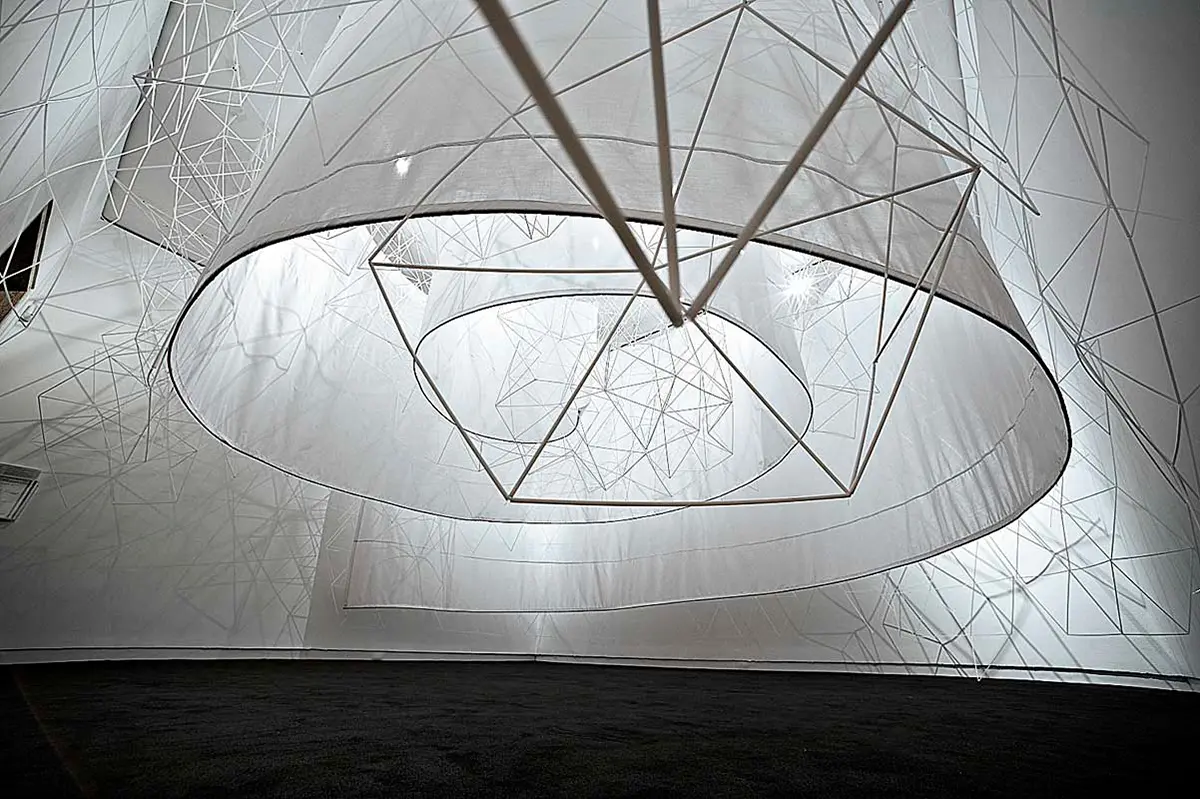
The America's society is introducing the For Rent project as a series of three exhibits during 2011-2013, for mid-career artists from the Caribbean and Canada, of which the Consuelo Castañeda project is the first in the series. The exhibit of Consuelo Castañeda at the Americas Society consists of a retrospective installation covering the walls with reproductions of her works ranging in scope from her entire career, as well as a reinterpretation of a Gego installation that Gego herself had made years ago for the same venue. At the time, (1969) Gego was producing the first Reticularia outside Venezuela and Castañeda's re-interpretation of this pivotal work in Gego's career anchors her retrospective within the new line of vision created by post-modernist women artists in Latin America.
The installation, which is the main work on view, consists of four decades of Castañeda 's work, which shares similar readings with her older, yet contemporary, women artists in the US: Barbara Kruger and Jenny Holzer, who combined a body of commentary with their work that was always assertive and often challenging to pre-conceived cultural notions. Very much in the spirit of critical approach, Castañeda has appropriated images from the visual cultural past, classical, modern and contemporary and added her own comments and interpretations, all of which point out the changing and developing the image of women in the arts as well as to the post-modernist discourse of the feminine voice and interpretation of art history which had been absent in the past from the official discourse of art history. This cultural void has remained a perpetual challenge to Castañeda's generation and it is an issue to which she has devoted a consistent amount of artistic output.
In between these two galleries, the Scottish filmmakers David Harding and Ross Birrell have been invited to participate by showing their twin videos on two separate screens, showing two interpretations of the popular song Guantanamera, often considered an unofficial national anthem, one sung from Cuba and the other by a Cuban singer in Miami, thus bringing into focus the issues of exile and diaspora that have been of marked importance in the development of Castañeda's work. The installation is also referenced in some of the images in her long collaboration with Quisqueya Henriquez.
The installation gallery also contained an information center which was extremely useful to comprehend the trajectory of the artist as well as the development of her aesthetic. It really is as much a part of the work as any of the pieces shown on the walls, which is quite an accomplishment in this information-saturated age. The construction of this information 'tower' in the gallery was inspired by Tatlin's famous maquette (yet never constructed) Monument to the Third International. It contained books from Castañeda's library that have been a source of inspiration and revelation to her throughout her career as well as a computer and exhibition website which provided a complete and very in-depth archive of her work and projects as well as a detailed record of the planning stages, drawings and development of the exhibition on view.
Aside from presenting a record of her artistic output, this exhibition was surprising in how contemporary the subject, images, and representation are. This is a great credit to the artist who has remained so relevant and current through her long career, but also to the Americas Society's curatorial program that has been functioning under the direction of Gabriela Rangel as an alternative museum for contemporary art, presenting interesting and challenging exhibits of Latin American contemporary art in New York.
ALBERTO BARRAL