

Often emerged from clandestine spaces, Latin America’s art of confrontation has faced as many battles as the number of causes it has embraced over time. Since the 1940s, and with greater intensity from the 1950s onwards, the voices of visual artists, along with the voices of writers, emphasized issues that the official world would much rather have left unmentioned, or that at least caused significant discomfort.
The effectiveness of these visual artists’ proposals and the depth of their reach are such that the irritation caused by their works often drove important shifts in the historically unbalanced relationship between governments and the governed. Indeed, art has been a powerful instrument, shaped not only by anesthetics developed in other platforms with the proven ability to affect public opinion but also by the contributions of visual artists themselves, a valuable sample of which is presented in this exhibition.
Clearly, crisisss, América Latina, arte y confrontación 1919-2010 does not aspire to perfect academic rigor or a totalizing erudition. It is a rich curatorial exercise designed to prompt a dialog between the different works on exhibit and to highlight affinities or tensions between them. The result is a highly personal visual discourse by curator Gerardo Mosquera, who spent three years carefully preparing the show.
The exhibition was presented at Mexico City’s Museo del Palacio de Bellas Artes (MPBA) and Ex Teresa Arte Actual, perhaps one of the most emblematic and canonical spaces in Mexico’s official circuit, and this circumstance certainly gave crisisss expressive possibilities that would have been absent in a location of lesser symbolic weight.
Originally, the plan was to have some works located in the exterior of the building, “touching” and altering the façade; such was to be the case of Gonzalo Díaz’s series of 13 words in neon lights, or a 5-ton truck (Ernesto Salmerón’s Auras de guerra) on one of the side balconies. Due to recent issues with the restoration of the building and the debates around it among the public, it proved impossible to install these works as planned.
So, the exhibit had to be fragmented, and works like Wilfredo Prieto’s flags, a loom by Teresa Margolles, Chilean artist Juan Dávila’s controversial postcard El Libertador Simón Bolívar (with breasts, fishnets, Afro-American facial features, making an obscene gesture with his left hand), as well as Ernesto Salmerón’s work and some others, went to Ex Teresa Arte Actual, a former religious building now devoted to contemporary art, especially to performance.
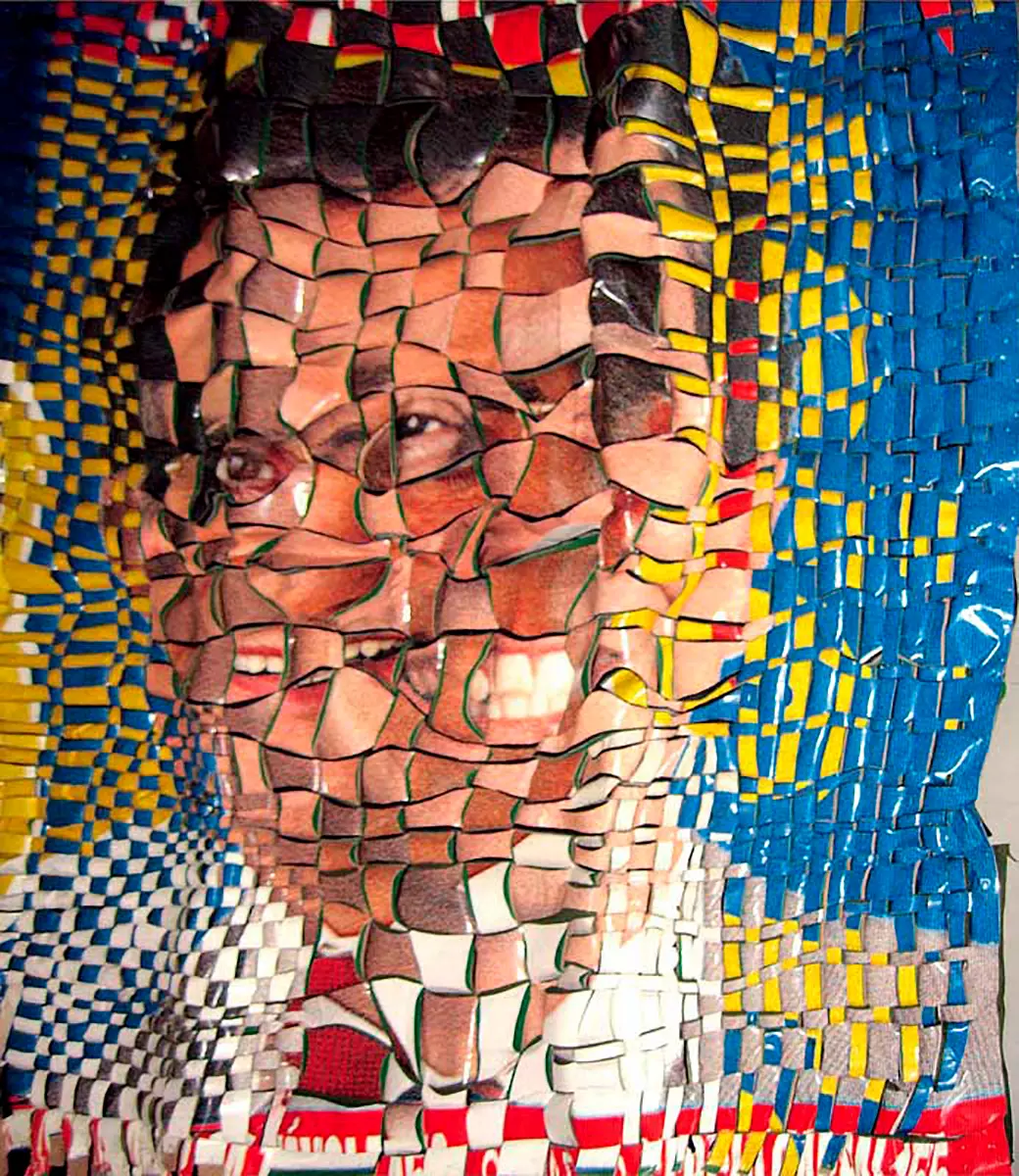
This opened up for crisisss the possibility of a parallel reading, in the sense that the occupation of Ex Teresa Arte Actual, seen initially as the fragmentation of a show that had been conceived as a unit to be presented in a single site, acquired a singular expansive character, mainly because the works installed there had an urgent currency very much in accordance with the spirit that space has retained since its inception.
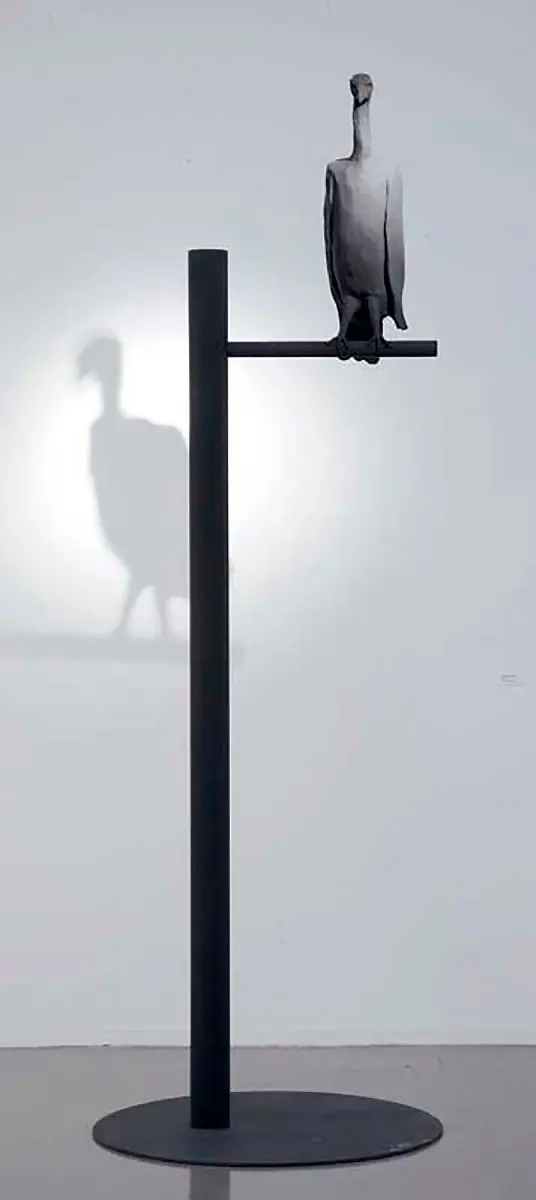
Crisisss begins in the atrium of the Museo del Palacio de Bellas Artes. We are welcomed by a façade illuminated with red lights by Gonzalo Díaz, a work which, because of its technical characteristics, can only be properly appreciated after dusk. Also in the atrium, a vulture by Jimmie Durham contemplates, unfazed, the overdecorated building as if waiting for the end of its agony so that it can fly over and devour the remains. This work, ironically titled Thinking of you, was made on commission for the city of Brussels and originally placed on a busy thoroughfare, which is why Durham decided to create this kind of lamppost with a branch on its top section, on which the vulture sits (with the same morbid intentions, surely) to watch the passing cars.
Mexican artist Marcos Ramírez (ERRE) presents a portable toilet titled Estado de emergencia, a commentary on his country’s political and social situation. There is a clear semantic play with the concept of a “sanitary emergency” and the notion of a State in a situation of emergency.
Access to the MPBA interior was marked by a potent image by Chilean artist Juan Downey, who died in 1993: El ojo pensante, an oversized black and white image of a Yanomami Indian wielding a camera-like a weapon. The giant photograph hangs inside the vestibule to welcome us and to set the tone for what follows in the rest of the show.
Reaching the first gallery, we discover that the photograph is closely connected, in spatial terms, to what awaits there, including one of Joaquín Torres García’s key works, Universalismo constructivo (also known as Nuestro norte es el Sur), from 1943. A year after making this drawing, Torres García commented: “I have said School Of the South because in truth our North is the South. For us there should be no North but in opposition to the South. This is why we overturn the map now, to have a precise idea of our own position, which is not what the rest of the world wants. From now on, the tip of the Americas, extending outwardly, insistently signals the South, our North.”
Across from this work, set on the floor, we find Luis Camnitzer’s Fosa común. Torres García’s map refers us to the ideal, to longing, while Camnitzer brings us back down to earth, to the urgent and inescapable reality of unbound, out-of-control violence. And facing this work is Pasaportes, by Félix González Torres; once again, the idyllic represented as a pile of white sheets to be filled by each migrant, in whatever their language, to go to the country of their wish.
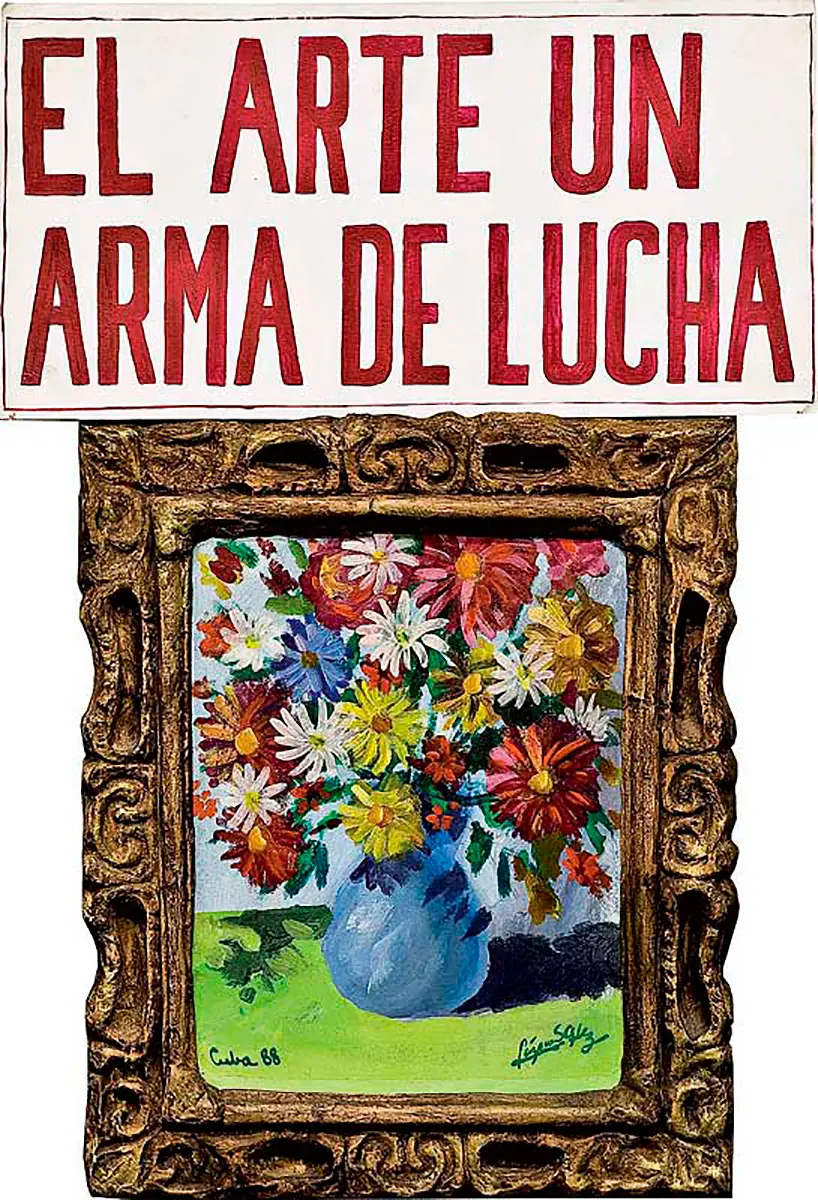
Supported by a careful museography (especially in the first gallery), the tensions created with these works open the path of discourse that, encompassing artworks of different quality and origins, courses through years and countries to tell the story of a Latin American art born of social struggle, critique, inconformity, and especially of the voice of the masses, embraced by visual language as a synthesis of collective feelings.
Thus we find Arturo Duclós’ famous Chilean flag formed by sixty-six human femurs. This work has been prominently set close to the entrance to a side gallery displaying videos like José Toirac’s Opus (where we see numbers read aloud by Fidel Castro) and State of the Union (Clinton), by Aarón Valdéz, where numbers are in turn recited by the former US president thanks to ingenious editing.
Another achievement of crisisss is its direct relationship to works from the MPBA permanent collection. As is known, this institution holds major works by Diego Rivera, David Alfaro Siqueiros, José Clemente Orozco, Rufino Tamayo, Manuel Rodríguez Lozano, and Guillermo González Camarena. The themes of these works are closely connected to Mosquera’s curatorial proposal.
While it is true that, given the untouchability of the Museum (by law and because of its proportions), the works of these artists are inevitably part of all the exhibitions presented there, this is the rarer event of their having been properly integrated into the exhibit. This goes from their actual inclusion in the catalog to their physical presence in the show.
Alongside, for instance, two particularly relevant works that, despite their discreet footprint (in contrast to the stridency of the two Siqueiros murals flanking them), denote an impeccable conceptual structure. First, by Luis Camnitzer, a 1968 etching that simply reads “CHE” in typography very much like the stencils used for labeling packing boxes. Created barely a year after the killing of Ernesto “Che” Guevara, this work places the guerrilla fighter’s figure at the center of the social struggles that are illustrated in murals like Siqueiros’ La nueva democracia, seen here right next to it.
Then, in the same vein, a banknote from Cuba’s National Bank was signed by Che when he was the bank’s President. As the curator puts it, finding this piece of legal tender signed by one of the Cuban revolution’s fiercest enemies of the mercantile economy is nothing if not a Duchampian act.
More than the illustration of an erudite proposal, crisisss flows from a spirit of visual discourse. Thus, we find here proposals that move back and forth between the various disciplines of modern, contemporary, and current art. Works like Santiago Sierra’s and Jorge Méndez Blake’s unfold on the platforms that govern the rules of sound art.
Sierra presents us with an installation of powerful speakers simultaneously reproducing the national hymns of Argentina, Brazil, Chile, Paraguay, and Uruguay; the resulting auditory chaos barely allows us to identify some moments and chords that in isolation, in a different context, would give rise to feelings of patriotism among their listeners. Mostly unrecognizable as they play all at once—like the cacophony of Latin American politics—they are rendered incapable of communicating their message as the musical symbol of one country or another. According to Gerardo Mosquera, this work prompts a reflection about the paradox of multilateral relations between nations that, in the end, are incapable of listening to one another.
Another sound-art work is José Méndez Blake’s simple and potent Diles que no me maten, which consists in the title of a short story by Juan Rulfo—like Méndez Blake, a Jalisco, Mexico native—recited by the author in a recording by the Universidad Autónoma de México, where the writer read his most popular stories. The phrase is repeated many times, becoming more and more powerful as we hear it and think about the dreadful realities of Latin America today, and especially Mexico, a country gripped by a full-on struggle against drug cartels and organized crime that in recent years has resulted in more than 40,000 deaths.
It is not by chance that the nations with the greatest numbers of representatives in the show are Chile, Colombia, Cuba, and Mexico: given their recent histories, these countries have fostered some of the richest expressions of the voice of the voiceless, which seem to hit the nail of a history that does not favor all of its subjects equally, very precisely on the head.
Although all Latin American countries are represented, the four mentioned above are the most dominant in crisisss; at the same time, there are artists who, while not strictly speaking native to the region, have consistently been close to its creative dynamics, visiting often and becoming significant actors in Latin America’s visual art world. Such are the cases of Jimmie Durham and Mona Hatoum, the latter presenting a counterproposal to Jesús Soto’s “penetrable” with her Impenetrable, made using rigid barb wire.
It is impossible to comment here on each one of the artists included in crisisss. Establishing the essential contributions to the Latin American imaginary of confrontation of people like Ana Mendieta, Gordon Matta-Clark, Cildo Meireles, Dulce Pinzón, Guillermo Gómez Peña, Beatriz González, Daniela Rosell, Adrián Paci, Regina José Galindo, and Gustavo Artigas, to mention just a few names from the vast roster of artists in this show, would require detailed analysis and much more space.
Crisisss deals, ultimately, with the issue of dissent in Latin American art, a complex space that, as such, generates similarly complex expressive forms. It is clear after visiting this show that Latin America’s art of confrontation has its genetic roots in a political and social tone that, despite permeating the dominant discourses, does remain at the level of doctrinaire pamphleteering, much less to the simple evocation of lines of thought that have historically believed art to be at the service of a party or a State. A confrontational visual production would be useless if it hadn’t been born in the art field and developed therein with the amplitude shown by a good part of the works we see in this show.
What is clear is the importance of Latin America as a global space where groups set in opposition to the powers that be move with swiftness and agility. A continent of great racial and cultural diversity, Latin America seems to find in artistic languages a common lingo to express the reasons behind social struggle, diasporas, the critique of the State, migrations, and even the critique of critique, which reverts the idea of a guild-like complacency and unquestionably elevates the discourse on which these visual expressions must be revised.
Latin America is approached in crisisss in all of its complex vastness, putting on the table reading of conflicts, power hierarchies (and their confrontation), and the different positions taken by the artists that participate in the show. This reveals strategies, platforms, and structures to trace non-linear vectors about the recent history of Latin America, one of the most influential spaces of contemporary thought. Multiple narratives and transversal dialogs leave the viewer with an intricate map of unfinished phrases, of inconclusive conversations. It was to be expected: there is a long way to go before the misencounter ends.
SANTIAGO ESPINOSA DE LOS MONTEROS