
The starting point for the show presented by Eduardo Médici at Galería Rubbers was his enjoyment of the pure pleasure of painting, regardless of opinions or expectations, freed from the fact of his being an artist with a recognized trajectory. In opposition to conceptualism, he embraced the idea that "painting thinks, the artist paints."
This letting himself be carried forward by painting itself originated this exhibition, Nada está quieto, which reasserts Médici's intent never to be codified into a given image.
As Médici puts it, the show is highly Deleuzian (the name of the French philosopher appears in one of the works), with many points of flight, where multiplicity and nomadism play into the art.
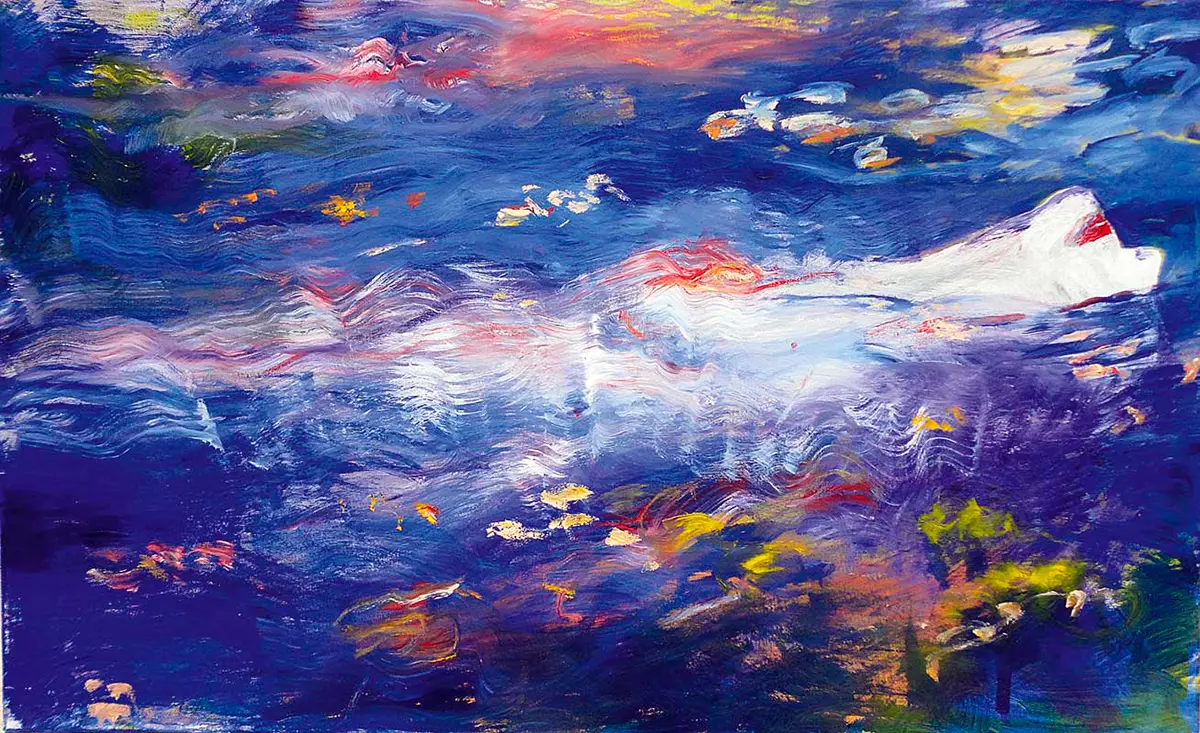
The artist may not be easily recognizable for some viewers. Indeed, color acquires here a protagonism that has not been frequent in his work. Yet the signs of identity of his pictorialism appear one after the other upon contemplation.
We do find, for instance, his compositional organization of a square within a square, as a decorative frame. Also, he needs to cover the space in its entirety, as well as his nude characters in different scales, always gesticulating, always in motion. For Médici, motion seems to signal an impossibility of breaking with the figure, which is also seen in his repetitions, the figures that are doubled, piled up, and brought to the brim of abstraction.
This pleasure in working with superimposed lines, generating movement, becomes very evident in the four drawings on exhibit, created using pastel-oil directly on paper, with blotchings of solvent.
In some of the canvases, Médici has used stencils in lively colors, covering the background with uncertain regularity and leaving his characters lost against it.
Iluminaciones is the most abstract work in this miscellanea, resolved in an exquisite palette of blues and violet hues. Médici's sense of creation has always been the ability to see, to illuminate-painfully-that which resists illumination and deliverance.
It is true that this show features less lacerated bodies, fewer reiterations of ritual and sacrifice, and an attenuated obsession for cryptic signs and anonymity.
Here, the artist is convoked by the pictorial act, and his enjoyment of it drives him to deploy his sense of humor, as in one of the first works, with a painter whose extremely elongated arm brandishes a brush as if to remind us that we are about to journey through the fiction that the artist builds to comment on the fictions that every human being builds about reality. The fiction of fiction.
This sense of humor is also present in the quotations-always abundant in Médici's work-in this case an Ophelia that alludes to that painted by the pre-Raphaelite John E. Millais (1852), which Médici connects to a more marine, almost Romantic landscape and in a subtle pirouette transforms into a self-quotation, through the red lips that recall his previous series Boquitas pintadas.
For Médici, words are an indispensable medium, incorporated into his paintings whenever possible. In the catalog, he quotes words by Argentine poet Roberto Juarroz, which I transcribe here partially;" At the center of the feast there is no one at the center of the feast there is the vacuum but at the center of the vacuum, there is another feast."
This seems the key to the show, where the artists wonder: "The language I manage is my world. Why not seek pleasure within those boundaries?"
NELLY PERAZZO