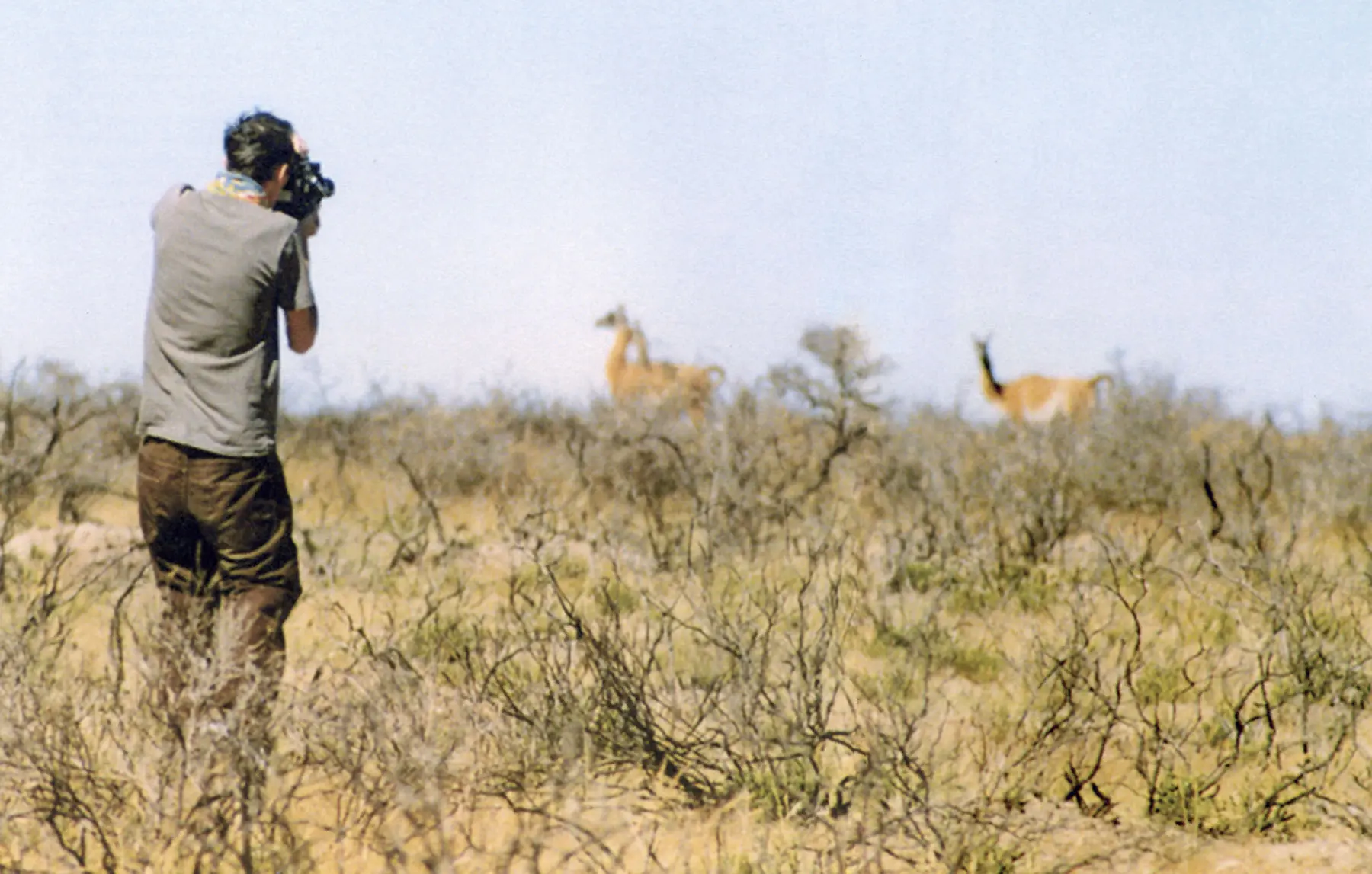
The exhibition title, A Story of Deception, takes its name from a video of a mirage that appears over a heated asphalt roadway in Patagonia (2003-2006). As you move toward it, the visual promise remains enticingly, deceptively close, but you never arrive. Progress defined by final arrival is a sham for Alÿs and the mirage serves his work as a metaphor for deceptions of many kinds, but his recurring and foundational deception is the continual empty promises of modernist capitalism (of the USA and Western Europe—his first home) and their acceptance by “so-called Third World countries” that consistently lead to a “new social collapse.” In a sense, he is a visual embodiment of Marx and Engels’ famous attack on the capitalist bourgeoisie in The Communist Manifesto in that “All that is solid (in real human conditions) melts into air...”
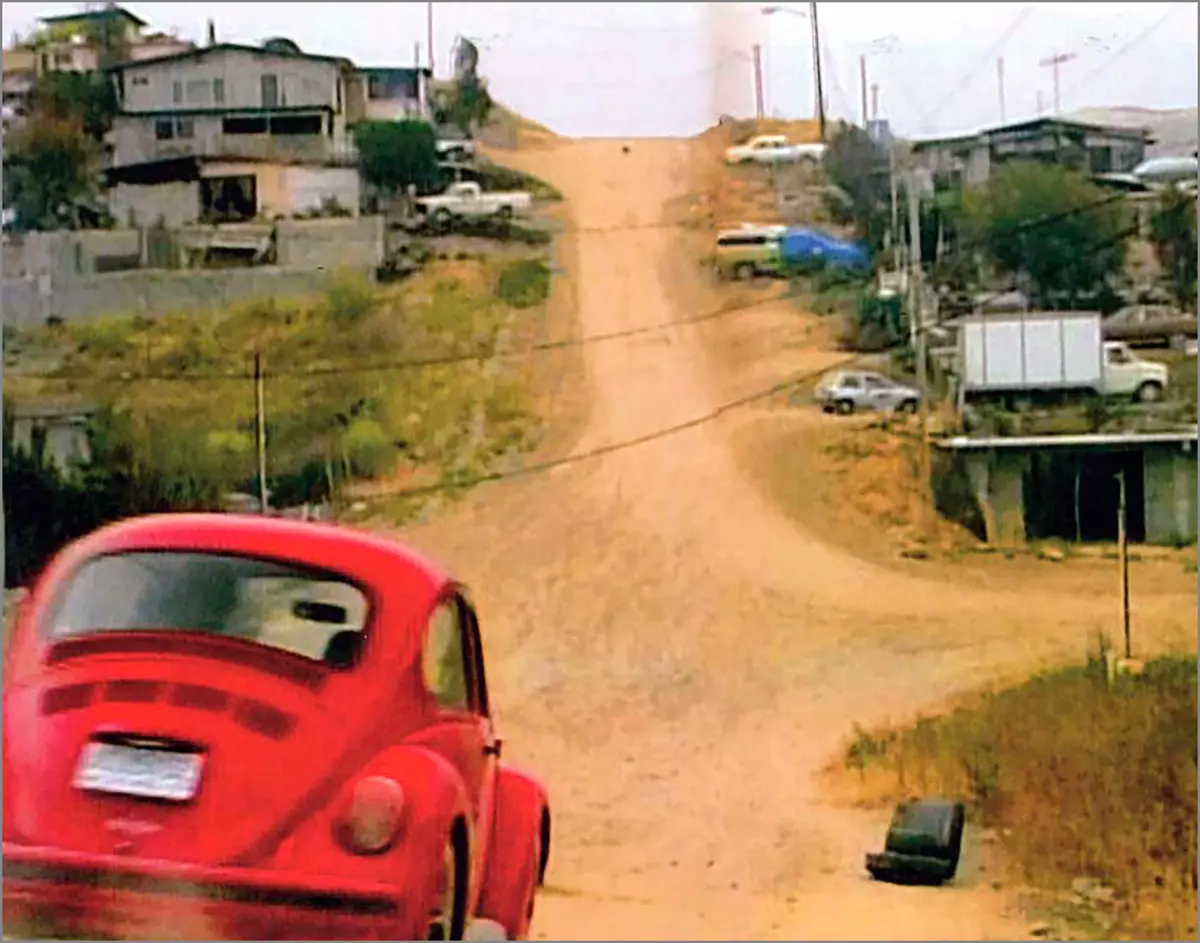
Where the metaphor holds strongly it manifests in works related to the theme of rehearsals, defined as continuous preparation but no real accomplishment, thus always deceptive. In Rehearsal I (1999-2001) the attempts of a Volkswagen to climb a dusty hill outside Tijuana are structured according to the stops and starts of a Mexican brass band in rehearsal. The VW, driving forward then falling back, never makes it over the top to the awaiting promised land, across the border. The oblique directness here is brilliant. I and the eight-year-old seated next to me laughed until tears, albeit for slightly different reasons. But the shadow of concern was the location of a structural failure, which seemed not far removed from an argument for indigenous characteristics or consistent helplessness before an external agent, much like Takashi Murakami’s explanation for the infantilism of post-war Japan.
Rehearsal II (2001-2005) is a video of a stripper rehearsing at the same time as a soprano singer and pianist. She too starts and stops, undresses and redresses, literally loss and gain, as the music rehearsal and she lurches forward unevenly. There is no explanation except in the catalog. By 2004 Alÿs returns with Politics of Rehearsal to reconsider the degree of clarity using an excerpt from the US President Harry Truman’s 1949 inauguration speech that initiated the concept of “underdevelopment” in “other” nations and a voiceover narrative by the Mexican critic and an Alÿs collaborator Cuauhtémoc Medina, to tell us the job of the performer is to provide an unsatisfied dream, a form of political pornography.
While didacticism can be the death knell of the poetic, I find Alÿs’s developmental indexicality revelatory, as it allows us to read backward in time to not simply supply touchstones for understanding but for the work to support the claims. To be fair, Alÿs has been on the horns of this dilemma for years and played the terms of the problem out in public in some of his most famous videos.
His 1997 document of pushing a block of ice through Mexico City until it melted partakes of the frustrations I’ve outlined yet are self-reflexive in his title Paradox of Praxis 1 (Sometimes Doing Something Leads to Nothing). By 2002, the disturbing, sly, and problematic underbelly remains in When Faith Moves Mountains where a line of 500 idealistic college students attempt to displace 10 cm of a sand mountain near Lima, one shovel full at a time. The claimed link between absurd action and Alberto Fujimori’s dictatorship or rural migrations is a weak love story (not a fable but perhaps a parable) designed for the art world but matters little. By 2004 his trajectory has sharpened, based largely on the input from his audiences over time, a true public, critical praxis.
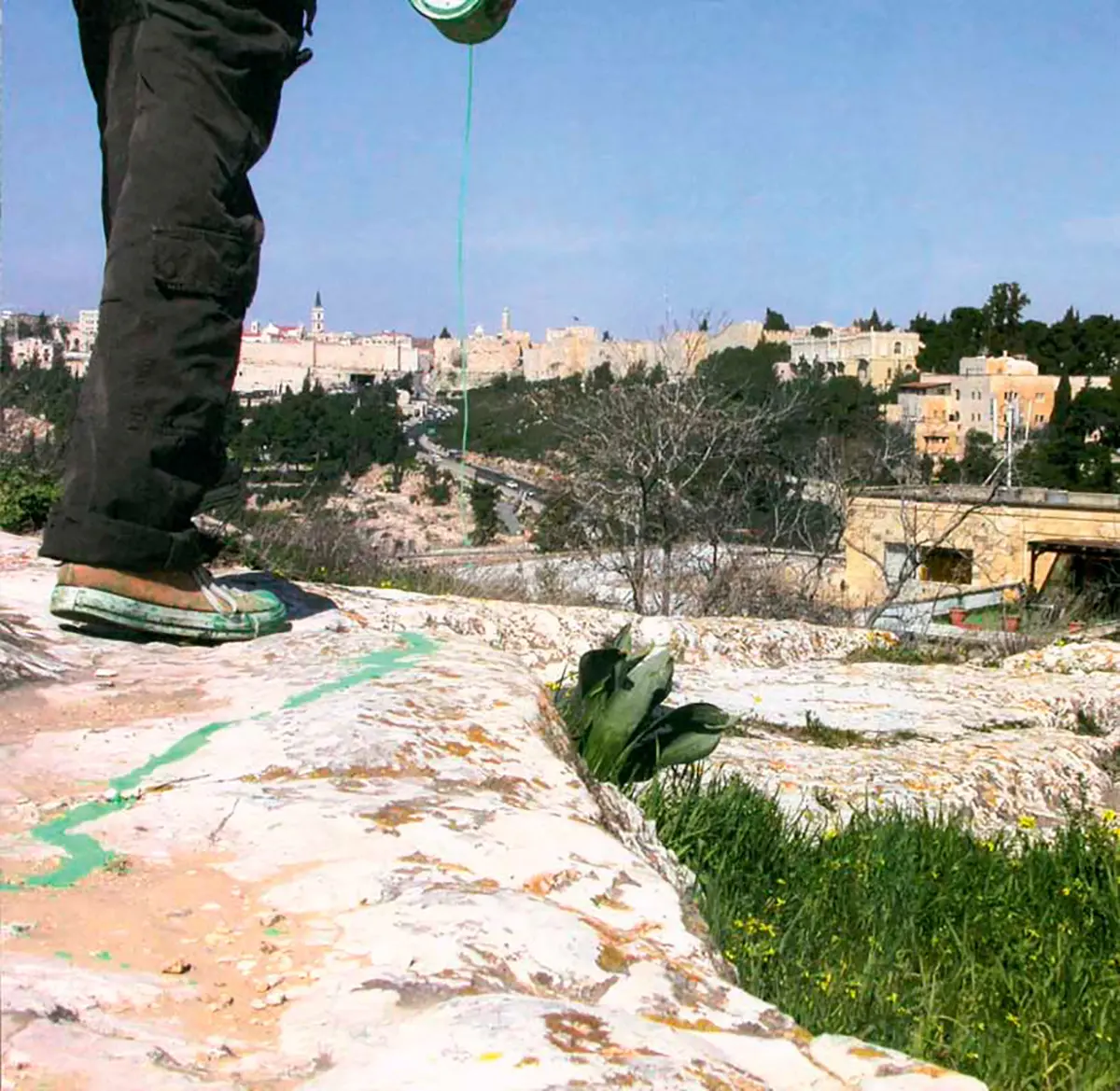
Oriented toward urban social conditions by his early architect’s training, he began to forsake the gallery space for the world in the early 1990s, his peripatetic wanderings—walking is his major metaphor and made evident throughout the exhibition—apparently accepting much of the Situationist and the Nouveaux Realistes aesthetics. Yet the same trajectory toward specificity is present. The Leak of 1995, initiated his ploy of marking his “drifts” with a leaking paint can in São Paulo as he moved away from a gallery exhibition, while the dripping Green Line of 2004 in Jerusalem reenacted the divisions and evoked the tenuousness of borders. In 2008 (Retoque/Painting) he repainted the existing median strips erased by time in the ex-US Panama Canal Zone.
I’m now beginning to see Alÿs as the Volkswagen, his own repeated attempts proving that it is the process that matters most BUT with the caveat that a goal is useful as it emerges from the weave of the fabric of effort and social consciousness.
RICHARD LESLIE
Historian, art critic, and curator.