Germán Arrubla's exhibition Archivos is an artistic rumination on the meaning of the "care of the self," an expression that is closely connected to caring for memory, which in that sense is an essential component of our selfhood. For this artist, the care of memory is extremely important given the inevitable disappearance of our corporeal entity–death. In order to overcome death, it is necessary to remember; it is necessary to foster and take care of our memory. This is the deepest essence of Archivos. For Arrubla, Roland Barthes' Camera Lucida is a revelation, as the essential element in this work is photographic, even though most of the show is objectual in nature.
To shape his exhibition, the artist finds conceptual support in the Greek notion of epimeneia deployed by philosopher Michel Foucault, who insisted on the "care of the self" over the ancient command of "know thyself." The show is comprised of several segments related to the absence of the body. In place of bodies, like forceful remembrances of our passage through this world, we see for instance a series of photographs reminiscent of the Belle Epoque, where beautiful women coquettishly display the elegant garments and outfits characteristic of the period. These images, Arrubla reminds us, are a dialog with the past and an attempt to keep the memory alive.
The photographs are arranged one by one inside black boxes, piled up one on top of the other, like a wall; through magnifying glasses, we see details of the model's expressions or of their clothes. The images were lovingly collected by an individual who, Arrubla tells us, stopped looking for them after her sister vanished and he found her in a morgue's refrigerated chamber. The relationship between the desire to collect these postcards and the individual's sister is unimportant here. What matters is the relationship between death and photography; as the artist puts it, "photography is our connection with the other and with now." This temporal and personal relationship gives this segment an enigmatic character. Another segment of the show is La bitácora de los muertos, a logbook of deaths found at the morgue in the San Juan de Dios Hospital, closed years ago for lack of funds. The book contains a series of names, dates, and other information for people we don't know. Despite our ignorance, it moves us with the realization of the way in which death is entered into the books and filed away. This record-book of death seems the only way for those absent individuals to remain in our memory.
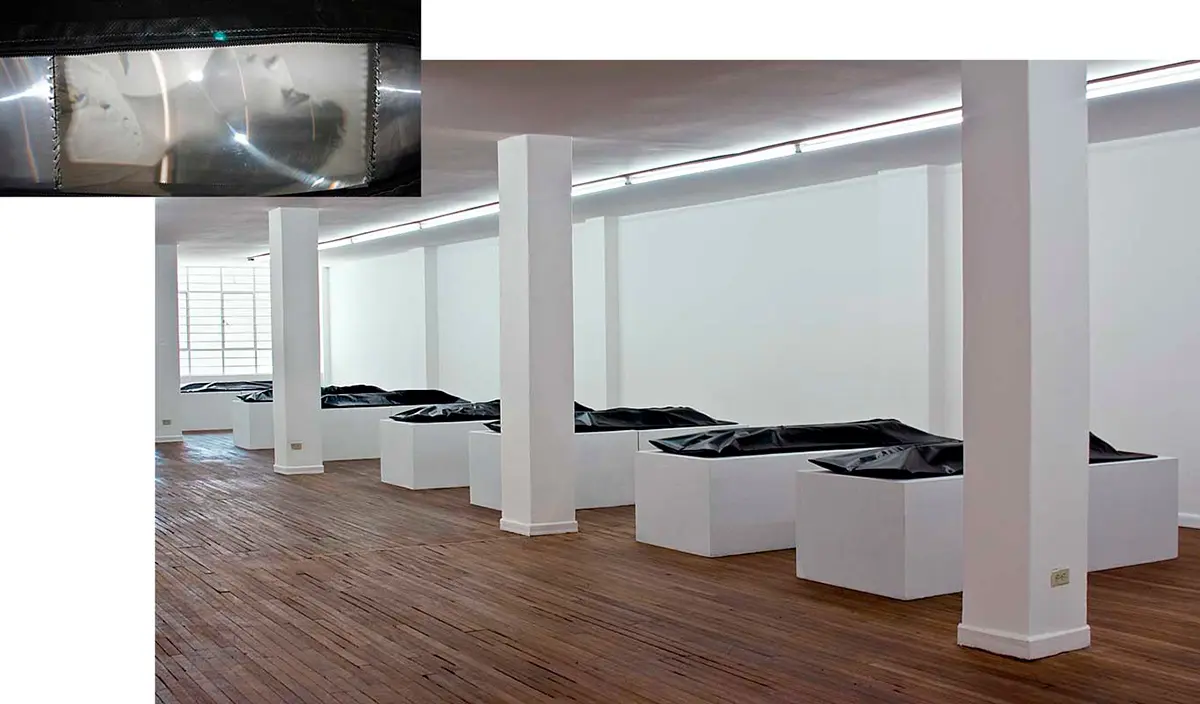
There are also four life-size body bags: one of them contained a postcard-like the one in the first work described; half-opened, the bag reveals the face of a model as if it were a corpse we come to bid farewell. Another bag contained a series of letters carefully preserved by the artist, belonging to people who were close to him and who no longer exist; the idea of correspondence and of that dialog with memory is essential here. The third bag is filled with recently bought handkerchiefs as if insisting on the inevitability of our departure and the need to be "prepared for tears," Arrubla says. The last bag appears to contain an actual body, but is empty: nothing remains, no traces of our body, not even an object to tell us about it. This segment ties Arrubla's discourse together: remember in order to remain, he seems to insist time and again.
This work closes the circle: when we are no longer a body, what is left? Nothing, only memory, images, things, the objects that speak of our passage through the world. Archives insist on those drawers where we preserve that which is most precious in our memory, that speak of people who are no longer here but are paradoxically reborn as we invoke them every time we see their images, read their letters, or simply pronounce their names at a time when nobody else does. A look into the past, a collection of letters and photographs, salvaging of death logs, body bags... a whole device speaking to us of death and of the persistence of our remaining in the memory of stone, as Vicente Huidobro wrote in Altazor. Germán Arrubla's Archivos is an artistic device for guarding and organizing that which is most precious, which time cannot abolish.
RICARDO ARCOS PALMA