
Graciela Iturbide's first individual exhibition was at the Casa de la Cultura in Juchitán, Oaxaca, in 1980. She had been invited the previous year by painter Francisco Toledo to organize an exhibition about the Zapotec culture, and in the course of her visits she discovered a fascinating world, as intimate as it was brutal, which she revealed through her images of faces and gazes peering into the camera with a stoic curiosity, distant and disdainful women brought to bear as a palpitating, always immediate reality rather than as a faraway or magical aside. A highlight of that show was Nuestra señora de las iguanas, the uncanny portrait of a woman gazing beyond the frame and the lens, wearing a headdress of live iguanas that invokes (and also solves) André Breton's post-colonialist journey through Mexico. This is no longer Surrealism, not even an exoticism in touch with the magical. That photograph is an icon that signifies in equal parts the work and career of Graciela Iturbide and the Juchitán community. Her model, Zobeida, has passed away. There is an altar with a postcard. Recently, a sculpture was made in her honor.
Graciela Iturbide is a photographer schooled in the real, in the capture of its moments as they appear, not as much by instinct as through a mastery of the craft. She had been an assistant to Manuel Álvarez Bravo, whom she accompanied in his travels through indigenous communities. In 1974, she was invited by the Communist Party to the Peace Congress in Panama. She was visiting a Guaymí community when she met General Omar Torrijos, who had arrived on a plane hoping to be taken for the saving bird the locals were expecting. A visual testament to that encounter is Iturbide's photograph of Torrijos smoking a cigar next to an old man, wearing a Panama hat and a checkered shirt, his glasses shiny with reflections. Torrijos invited her to Mar de Farallón, where she met the General's family and witnessed his everyday routines. Later she accompanied him to Washington, D.C., where Torrijos met with President Carter and negotiated the return of the Panama Canal. Graciela Iturbide recently presented a book in New York City where she gathers her Panama photographs, not only of Torrijos but of the local people (a highlight, for instance, is the photograph of a woman with a child eating ice cream, with the Panamanian flag on a fence in the background). The book was harshly criticized by Panamanians, who today renege of the General.
Camera in hand, driven by events and people but above all by her real-time curiosity for the world, Graciela Iturbide has traveled ceaselessly to innumerable destinations, from the Sonora desert, where she photographed the Seri people, to India. These continuous travels outline a process through her photographs, a will to discover, a pursuit of the startling in the everyday. A formal path that has distilled its themes to the point of rendering them their own vestige. Her models become signals within the landscape, are lost and reduced in the tense, and always fleeting space of a visual territory that opens itself up to immensity. they end up leaving the frame, becoming their own traces, the objects they leave behind in their passing, as for instance the overcoat hanging from a tree next to a bird in flight, which revises some motifs in the work of the photographer and brings them, with the decoupled evidence of the out-of-place garment, to a lyrical sense that transcends its documentary nature. Reaching into still life, her photographs of the Oaxaca Botanic Gardens signal an intervention in the literal sense: covered and protected, the plants brought into the garden allow themselves to be felt as refugees awaiting deliverance. Reaching into the object, she invokes all that cannot be seen, an intimate history of things, be it some blocks of ice or the objects left behind by Frida Kahlo in her bathroom, the last traces of her passions and pain.
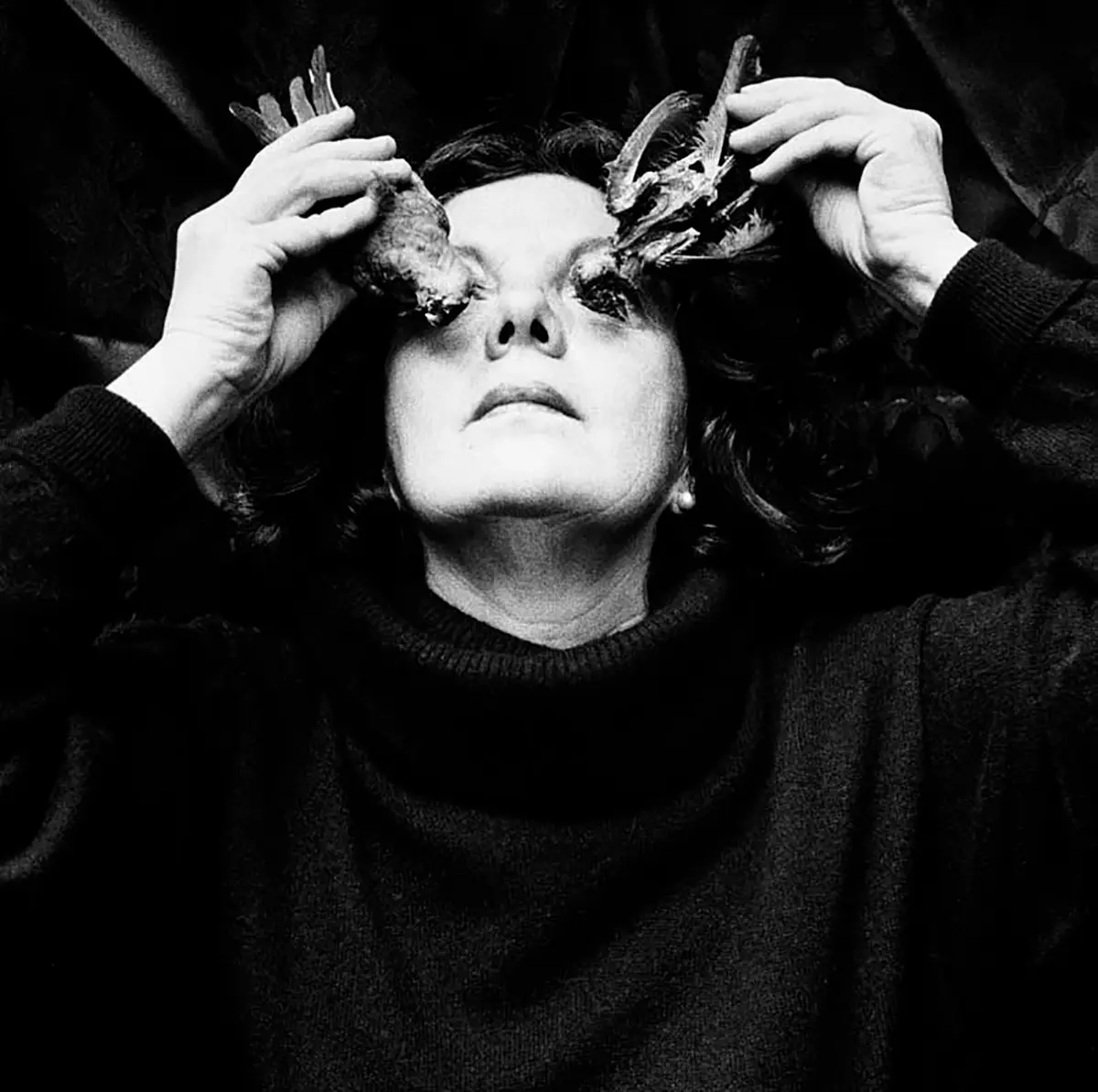
With her own visage as a topic, Iturbide makes a literal representation of its extensions. In one self-portrait she covers her eyes with birds to metaphorize the gaze as flight, the gaze as passing time, a corpse, as a totemic rhythm of invocation that reveals what is hidden under every day, the anodyne, the apparent.
The exhibition was curated by Martha Dahó and comprises 180 images distributed in seven sections: Seris: Those who live in the sand; Juchitán; Mexico: Rituals, Festivals, and Death; Other Borders; In the Name of the Father; The Botanic Garden; Landscapes and Objects; and Frida's Bath. The show, sponsored by the Mapfre Foundation, will travel to France in the fall for the Arles Festival, and in 2012 will be seen in Colombia and other Latin American locations.
RICARDO POHLENZ