
The creative path followed by Jesús “Bubu” Negrón, one of Latin America’s most important conceptual artists of his generation, makes it clear that he is an artist of depths and provocations. Let’s remember some of his most significant works: many international exhibitions/projects, ranging from small villages in Central America to the United Arab Emirates; his highly sought-after Colillones, giant cigarette butts—á la Claes Oldenburg but within a postmo-pop—his invitation to Art Basel Miami Beach (2003); the San Juan Polygraphic Triennial with his VELA Parking Service (2004); his Rosa tecata (a large flower made with banana leaves resembling those made, on a smaller scale, by San Juan addicts to sell to tourists to finance their next fix) presented alongside Pistoletto’s Rose; his participation in the first Turin Triennale Tremusei, in Turin (2005); the final project for his residence in Utrecht, the Netherlands, in late 2005, where he intervened hundreds of bicycles by wrapping them in fluorescent tape and having them course through the city at night; his puerto rican pica (a machine that makes a group of small racehorses race as in a track), exhibited in 2006 in Puerto Rico under the title Picas, museos y ferias, and finally presented in Art Basel, Switzerland, in 2006; and his invitation to the 2006 Whitney Biennial, where the artist took a street-vendor table, of the kind used by some African immigrants to sell handcrafts outside museums, and a hot-dog cart, and simply brought them inside the Whitney and titled them Honoris causa. They all have something in common: Negrón’s proposal, “a tribute to the true artists, the artists or daily survival.” His ethical and aesthetic discourse is clear and forceful: “To take every day out of its context, to reveal the world of common people and the world of injustice that surrounds them, and present it in the elitist spaces of important art fairs and biennials.”
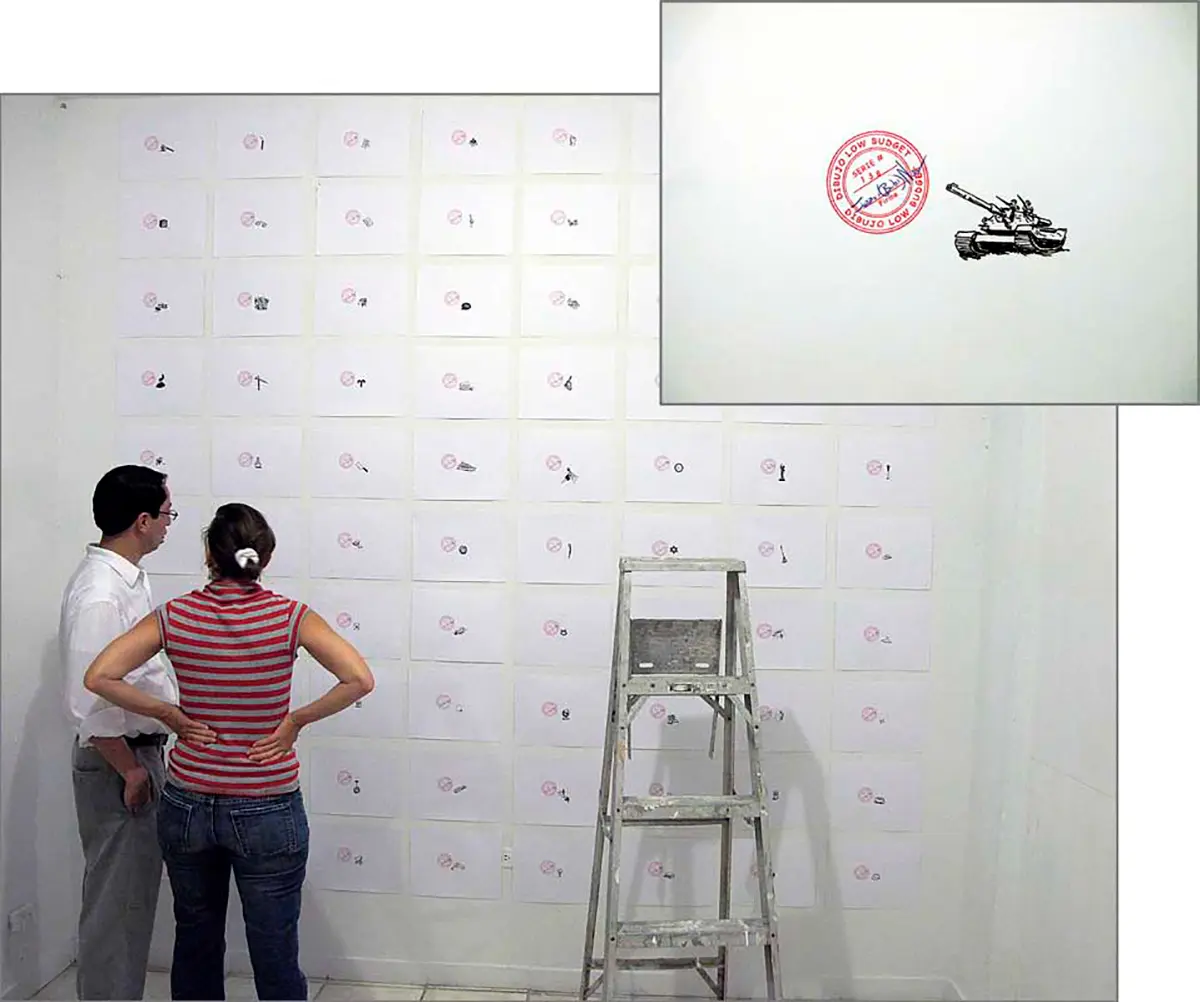
We must acknowledge nonetheless that “Bubu” is magnificently unpredictable, never ceasing to surprise us with the materialization in his work of some of the labyrinths where his mind moves freely. And thus the reason for his new exhibition, Low Budget. Like so many visual artists, “Bubu” has been impacted by the economic crisis (in recent years he has had to work as a gardener and in music, another passion of his), and, after Allora & Calzadilla, he remains one of the most highly valued young Puerto Rican artists in the global visual arts marketplace. The problem, as the artist puts it, is that he “can’t live off projects that are more directed towards an exhibition and an artist’s international prestige.”
In such a situation, “Bubu” (Arecibo-Barceloneta, Puerto Rico, 1975) decided to embrace economic reality and play with the selling of art. This exhibition has to do with a realistic view of the influence that the current economic disaster—in Puerto Rico and the world—has had on the local and international markets for young artists. “Bubu” decided to “create small drawings, high-quality yet accessible —meaning, cheap.” He produced more than 350 impeccable and effective drawings (on 9” x 12” paper), of which only 120 were exhibited. These are drawings of everyday life, of that which makes us “the people”: fountains, coins, tables, roosters, extinguishers, teddy bears, statues, thimbles, buildings, etc. The show was an economic and financial success. “It was fun. I appropriated what is around me and translated it, drew it, transformed it into small poems or anti-poems.”
This shy, quiet artist, unrecognized in his talent by the Escuela de Artes Plásticas de Puerto Rico in his time, who once said that “being an artist is better than working at McDonald’s…”, sends out a forceful message in Low Budget: solidarity, respect, and compassion. “Bubu”, whom I have always seen as a speaker for the proletariat, not only materializes his feelings in each one of his important projects but makes us his partners in each one of his proposals about human nature and dignity.
What Argentinean artist Leopoldo Maler said about his own work, “I use art as a language of effect,” applies well to Negrón’s oeuvre. We saw it in La promesa, (2003), where the artist documented—through photographs, drawings, writing, videos, recordings, and even the wheelchair he used for transport during his last bender—the promise he made his mother of quitting alcohol, as he was losing control of his own life. This Vía Crucis, this exorcism, which began in Puerto Rico and ended in Mexico and is now on exhibit at the Museo de Arte de Puerto Rico (after traveling toß several cities around the world), is an extraordinary narrative of a difficult moment in his life, which he is able to transform into collective catharsis.
Once again, “Bubu” Negrón proves he is not the only witness to the human condition but spokesperson/poet/chronicler—with a 360-degree angle of vision—of what is happening to us as the Twenty-First century moves forward.
MANUEL ÁLVAREZ LEZAMA