Established recently in Bogotá, NC-Arte is an exhibition space described by its director, Guillermo Ovalle, as “a cultural and educational program of the Neme Foundation, intended to contribute to the development and growth of the visual arts in Colombian society. Its mission is to promote, research, and contextualize art by means of exhibitions and multi-disciplinary projects that generate reflection. NC-Arte is a non-for-profit space.” It is here that we find Exhibit Juan Fernando Herrán’s Espina Dorsal (Vertebral column).
Juan Fernando Herrán is one of Colombia’s outstanding contemporary artists: his work in recent years has focused on a reflection about illegal crops and the construction of military bases, with a magisterial resolution of the question of legality. We can say that his work belongs to that of whom I have called the “other realists” or alterrealists, who insist on bringing the very reality surrounding us to the center of their artistic practice.
Herrán’s most recent work, Espina Dorsal, is based on social and historical structures, on informal urban buildings, and on the appropriation of impossible places where living in precarious conditions becomes a life option for a good sector of Colombian —and perhaps Latin American— society, immersed in great social depression. This work has the virtue of materializing a certain utopia where progress, the promise of happiness and comfort presented by the project of Modernity, has utterly failed, and where marginality ends up fostering modes of habitation that transform urban landscapes and public spaces.
From Escalas to Espina Dorsal: Photography as the Axis of Articulation
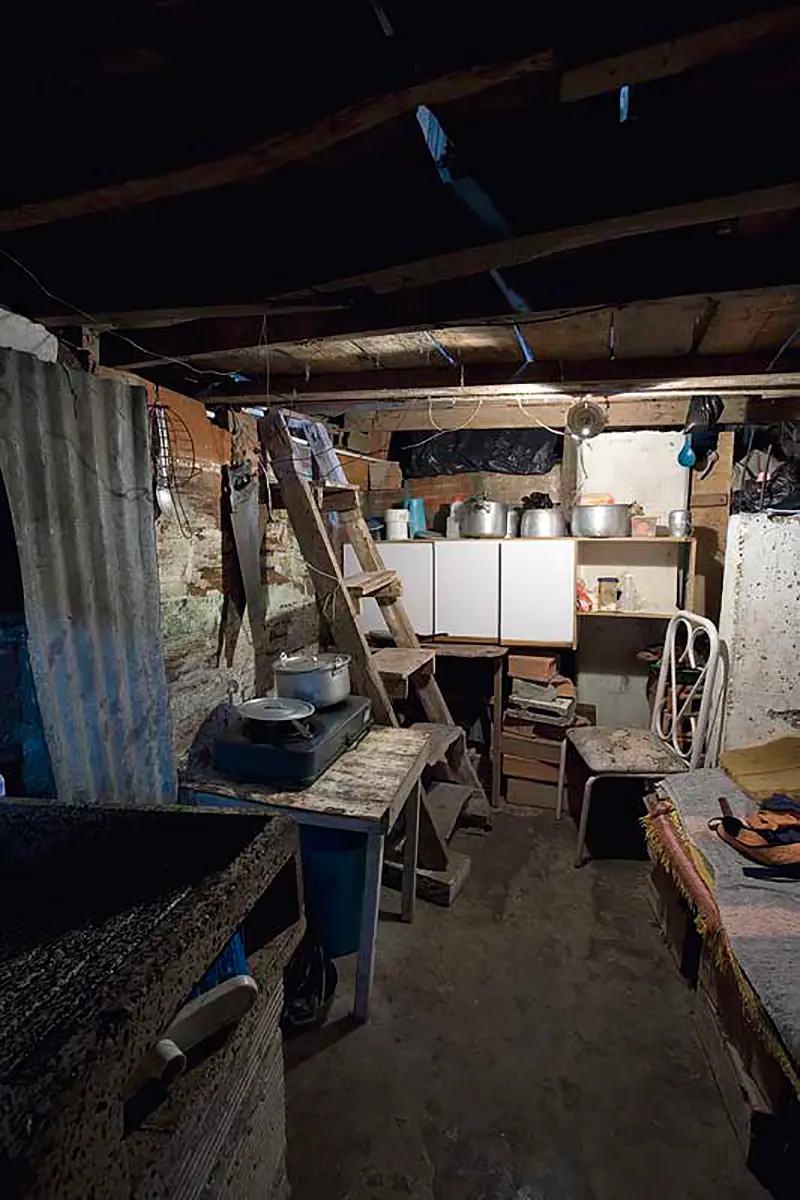
This eminently photographic work (in Rosalind Krauss’ terms) has two precedents, in terms of exhibitions: the first one was called Proyecto Escalas (Stairs) and began as a visual investigation developed during the Encuentro Internacional de Prácticas Artísticas Contemporáneas en Medellín, in 2007, where the artist was called to present a project related to the city. The starting point for his work was searching for an interpretation of public sculpture and creating a comparison with the construction of such lodgings. At that time, Herrán documented informal constructions of the public space that pullulate in Medellin’s peripheral areas (comunas), which for him possess a true sculptural aspect; at that initial instance, photography served as the material for an investigation in sculpture: a record of the rocks used as part of the improvised furnishing of the urban space, generally decorated with the colors of local soccer teams (Nacional and Medellín), which become a point of reference for the working class; a record of those constructions and of its pathways of access, those staircases that are at the center of Herrán’s work.
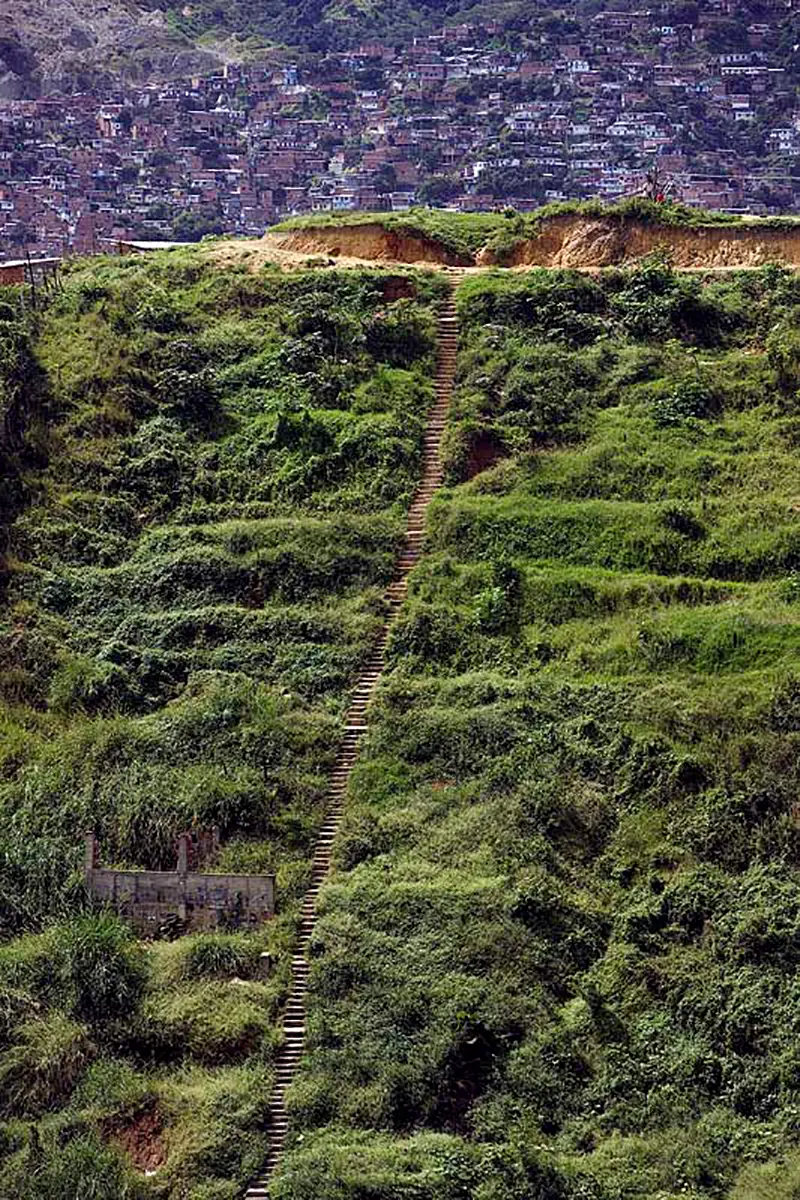
Afterward, the artist documented the staircases accessing informal villages built on mountainsides. In this way, staircases emerge as a key element in Herrán’s visual quest, with the irregular shapes that follow the abrupt topography of each site, something that seduces the artist and drives him forward in his project. For Herrán, these constructions are a veritable “public space” resulting from the appropriation of the site by its inhabitants. Up to then, Herrán is interested in a photographic reflection about an aesthetic element found in such places, mostly formed as a result of decades of displacement of rural populations in the country.
The second precedent took place last year in Menos tiempo que lugar, a traveling exhibition presented as part of the celebrations of the Bicentennial anniversary of Colombia’s independence. Curated by Alfons Hug, from Germany, the show gathered works by artists who investigate the Bolivarian utopia from the perspective of the present, among them Narda Alvarado (Bolivia), Frank Semper (Germany), Fernando Gutiérrez (Peru), and Claudia Aravena (Chile). One of the projects included in this exhibition was, in fact, Espina Dorsal, an installation conceived specifically for the Palais de Glace in Buenos Aires. This work displayed the Escalas project via a photographic series and, in turn, the processes of informal construction of the public space that characterize Medellin’s peripheral areas, and perhaps those of any Latin American city, by way of sculptures in wood.
At that point, the work was configured on the basis of a photographic document from 1910, created on the occasion of the Centennial celebrations. In that image we saw a wooden structure overtaking the sculpture of Bolívar and holding a Colombian flag; the structure served to crown the Libertador in the act of celebration. What surprised the artist was the wooden construction that surpassed the image of the national hero. In Espina Dorsal, the structure was projected as a construction similar to that seen in the photograph. But at the Palace in Buenos Aires, there no longer was a celebration, or a hero to be crowned, or a flag. And the construction lacked a footing so that the Espina Dorsal was unable to actually support anything as if Bolívar’s utopian project no longer had a scaffold in our times.
Espina Dorsal: The Fragile Structure of Modern Progress
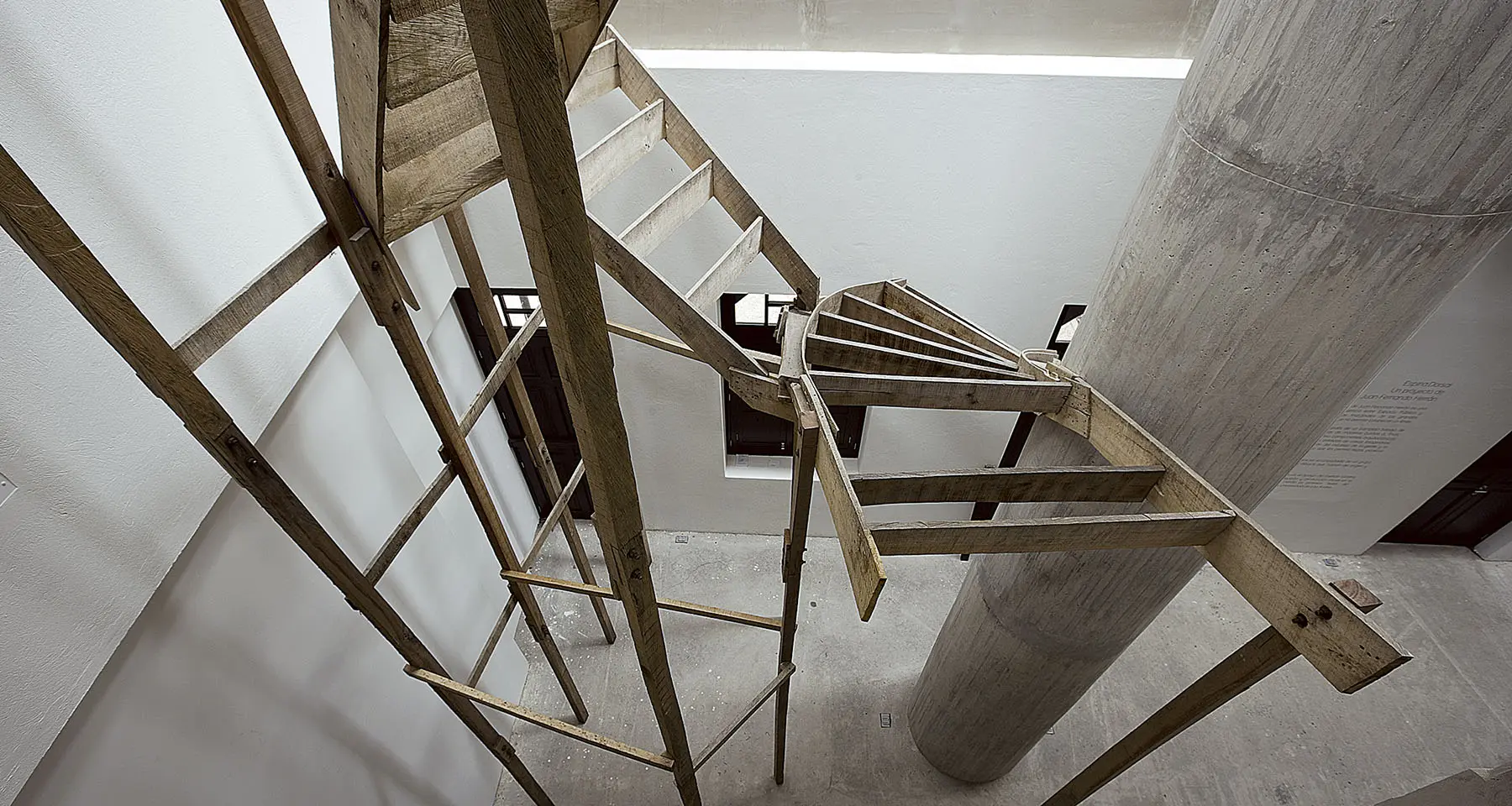
The version projected for NC-Arte in Bogotá is a large installation that recapitulates both previous projects with photographs, models, and wooden structures, and directly refers to those structures in raw wood and to the informal constructions that Herrán encountered during his time in Medellin and his research process. The show includes a series of photographs of those places where cement staircases become true informal urban interventions, with individual needs driving a collective response of dominion over the territory for marginal habitation. The images present us with constructions erected with a certain poetic insolence, within a precarious economic situation, in impossible places. The staircases built not in a rigid way but in an organic fashion, attract Herrán, who however structures his work at a distance from any social intention.
The construction created on this occasion by the artist is seamlessly integrated into the exhibition space, generating an impression of building in “black work.” On one of the walls, we find some wooden frameworks that fuse the sides of the cement staircases. This is reminiscent of the staircases Herrán photographs, where beauty and perfection are questioned by functionality, but highlighting those shapes that move away from their function and become a sculptural excuse. This play of pieces moves entirely away from the image of the initial structure and almost becomes a drawing, where the shadows projected onto the wall and the floor generate a rather interesting sense of motion with the serrated shapes as its protagonists. These wooden frameworks perhaps were used in the construction of actual staircases in the Medellin hillsides, but that matter little: what counts here is an exaltation of forms and a wager for the material, in what is clearly a recovery of formalism.
The structure is divided into several staircases that are not actually such since they do not allow ascent. We are surprised by the fact that Espina Dorsal, which is the support structure for a body, in this case, construction understood as the anatomy of inhabitable space, is a misshapen “vertebral column” that doesn’t let us move up, that has no support for our feet, and seems to foreshadow and inevitable fall. These are false staircases. In that sense, Espina Dorsal is an anti-construction or a pre-construction, a non-support, and a veritable negation of Modernity’s urbanistic utopia, which can no longer respond to the overpopulation and crowding produced by the poverty that encircles our cities —cities that have supposedly superseded modernity.
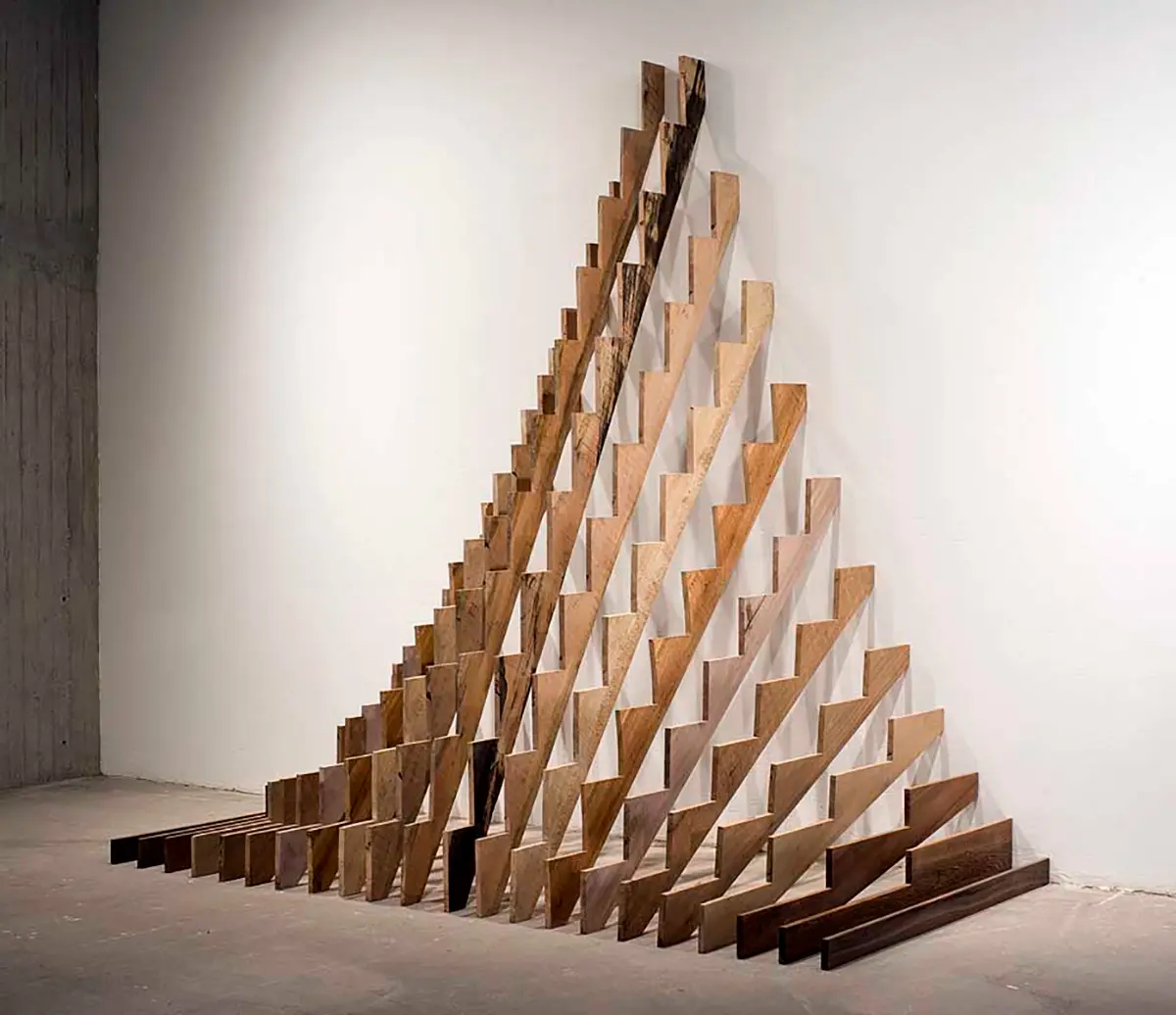
The staircases in Espina Dorsal are potentialities, a kind of promise of comfort since space is in construction and seems to be at an intermediate stage or a sort of “black spot”. These structures materialize in one way or another the utopia founded on the modern promise of progress, which seems to never have reached such marginal areas. The use of untreated wood and the precariousness of the illusion of the future remind us, how could they not, of Tatlin’s Tower, with the Third Socialist International’s utopia of collective construction disarticulated and disassembled here into several staircases that go nowhere, that don’t even let us set a foot on them. Vladimir Tatlin’s tower was never built and remained as an architectural model, and something similar seems to have taken place here: modern social progress has been utterly unable to fulfill our most immediate needs, such as decent housing.
Far from exalting these modes of precarious appropriation of space on the part of marginal populations, which would be inconsistent with their reality, this work rather attempts to make visible the virtues and difficulties of inhabiting the uninhabitable. How is it possible to build such lodgings in those impossible places, and how can their inhabitants live there? This question is undoubtedly at the core of Herrán’s work, which is able to displace all anecdote and social altruism in order to deploy a visual reflection about staircases as urbanistic and metaphoric material, as well as material for sculpture.
With this reference, the artist reminds us that staircases emerged in antiquity as the result of human ingenuity, a resource to escape from the dangers that lurk at ground level. Later, stairs became a place for ascent in search of a certain spirituality, and sacred cities such as those in the Sierra Nevada of Santa Marta, Colombia, and Cuzco, Peru, become sanctuaries of difficult access. Today, the opposite seems to be the case: large hillsides are built over, and these staircases, which have a sculptural side for Herrán, are built to facilitate access to them.
RICARDO ARCOS PALMA
Ph.D. in Arts and Art Sciences. Coordinator of the Master's Program in The History and The Theory of Art, Architecture, and The City, at Universidad Nacional de Colombia.