
Just a few months ago, I visited the studio workshop of Larissa Marangoni (Guayaquil, 1967) and saw her most recent sculptures. Her workspace is not difficult to imagine: ample, imposing, filled to the brim with materials and works. It resembles nothing more than it does an industrial warehouse. And nothing in it announced, “a woman works here.” My visit was ultimately intended to contribute to the writing of Re-reading Bourgeois, or matriarcado man-made materials, a text for the El producto show to be held in Machala (Casa de la Cultura Ecuatoriana “Benjamín Carrión, Núcleo de El Oro, November 17 – December 20), where she was to gather these white sculptures (in their just appearance), but from the standpoint of her own physicality and the discomfort-laden intentions that decision-making can generate for a woman.
The more works by this artist I see, the more convinced am I that in the expressive fluctuations of her practice she activates an intense humanist vocation. My conviction comes from “controlling” her work as an artist and as a cultural activist in its proper Guayaquil context, where she devotes time and passion to her art and also labors altruistically in the presentation of experimental workshops in rural communities, along with other artists. Such projection reminds me of Joseph Beuys’ amplified concept. The residences developed by her project Solo con Natura 1 are related to the German artist’s famous dictums: “every man is an artist” and “the true capital of the world is human creativity.” Beuys understood the latter in an anthropological framework, similar to the one deployed by Marangoni.
Marangoni can’t imagine herself creating ephemeral works like those by Ana Mendieta, with whom she feels deep levels of poetic identity. Or like the practitioners of Land Art, such as Smithson, whose catalog I discover first in her library next to Eva Hesse and Cindy Sherman, two women who also influenced Marangoni with their anthropological and gender-based notes, so dear also to her own work.
Marangoni describes herself as a fragmented woman. On the one hand, this is because of the changes her identity has undergone through the migrations of her family and her own; on the other, because of the life she has lived, marked by frightful jolts at the most intimate level.

Marangoni’s discursive axis is human beings. Their capacity to assemble ballast, conventions, and even expiations (as when she approaches the topic of sainted women in the history of humanity), are the concerns of an artist who has never stopped reflecting about the role of women in social and domestic relationships —albeit without militancy or diatribes that place femaleness at the center but justly defending a position of respect and equality.
While a student at Bennington College, Marangoni volunteered for a Senior Veterans home. A series of iron-and-concrete works at human scale, created between 1987 and 1988, referred to mutilated, depressed, abandoned, seemingly marginal bodies. During the same period, she produced paintings that are halfway between figurative art and neo-expressionism, where she continued to pay tribute to these forgotten individuals, visited by their families once a year.
A group of proposals in which the rodeo becomes the propitiatory excuse for other playful enunciations dealt with the topic of power relationships, seen from a sublimated perspective. During the 1990s, there began to appear concerns about gender roles, the diverse manifestations of human sexuality, and the theme of possession. Marangoni visited these practices often to persuade herself that such spaces are zones of incredible ambiguity. The cowboys, with the hard bodies and well-fitted attires, were ready to be enjoyed by a public avid for possession, who screamed from the bleachers with a mixture of pleasure and paroxysm. Frequent during this period is an allusion to male genitalia and also to levels of flagellation, as in Rodeo, Rodeo I, Stand Me, and I came, I saw, I conquered. In their realization she used wood, cables, aluminum, and bronze, paying attention to a world of insinuations and human crevasses that fluctuates between pliability and aggression.
From 1992 to 1995, Marangoni investigated the lives of female saints as part of her philosophical explorations, now focused on the heroic, iconoclastic side of women who, as we commonly put it, lived before their time. She researched the personal histories of St. Agatha (Agatha, 1992), Joan of Arc (Juana de Arco, 1993), Narcisa de Jesús (1994), and St. Catherine of Sienna (1995). In one of the versions devoted to the latter, Marangoni collaborated with poet Sean Thomas Dougherty in the interpretation of a poem dedicated to this heroic woman whom the Dominican friars dismembered upon her death.
Another work about this particular story consists of a white, large-format sculpture with female symbolism. A receptacle on the floor signals a reference to Catherine’s washing of lepers’ feet and her drinking of the resulting water afterward. Marangoni’s interpretation combines, in a sui-generis way, the scatological side of the Saint’s life with her supra-physical experiences.
Penitence is the common denominator here. An apparent order is referred to using geometric shapes or repetitions of some elements such as the cross, the arrows (in the case of Joan of Arc, 1993), the heart. At the same time, the balance is broken by the vitality and irreverence with which the artist handles her material. To the eccentric abstraction of post-minimalist artists, we often attribute the reconciliation of differing formal effects and the combination of realities inherited from Surrealism. Marangoni has mastered ways of doing this effectively.
Marangoni carries out works that are highly contrasting at the conceptual and morphological levels with considerable bravado.2 She believes in the need to research and develop proposals that are rooted in the inconveniences of daily labor, and at the same time of exploiting the possibility of working under commission. She places her works in public locales or social institutions (Infinite, World Trade Center, 1999), and conceives others under external sentimental pressures.
When it comes to producing philosophical essays on human alienation, Marangoni explores video as her support. Cristo histórico (2001, video installation) is her most outstanding work from this period when her proposals reverberate into the levels of disequilibrium caused by humanity as it creates situations of family desertion, violence, unhealthy environments, and dehumanized forms of labor.3
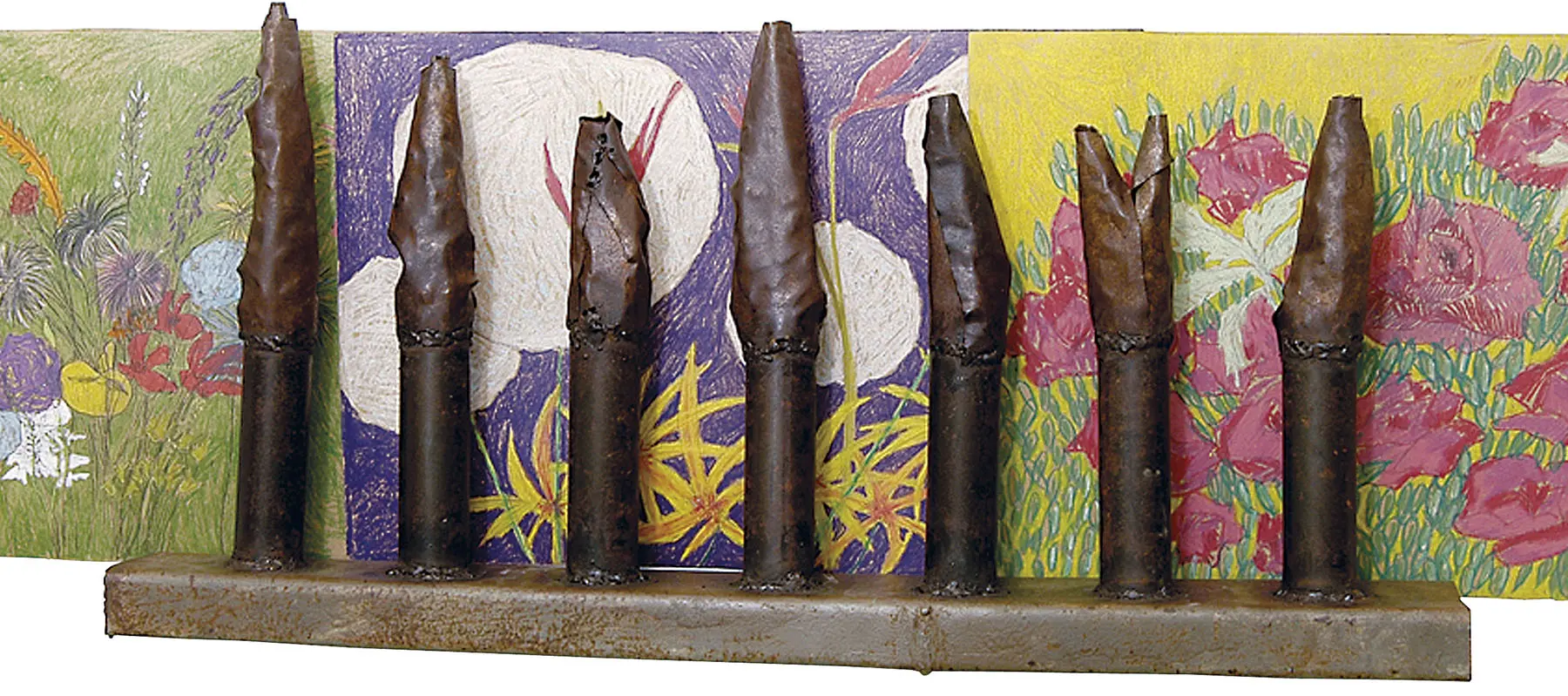
Towards the end of the 1990s, Marangoni began a journey that allowed her to represent herself as she is: a warrior who tries to maintain balance despite her temperamental nature. Ethnic, religious, and political conflicts came to join a more private confrontation: divorce. Invited by the Israeli Embassy, along with other artists, to participate in a convivial experience in a different cultural and religious context, she created Weapons of War (1990, 2002), her most prolific series, at a time in her life that was torn apart by the anguish of separation. The defensive posture of the war-like context and the feeling of abandonment provoked by any breakup came together in proposals that suggest a search for balance, and at the same time contain an expression of visceral angst.
Wood and iron are once again protagonists in these sensorial products, where Marangoni also included resin and fabric, although to a lesser extent. The combination of such materials establishes a sensation of the enclosure, of epistemological ramparts where the artist seeks refuge while the period of struggle passes. The dimensions of these works fluctuate between two and three meters, pointing to a biographical component.
In 2002, Marangoni revisited her series Weapons of War, created two new works, and exhibited them at the Centro Cultural Metropolitano in Quito. These works contain the bad taste leftover by her first marriage, where she finds one positive element: the birth of her daughter, Sophia. Speaking about these matters, Marangoni often becomes emotional. These experiences surely helped her mature and favorably influenced art that is sharp-edged and devoid of affectations. Such private considerations of her own life are at the center of her series Running Away from Home and The Bride (2003).
The latter, in fact, is one of Marangoni’s most revealing proposals. There is a group of paintings inspired by passages and places that are unforgettable for their devastating impact. These canvases illustrate offenses committed by her second husband through the use of a warm palette, in large formats attached directly to the wall, and arranged without apparent order, as if trying to speak to us in real-time. In the Marangoni inserted texts with dialogs between the couple. She gathered them in a show under the title of The Small Delights of Married Life, evading any possible euphemism when it came to evaluating a static time in her life.
The Bride, the work from which the series takes its title, includes several sculptures. The main figure is a synthesis of a stunning wedding dress with a long train made of wire links. Seven bridesmaids accompany the bride into the ceremony, represented by an unmoving, stone-based central structure and attired with similar roughness in plain construction wire rods. They could be the next “chosen ones,” and from the start, Marangoni anticipates their domestic prisons.
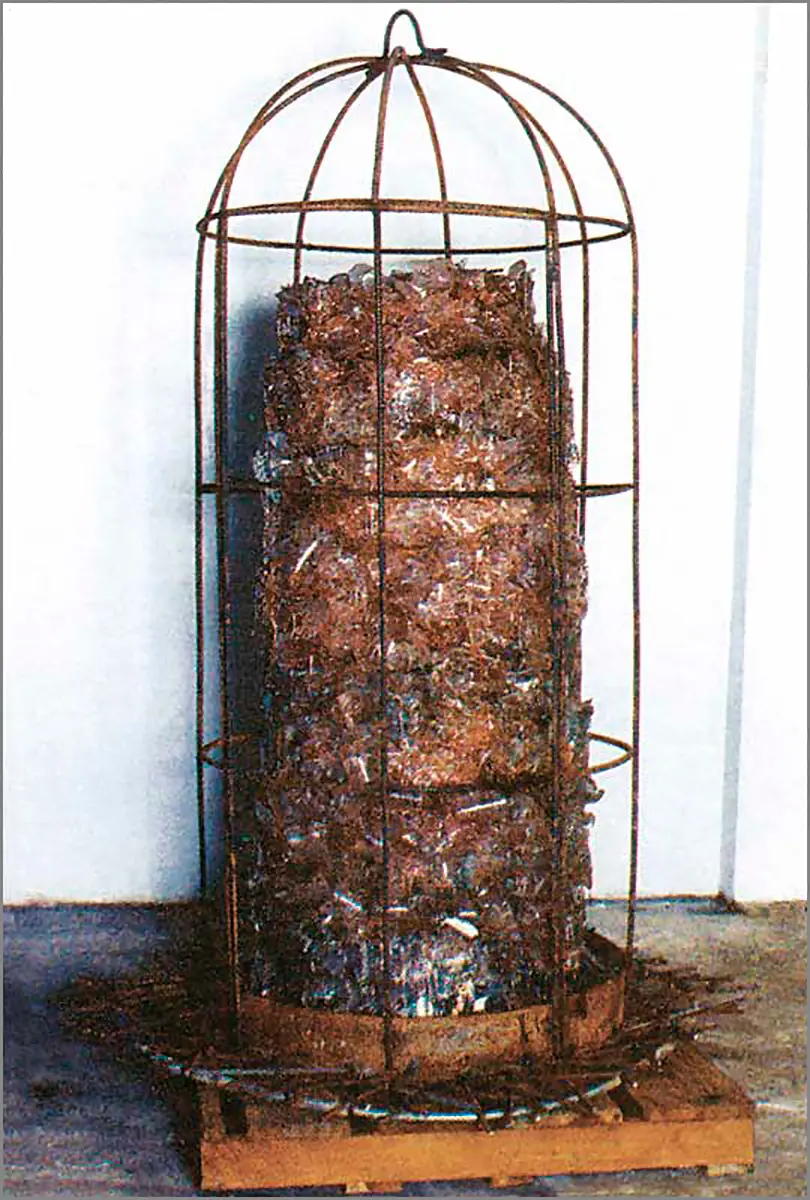
In another gallery, she arranged a phallic structure based on broken pieces of glass enclosed inside a cage with iron bars, similar to those used to house captive birds. Commenting on her motivations, Marangoni refers jokingly to the “dinnerware that breaks” when a couple of fights; a metaphor for the unhappiness and frustrated expectations that can define marriage.
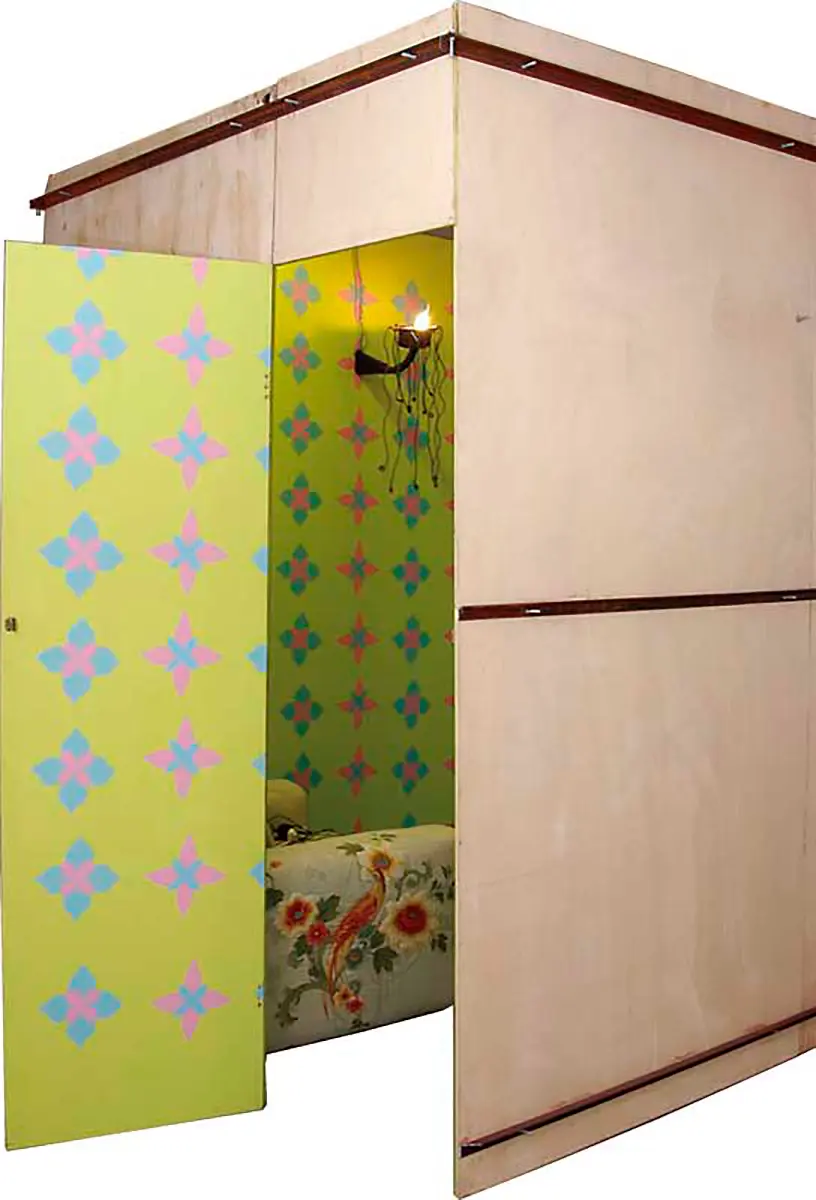
In 2005, Marangoni divorced for the second time and developed Closed Garden With a Back Room, in collaboration with the Portobello poet Rey Sigüenza. This show was one of her most forceful proposals, thanks to its interactive character. The public could see, listen to, and touch a corpus related to private sexual experiences—in this case, sex not enjoyed in full but mediated by cultural and historical taboos that result in frustration. Marangoni attempts to revert them and erode their credibility through the use of kitsch and other elements identifiable as belonging to the household/feminine imaginations.
Marangoni arranges a room with an armchair and headphones so that visitors can comfortably listen to Sigüenza’s ambiguous verses, which appeal to introspection and question our space in the context of pleasure (traditionally seen as terrain of conflict for women, who often have to choose between it and their personal fulfillment, without finding easy ways to combine both). The room (physical body) is set up to the liking of a common man: clean, organized, somewhat tacky in its design, flowers, lamps. A subtle way of accusing "machismo of sugar-coating the pill," as they say in Cuba.
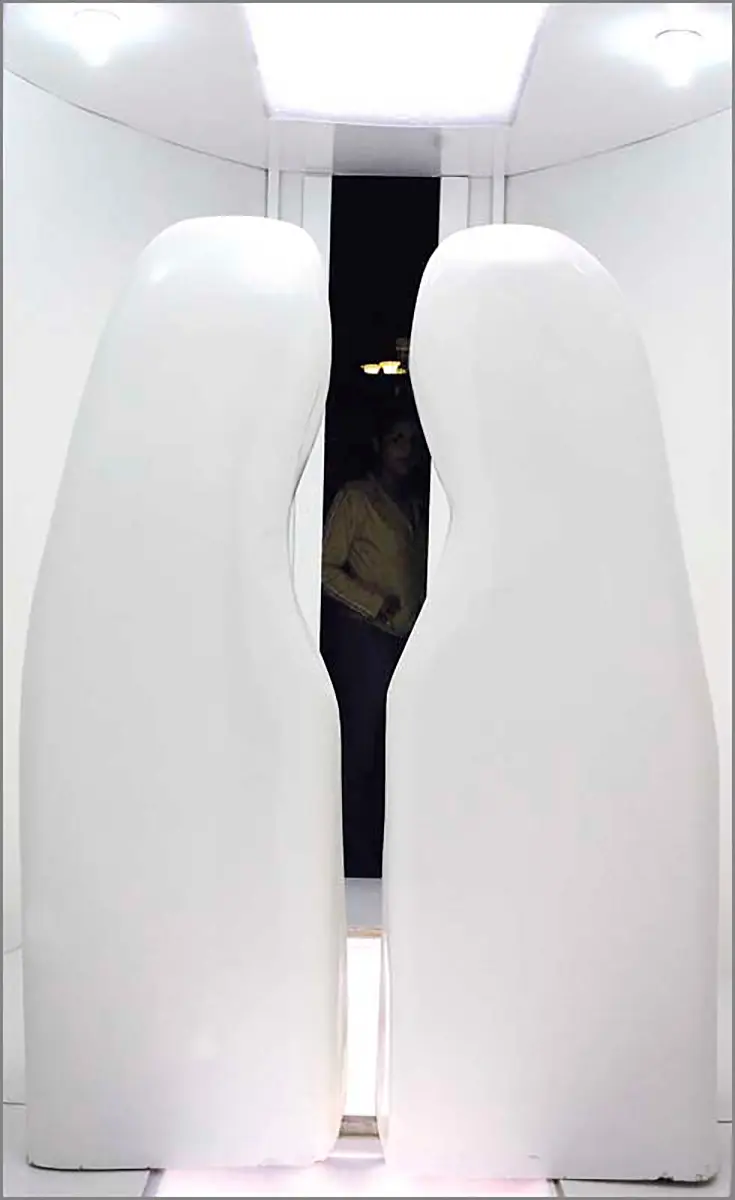
For a time, Marangoni explored taking photographs of her thighs from a high angle, while seated. This always resulted in an empty space between her legs, a consequence of her anatomical features, which she has explored in detail. This study ended with one of her most poignant works, My Void Space (2006). An allegory of her personal history, reinforced by the fact that the gap was the sublimation of her own bodily geography. The sequel of her second divorce is still present, and marked not only her life but also the life of her daughter, Sophia, the artist says. Wood, lamps, industrial paint serve Marangoni in the construction of an aseptic, cold space where the gap previously photographed is reproduced.
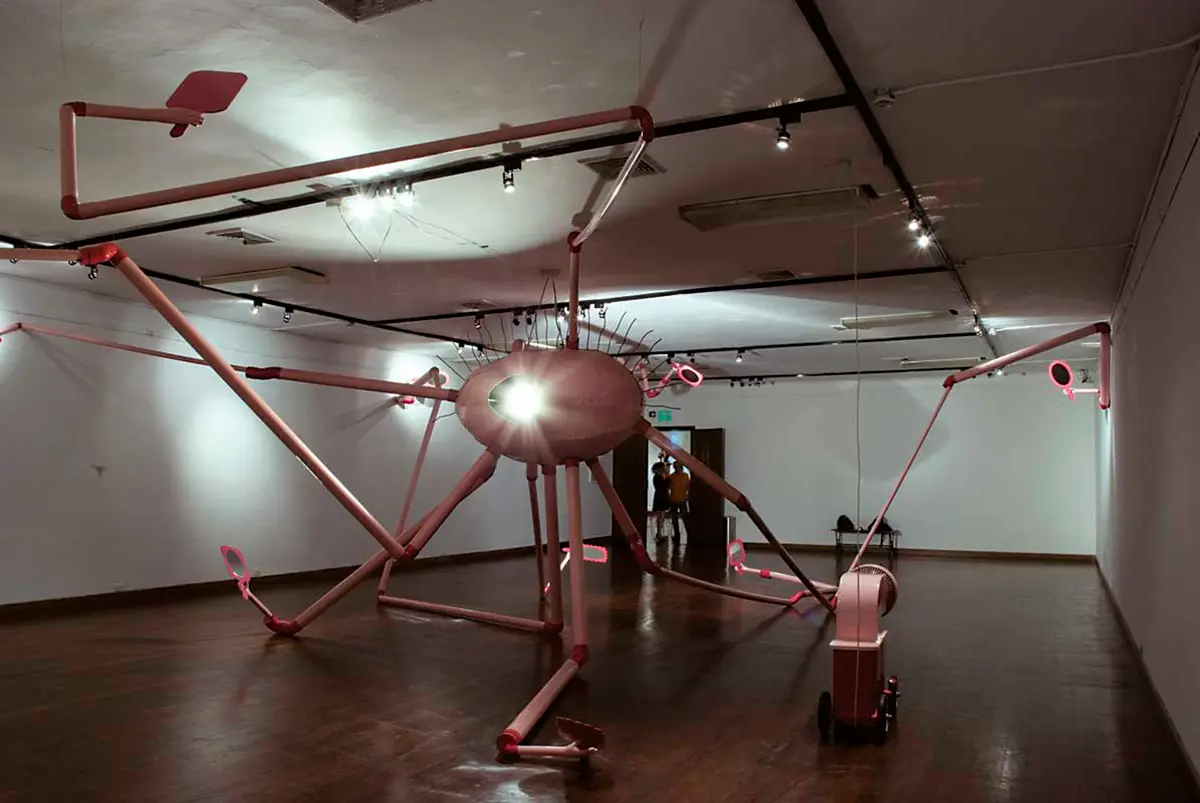
I Have Watched Myself (2008) was her second-to-last individual show and it continued with her investigation of the stigmas and marginalizations imposed on women by a male-dominated society. She explores the life of Lilith (Adam’s first companion, according to the Book of Genesis), and from Hindu mythology, she develops an interest in Durga (Shiva’s perpetual associate). For the first segment, Marangoni installs a large number of figures that are threatening in their verticality, kinetic in appearance, and crowned by all kinds of scrap materials and technological components. In the next gallery, there appears a fuchsia-colored artifact with Shiva’s third eye at its center, which belongs to the spiritual world. When a person is able to activate this chakra, he or she achieves dominion over the material planes and is positively prepared for life; the chakra brings enlightenment, the fullness of energy, and clairvoyance.
Spreading out from this eye are ten arms (Durga), which end in female self-exploration, allegorized through the placement of mirrors at the limbs. Three characters mounted on wheels, named Bridgit, Kasandra, and Estrella by the artist, summarize the castration complex. The first one is a hairdryer and the other two are clocks, all fitted into structures like those found in some public buildings to transport waste. Behind Estrella she placed a string of empty cans, of the kind that is traditionally used to accompany newlyweds as they take off on their honeymoon. In its frivolity and anodyne character, this triad is a commentary on the banal world of Barbie dolls, extensive to male and female psychology in large measure.
Durga represents power and the protective nature of motherhood, in Marangoni’s contextualized vision; by entering into communion with the opposite sex (her husband, Shiva), she reaches a higher plane of wisdom, balances harmoniously her inner strengths, and achieves the equilibrium between male and female, high and low. In Hindu belief, the third eye or chakra is called a “control”, and the artist gives it preeminence to that center, which she has been able to reach only after triumphing over many obstacles.
Summarizing Larissa Marangoni’s oeuvre is a difficult task. Aroused by the dust of so many flyers, slides, newspaper cutouts, and magazines promoting her work, my allergies forced me to stop. Confronted with all this material, I have no doubt that hers has been one of the most effective careers in contemporary Latin American art. And let it be understood as part of such effectiveness the mobilization of ideas about a space for the feminine and the human that still awaits consolidation in our current social dynamics. I can’t understand how or why (karma, perhaps) this work had not been reviewed in detail to tell the story of a woman of unlimited creativity.
NOTES
1. Solo con Natura (www.soloconnatura.org) is a multidisciplinary anthropological project that promotes empowering practices on the basis of shared experiences for artists, mediators, and inhabitants of remote communities. The workshops, educational activities, lectures, and other actions involved foster new levels of communication, make it possible to share collective ways of working, guarantee epistemological exchange, and allow participants to develop skills in the search of practical solutions within their strategies for survival.
2. Marangoni is capable of comfortably shifting her expressive register and objective. To mention one example, a series like ¿Dónde está la satisfacción? moves away from the treatment and the intentions of Armas de guerra. Similarly, after producing the best-known works in the series La novia, she extended her irreverent approach towards works that are more in tune with her commercial intent, while still belonging to the set.
3. Cristo histórico, video installation, 2001, summarizes the artist’s pointed interest in the fate of humanity through the subtle displacement of levels of reading about power, love, the family, and social regimes.
AMALINA BOMNIN
Cuba, 1971. Lives in Guayaquil. Curator, professor, and art critic.