
Shifting Objects/Atmospheres-Structures-Grounds is the name of the most recent solo exhibition by Magdalena Fernández. Presented through the months of May and June of this year, it showcased known as well as never-before-seen works by this important Venezuelan artist. The exhibition was presented at three cultural venues in Caracas: Faría + Fábregas Galería, Periférico Caracas/Arte Contemporáneo, and at the Centro Cultural Chacao.
From the very first nomenclature of this exhibition, movement is asserted as an accurate and recurrent attempt to interact, to establish a dialogue between the work and the public. It is a translation that-whether as the physical phenomenon of shifting or the representation of the idea of movement-seems to reveal as many facets as it does approaches and interpretation about this body of work, all the while offering a complex and rich aesthetic experience full of subtleties.
Perhaps the point of departure of this idea of movement is the very act of visiting the exhibition spaces: an explicit physical transition required of the spectators in order to participate in the proposals at the three different venues in the city. It is a journey through time and space that appears to project an imaginary aerial map; an outline of coordinates and changing lines like the paths that lead one to these destinations.
In a smaller scale-through, the interaction with the works in the exhibition areas-this same physical act allows spectators the possibility of transforming the work as they transit through space. Thus, more than merely outlining the coordinates of a trajectory, movement determines in this instance the form and perception of the experience. The installation entitled 1i011 (2001), is a segment of the thematic section entitled Structures-exhibited at Periférico Caracas-that consists of several metal and copper rods arranged across a fourteen-meter surface. As they hang from the ceiling, they become like fragile and weightless branches from a transfigured forest that dangle with the contact of the persons who pass through them. It is an appearing-disappearing act associated with the concatenated succession of images in the videos of this new exhibition nucleus.
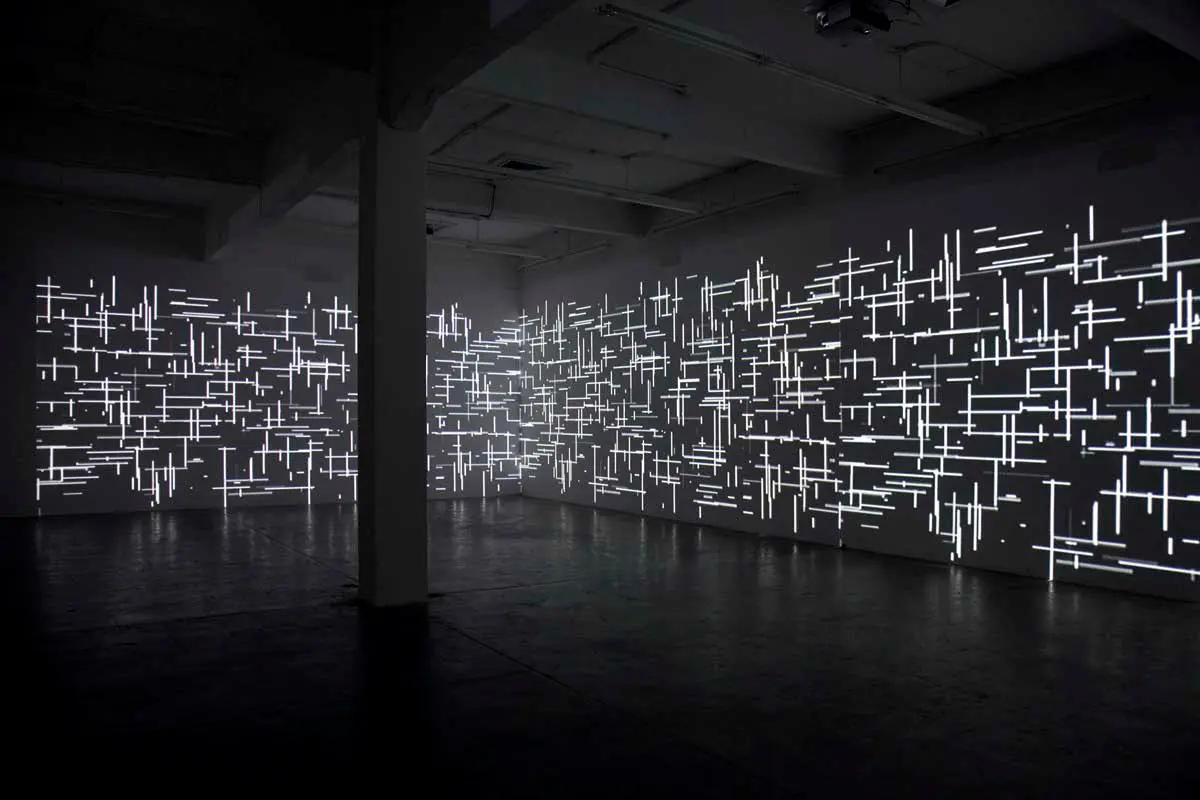
There is the continuous transition of planes that register the delicate undulations of leaves and tree branches rendered in black and white in eight small videos. There is also the geometrization of the natural phenomena that appears in the video installation entitled 2iPM009 (2009), an environment that surrounds spectators with the progression of points that stem from darkness and that are gradually transformed into lines, into fleeting orthogonal that allow light in and visually evoke-in parallel with the sound of rain, the audio of the work-the mutation of a tenuous drizzle that eventually turns into torrential rain.
The notion of movement in Fernández's proposal cannot solely be verified through the physical progression of the bodies or the visual transitions that appear in her videos. It is also possible to attain this notion by way of the conceptual journey that operates in the exhibition. It is a two-way trip that moves through nature toward a geometric transformation and then, on the way back, finds the geometrical forms transiting through the evocation of the natural world.
In the video and two-dimensional pieces included in the section entitled Grounds and shown at the Faría + Fábregas Galería, the matter becomes geometry through a stop-motion succession of images of wooden pieces that are gradually interconnected to reveal constructive compositions in a clear reference to Joaquín Torres-García. On the other hand, the matter is also transformed in a series of delicate works on small MDF boards that serve as support to forms created with seeds and woods.
In the animations presented in this gallery as well as in the section entitled Atmospheres, shown at the Centro Cultural Chacao, geometry is sensitized and naturalized in the chaos that momentarily disturbs the rigorous order of the orthogonal and color blocks eventually reorganized so the forms are-as it incurred in the works 1pm006, or Ara Ararauna, of 2011-simultaneously, a record of abstract tradition-through elements that underscore the influence of Piet Mondrian and Alejandro Otero-and the memory of nature itself, through the sounds of macaws and birds from the Venezuela forest.
Nonetheless, it is the movement as a sensitive manifestation of emotion that takes precedent over the rest of the movements of this exhibition: namely, the viewer's awareness of being part of a world that recognizes and moves him/her.
COSTANZA DE ROGATIS