Since reopening in 2010, the Museo de Arte de Lima (MALI) has expanded its contemporary art agenda by initiating a new program: Mali in situ. This program facilitates the creation and presentation of work that interacts with the museum spaces and the context of Lima. Within this framework, British artist Melanie Smith (Poole, England 1965) produced and presents her latest film Bulto, the result of a collaboration with Mexican film producer Rafael Ortega (Mexico City, 1965). The film, which portrays the circular journey of an undefined object, a bundle, in and about Lima, opens up poetic yet critical perspectives on the everyday reality of this Latin American metropolis.
The artistic practice of Melanie Smith, who has been living and working in Mexico City since 1989, is informed by the perpetual transformation of everyday reality in a metropolis. Working in a vast range of media painting, drawing, video, photography, sculpture, and installation-Smith pursues the utopian ambition of acquiring an all-encompassing view of life in the city. Investigating urban and pre-urban areas, she has developed a personal urban morphology in which spatial structures-from street vendor architecture to the street plan of Mexico City-are directly related to sculptural and pictorial abstractions. A leitmotiv in her work, the relation between abstraction and reality also constitutes the pivotal element of her latest project where she revisits Lima with a big red plastic object, a Bulto.
The opening scene, a traffic jam in the center of Lima, locates the Bulto in a no-exit scenario, inspired by Jean-Luc Godard's infamous traffic scene in Weekend. Cars, buses, taxis, trucks, typical Peruvian micros, and combis, standing still, moving slowly, crisscrossing each other, form a chaotic urban landscape producing a wall of noise. Parallel to Godard's scene that reflects a cross-section of French society with an endless animated line of vehicles, the film introduces Lima by displaying its characteristic multicolored traffic, an important motif throughout the film. If Godard intended a cultural critique of Western middle-class society, with Bulto, Melanie Smith takes a different stance. The film approaches the urban reality of the Peruvian capital from an intuitive, observational, and anthropological perspective. An undefined object thereby serves as a medium to shed light on those aspects of the city that go unnoticed but shape everyday Limeñan life.
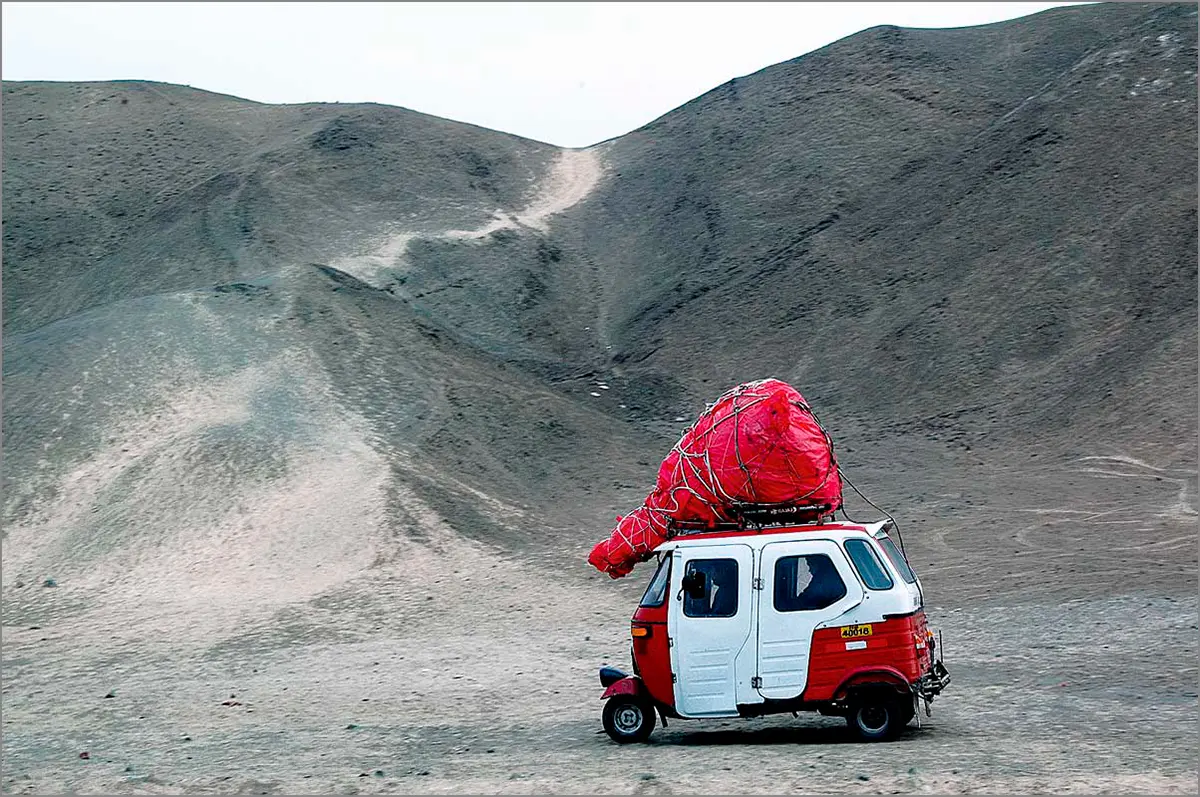
Following the peripatetic practices of the enigmatic object, one inevitably wonders what the Bulto is? With its huge conical shape, its vivid red color, and its plastic materiality, the object seems to elude any definition or classification. Yet, it is essentially nothing else than what it professes to be, a Bulto, literally meaning an unrecognizable shape, a vague figure, a bulky mass, a bundle or a package. As a package or a bundle, however, its content, together with its origin and destination, remains unclear. Moreover, when the film shows how the object is thrown off a dune, bashed into a taxi or wrapped in plastic for transportation, it becomes even doubtful if the Bulto contains anything. Whether it has content or not, it never stops being what it is-an an indeterminate object, a Bulto.
In an anthropological and archaeological context, the term Bulto refers to a widespread ritual in Pre-Columbian cultures-the the sacred bundle cult. Valuable objects, human remains, or natural elements bundled in layers of cloth performed a vital role in ceremonies and rituals, during which they were carried throughout the community and beyond. Endowed with supernatural powers, the bundles served the social function of unifying the community across temporal limits. Traces of this ancient cult returned in colonial Latin America and can still be found today in the ceremonial processions, in which the effigy of the Virgin Mary and other saints are paraded through the streets.
By making the Bulto travel across the community, much in the same way as the ancient cult but with all modern means, Melanie Smith transforms the ritual into a performance. The Bulto, an abstract volume, does not, however, represent a unifying community symbol. Its particular appearance sets the object apart from the context where it travels. From the intimate space of a living room to the back of a moving truck, wherever the Bulto is situated, it remains detached, uprooted and out of place. The object, far from being a symbolic core of a community, now functions as an external, contingent instrument to investigate society.
The passage of this unusual object enables the city to observe itself in the mirror of Smith's film. With its performance, the red bundle continuously seems to challenge its surroundings-and the viewer-to interpret the Bulto and its relation to the places it travels. The identity of the object is thereby defined by the situations it runs into. If the object starts off as cargo in the back of a truck, located in a collector's apartment it becomes a sculpture, a true work of art. Placed in a playground, it is transformed into a toy, a distraction carried out of the school by the children. Juxtaposed with the Paseo de la solidaridad, a monument erected in memory of the victims of the Shining Path terrorist attack in 1992, the Bulto enters the realm of the commemorative. Traversing the notorious black marketplace Polvos Azules, it becomes a commodity. When situated in the ruins of the Pachacamac Inca Sanctuary or the Pre-Inca sanctuary Huaca Pucllana, it turns into a mythological artifact ready to be archived and examined.
The recurring symbolic adaptation of the Bulto invokes the narratives of the places where it travels. Places that depict Lima in its diversity and unity, marked by an enduring conflict between tradition and modernity, myth and history, centers and peripheries. These conflicting narratives are amplified through the object, which resists transformation-as is cinematographically emphasized by repeatedly visualizing the materiality of the bundle. In remaining an abstract object, the Bulto both reveals contrasting realities and displays how the perception of an object can heighten our awareness of a context.
As volunteers and amateur actors handle the object, fiction and reality continuously intersect. This, however, does not constitute an impediment to the genuine integration of the Bulto in a Limeñan context. On the contrary, it is the play between fiction and reality that enables the Bulto to penetrate everyday Limeñan life. The object travels swiftly through the city and its suburbs using almost every plausible way of transport. In addition to being carried or dragged along, it is transferred in the back of a truck, in a micro, on top of a typical Peruvian motor-taxi, on the bonnet of a bus, in a boat and in a hearse. It smoothly enters official institutions such as Banco de la Nacion and the city hall. Nothing prevents the enormous ponderous object from participating in everyday life, nor does the Bulto disturb the ordinary urban routines. In the unruly order of the Peruvian capital, its conspicuous strangeness slowly fades. It is not the obstacle it seems to be at first glance. In response to every problem the object presents, the city formulates an answer, gradually revealing the creative dimension of quotidian life in the Latin American capital.
With Bulto, Melanie Smith reveals both the creative dimension unifying Lima and its fragmented urban landscape with scattered coexisting realities. Demonstrating the possible integration of the Bulto, the film conveys a positive yet ambiguous message, concluding with a critique. Ending where it begins, Bulto, in the words of the artist, is "a story of repetition." Fixed in a loop, the object is bound to continually relive its nomadic practices without effecting historical change wherever it has passed by. Bulto is absorbed in the routines of everyday reality, starting and finishing - or rather stuck - in traffic, a metaphor for movement without progress.
LAURENS DHAENENS