For Milton Becerra, creation is one more element of life, a constant process.
The logic of Becerra’s work is connected to the production and the space in which his pieces are exhibited. Removed from the more mundane art issues associated with art, this artist appears to have renounced to post-colonialist posturings. Instead, the Paris-based artist proposes inquiries into the origins and the use of the vestiges of past civilizations through ever-evolving conceptual proposals in an artistic trajectory that has expanded 35 years.
The recovery of artisanal techniques and the dialog with the regionalisms—very much used in postmodernism—have an essentialist purpose in the work by Milton Becerra. The Venezuelan artist is after the very content of expression associated with the so-called "early settlements."
This encounter between the present and cultural past that continues its ancient traditions was not merely an accident or a search for the artist’s origins, but rather part of a singular worldview and artistic practice.
Becerra’s first expedition to the Yanomami region inside Venezuelan territory in 1992 took more than a year and a half of preparations, while the time the artist actually spent in that community was a month and a half.
That is how Milton Becerra left for that region with his intellectual and technical wealth of knowledge. He left carrying workbooks, pencils, paper, photography and super 8 cameras with him, and returned with stones, feathers, weaves, baskets, masks, and all kinds of elements that could help salvage a way of seeing and understanding that which remains hidden from the Western world even under globalization. In this aspect, he is also a pioneer.
When the Guai-their—the warrior, shaman, and leader of the community—saw Becerra’s sketches and drawings for the first time, he asked the artist to teach him how to make them. Thus Becerra was able to develop a dialogue that transcended inter-subjectivity. He was able to establish an authentic process of communication where communion seemed impossible before. In this sense, drawings can be understood as a medium to communicate ideas in which to define the limits of language.
Becerra’s search for the mythic is the common essence that connects the artistic practice with the aboriginal person. The threads hide the secrets but also express life. An entire range of themes is interwoven like the threads of time… There is a travel and situational feel to this aesthetic enterprise. And despite the apparent fluidity of the language used—let us not forget the subjective sense of authenticity—each line, form, or knot is the product of profound meditation. The work finds its existential place through reflection and the preliminary sketches are evidence of these. Even the physical elements, from the visible and invisible realms or from the law of gravity itself, revolve around the work, as does the spectator in the space.
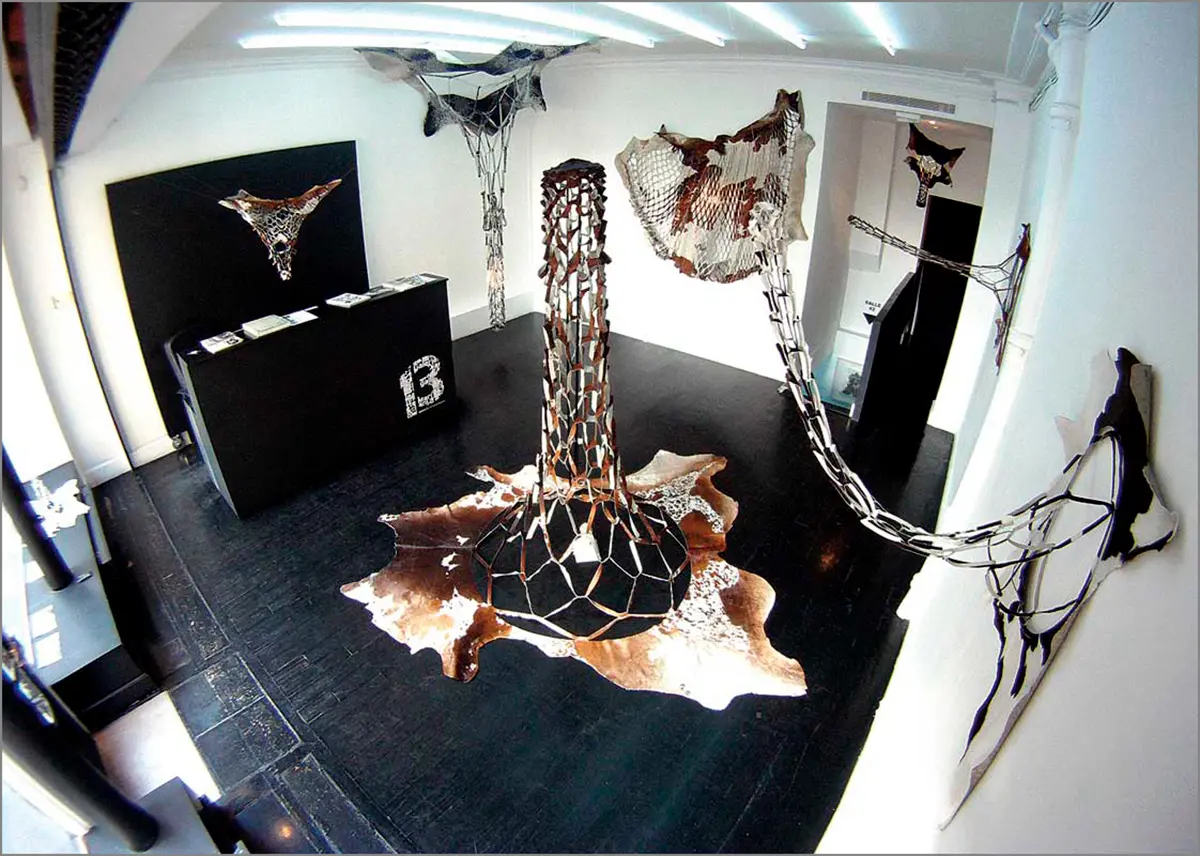
In the stand of the Galerie 13 Jeannette Mariani of the contemporary drawing fair Drawing Now Paris at the Carrousel du Louvre, Milton Becerra created a true installation entitled Copiar-Cortar-Coser (To Copy, to Cut, to Sew). The installation was on display from March 25 through March 28 of 2011.
The graphite drawings on Canson paper take the shape of malleable “windows” that contrast the passive receptacle of the Renaissance canvas. Every fold, square, and cutout form sometimes joint with knots—Gordian knots—create a meticulously elaborated group. The apparent simplicity of the forms, inspired in pre-Columbian motifs that have been redimensioned—some life-size renditions of human figures—hide an enigma, as they accentuate the search for a new proportion that opposes the classical Western version.
During the end of 1977 and the beginning of 1978, Milton Becerra began to work with stones he found in the natural world. Some of these even had traces that were retraced and recreated by the artist during the process of appropriation. Five hundred years of history are turned around like an unfolding terrestrial mantle.
Another transformation is also produced in Becerra’s work through a technical approach that confers new materiality to graphite. It results in the possibility of expressing the flesh-metal and the transfiguration of the paper as an integral part of the resulting re-transcribed human figure, in order to revive or re-visit the forgotten social body as it undergoes progressive transformations: the “others” in the general sense, and the primal, in a particular sense.
According to Milton Becerra, “The archeological characteristics of the works abundantly convey an understanding of mathematics through the geometrical elements (God is a number) in them. It is possible to observe developments that implicate us in situations generated through the creative process. Many examples come to mind: according to the Wayúu people, Wale´keru taught them the art of the structure—kanas—and the structure of the weave renders forms that represent the elements in the world.”
ALE’YA, Design Géométrique sur Meaux is the most recent solo show by Becerra at the Galerie 13 Jeannette Mariani in Paris. The exhibition remained open to the public from March 26 to May 15 of 2011.
ALE’YA means “book of the beginning of the written truths.”
Becerra searches for the glint of gold in the stone and, with a multiplicity of tones, attempts to transform it into a star. It is a process that involves elements found in ancient and modern civilizations that are combined “to recreate a constant and alternative nature” that exists because of Milton Becerra’s vision.
SUSANA SULIC