
The axis on which Mónica Meira's exhibition Piedras turns is the creation of new works on which rocks and small figures are the big protagonists of the landscape. The show is a summary of the last five years in the artist's production and its main elements are rocks and the traditional topic of the landscape; the latter is taken as a reference, an abstract manner within a pictorial tradition, since, as Meira notes, she is interested in the fact that landscape is one of the most widely investigated and studied themes, with a highly representative place in the different periods of the history of art.
The show, curated by Ana María Lozano, comprises 23 works in different techniques, from charcoal-on-paper drawings to an acrylic-on-aluminum installation, with ink paintings on cardboard in between. Such materials have allowed the artist to create different textures, rocky, and watery. The show also includes large drawings of rocks on acetate, resembling engravings painted inversely to be visualized from the back, which is the shining side. Inscribed into these landscapes are small, at times indefinable human figures, which surprise the viewer with unexpected rocky landscapes of cliffs and bluffs that are at once in the past and the future, in a known or an imaginary place, and encompass social and ecological intimations.
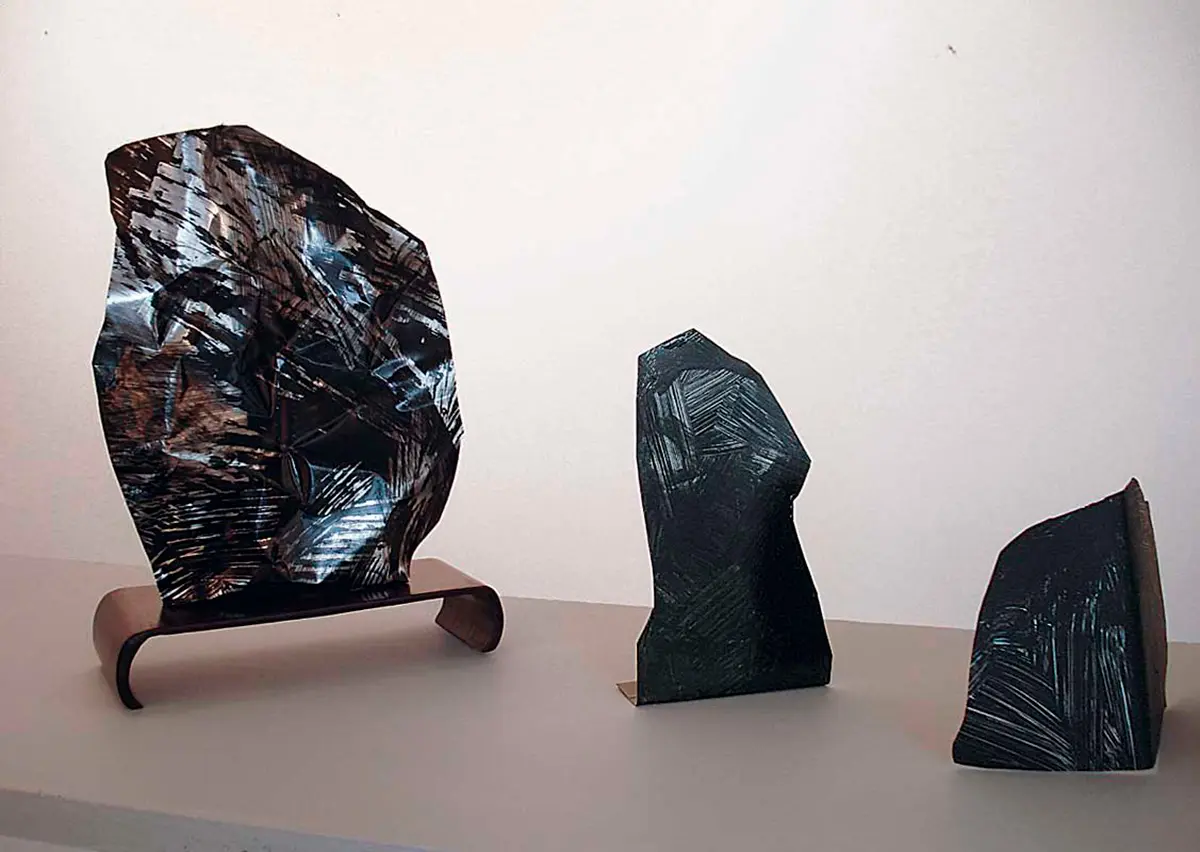
Some of these landscapes were two-dimensional in their origin and later became three-dimensional; painted, drawn upon, scratched, flattened, or handled like crumpled paper, aluminum becomes small-and medium-format sculptures and gives rise to an installation titled Caminito, which refers to the idea of a completely flat rock that is at the same time three-dimensional, as these figures are volumes that can be observed from three dimensions. With this installation, the artist develops the metaphor of personal existence in what she has called caminito: "it is the organization of my landscape, enclosing the idea of the path one creates in life."
In her effort to magnify and convert rocks into a large landscape, as a consequence of human intervention on nature, Meira notes that part of what her work reflects is, in fact, happening in her country, Colombia, now living through an entirely new winter experience with heavy rains and mudslides, something that interests the artist as her works then becomes a testament to what is occurring in reality.
These unexpected landscapes invite a reflection about humanity and the cosmos, captivate the viewer and make him or her feel like those travelers who contemplate a landscape from a distance or from above. The notions of solitude and isolation are common in Meira's work; the figures in her paintings seem engaged in tasks that are rather undefined but reflect those two ideas. Meira says that her works are like a metaphor for human existence; life itself struggles in these images that question humanity and its labors, its actions, and its place in the world.
The artist opens up for viewers the possibility of looking at it all from outside and at a larger scale, which can invite them to enter an environment rooted in the imagination that at the same time reminds them of places they already know. This generates a small tension as we attempt to decipher the conflict between Man and his environment, where Man gives meaning to those natural states and in that way produces an emotion. "That's what it is about, for each one of us to wander around the rocks and to find the cosmos and the Universe in each of them," Meira says.
DIANA MARCELA CÁRDENAS