
The Seven Wonders of the World is Pablo Cano's 12th annual marionette production and performance presented at the Museum of Contemporary Art, North Miami Beach (MOCA). Starting with the first presentation in 1997, the museum has annually commissioned Cano to make both a new set of marionettes and a stage performance. What began as a small affair in the project room has blossomed into the sophisticated occurrence that exists today. These elaborate presentations are a collaborative effort combining the talents of many skilled artists. Cano always makes the marionettes, and for this year's edition, comedian and playwright Carmen Pelaez wrote the script, with tap dancer and choreographer Katherine Kramer creating the choreography. This is not the first time they have worked together; Pelaez has lent her talents to this project twice in the past, while Kramer has participated seven times. Cano also worked with professional actors and dancers to manipulate the marionettes and to give them a voice.
The relationship between visual artists and stage productions is a long one. Many artists have done designs for theatre and ballet scenographic settings and costumes. Notable among these are Picasso's designs for the Russian ballet Parade in 1917, and Chagall's for Aleko in 1942. A less recognized figure in this tradition is Russian constructivist Alexandra Exter (1882-1949), known for her costume designs and for her marionettes. Cano's work has been influenced by her work ever since being exposed to it at an exhibition. In Cano's case, marionettes became the central subject of his work, devoting all his oeuvre to their design and construction. Other strong influences on his work are the Theatre of the Absurd, which emerges as a resource in almost every piece, and Dadaism, especially with regards to the treatment of the ludicrous and nonsensical as compelling creative elements.
Cano was born in Havana in 1961 and emigrated to the United States the following year. He holds an MFA from Queens College, New York, and his work can be found in museum collections such as the Museum of Contemporary Art, North Miami, Florida; Lowe Museum, University of Miami, Coral Gables, Florida and The Minneapolis Institute of Art, Minneapolis, Minnesota, just to name a few. It is also part of such prestigious private collections such as the Rubell Family Collection in Miami, and the Collection of Martin & Cricket Taplin, at the Sagamore Hotel, Miami Beach, Florida.
The Seven Wonders of the World is inspired by innovations that Cano refers to as "Wonders" and sees as turning points and shapers of contemporary life. It also has a political message since the main marionette, "Master of Ceremonies," is made in the likeness of, and named after, President Barack Obama.
The artist selected a number of revolutionary inventions and created individual marionettes, which he named after the rousing notion. We can divide them according to their affiliation, such as medical or technological. Among the medical pieces are The Madonna of DNA and The Clone Clowns, both referring to real groundbreaking advances in the field. The Madonna of DNA is one of the biggest and most impressive pieces in the ensemble. All white, and made up from dissimilar materials such as a discarded lampshade and a basket, it manages to create the notion of regalia, emblematic of such a symbol. Paradoxically, in this piece, Cano is mixing religion and technology by naming his marionette after unmistakable elements of each.
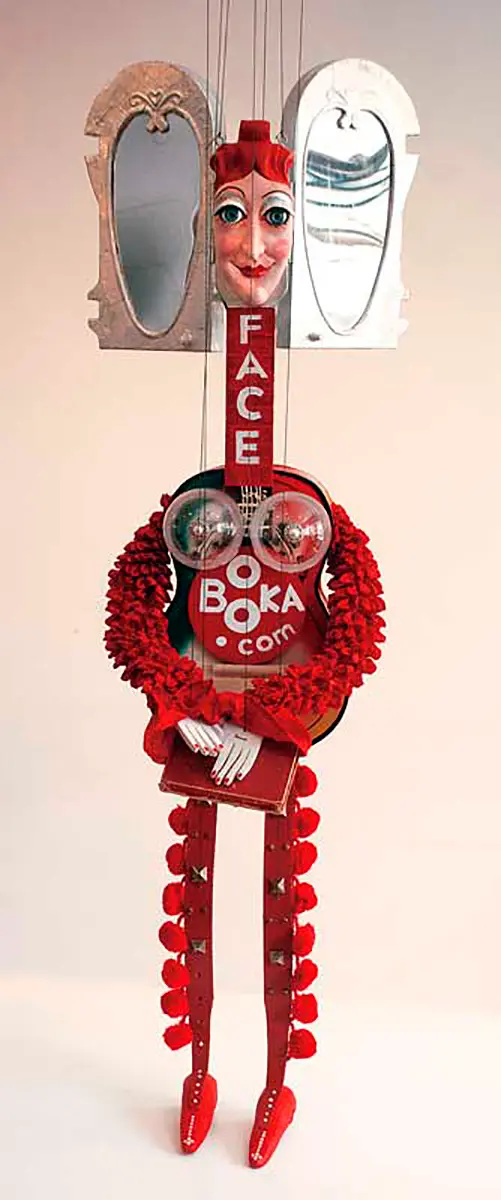
In the technological area he highlighted cellular phones, and, of course, the Internet. For this incredible invention he created three marionettes, the Internet Tappers, based on the most influential websites: Googleina, after Google; Face Booka, following Facebook, and Amazona for Amazon. The three tap dancers are showing similar sparkling red guitar-like 'bodies'. The Cell Phone Frog, aka Maurice Cellevalle is perhaps the most inventive. Cleverly made out of a real cellular phone, Cano masterfully created a convincing dancing frog.
The whimsical marionettes were on exhibition as individual pieces in between the four presentations. These pieces can be defined as mobile sculptures and can stand independently of their roles in performances. The primary difference between Cano and other artists who have made marionettes is that he has devoted his entire career to it, and also that he also gets directly involved in the stage presentation.
These pieces allow us to enter Cano's amazing world, a very personal universe that he has created, and see the world the way he sees it, through the eyes of an inquisitive child, without losing the fascination, surprise, and wonder. These pieces possess a fable-like quality that 'brings to life' otherwise inert objects that surround us daily. The telephones become frogs, the bobbin pins dancing 'people'. These enchanting characters are the result of Cano's astonishing imagination that makes them behave like human beings.
IRINA LEYVA