
Titled Recent Works, the exhibition is nothing less than an excellent example of an alter modern proposal by Tamayo. It consists of 15 pieces created with different techniques: there are portraits, video installations, two and three-dimensional works, as well as retouched photographs. The materials used vary from the most traditional ones-like acrylic, aluminum, tiny needles carefully painted and ordered-to even the use of sculpture on wood as a vehicle of video projections.
While there are no instructions or actual markings to guide the walk through the exhibition, the works are nonetheless suggestively arranged so viewers can guess a specific progression that leads to an understanding of the idea and language of each piece and its relationship to the others as a group.
Although sometimes they are blended to create shades of gray, most of the time the blacks and whites of the predominantly monochromatic works are applied in their purest form. Nonetheless, in some pieces like El Ratón (The Mouse)-a work that shows a bright red computer mouse-color is purposely used to complement the otherwise minimal palette observed throughout the exhibition.
The size between the works varies considerably, depending on the case. Portraits are almost always 100 ×100 cm (39.4 × 39.4 inches) or 100 × 80 (39.4 × 31.5 inches), with the exception of the much larger work El Niño de Vallecas (The Boy from Vallecas).
The rest of the works are also manageable. In other words, they are works that can easily be part of a private or personal collection and can also belong in the collections of cultural institutions, museums, or galleries.
Especially noteworthy is the painstakingly developed and researched connecting thread of the exhibition. The public does not appear to mind that the portraits of important historical personalities and everyday people coexist with completely geometrical or abstract pieces. It is precisely there where one can find the value of a well-structured and researched work; one with a serious aesthetic proposal that becomes the foundation of the work and passes the test of time without leaving anything to chance.
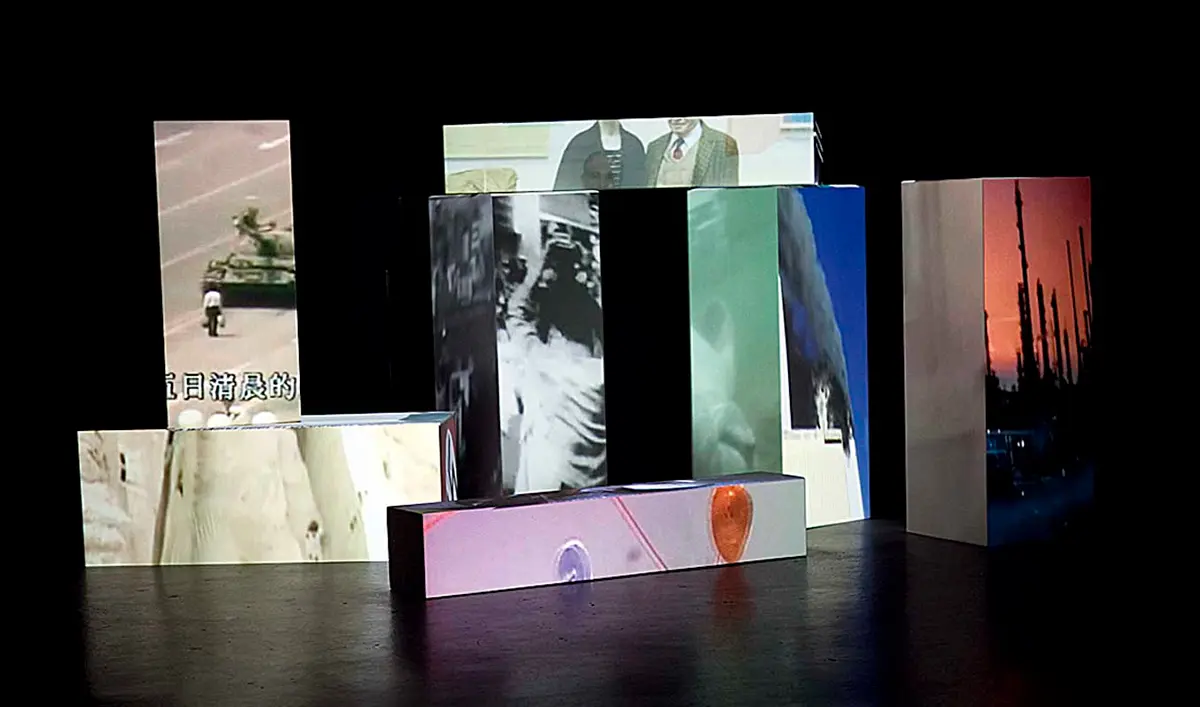
The backbone of the exhibition consists of three installations that constitute a symbiosis of sculptures with primary geometrical shapes, on which videos are repeatedly projected.
In the first installation, Tamayo takes spectators to the genesis of his most recent work. He explains concepts with concepts: on wooden cubes painted white, the artist projects definitions of these three recurring elements of his work; namely, cube, wood, and white. So he refers to the work itself and success in ensuring that the text refers to the piece and vice versa.
The second installation establishes a direct dialogue with viewers. They are guided by the hand to participate in a simple and yet ludic cognitive experience centered on the origin and foundation of the work; through the use, once again, of geometrical forms with juxtaposing rhombus, rectangle, and square templates -mobile and bicolor-in which blacks and whites are predominant.
The third installation titled Héroes y Villanos (Heroes and Villains) is perhaps the last opportunity the artist offers spectators, not solely to grasp the complexity and genesis of the work, but also of the entire exhibition. To do so, Tamayo uses color videos-as these are actual films of events connected to the characters portrayed in part of the exhibition.
The piece titled Instalación sin Título Número 2 (Untitled Installation Number 2), created with lacquered and cut MDF, is a piece that unifies the various video installations as well as the rest of the works in the exhibition since it contains the interactive and ludic nature that Tamayo tries to convey to the viewers throughout the show. The work consists of a series of geometrical forms that can be assembled and read in an infinite number of ways. Its design allows the piece to be reinvented time and time again, according to the wishes of the person that interacts with it.
The rest of the works included in the exhibition, such as the Modigliani portraits, Bombero (Fireman), or El Niño de Vallecas (Boy from Vallecas), as well as the two and three-dimensional geometrical pieces, complement each other. While each can exist without the other, they cannot convey on their own the complete concept of the exhibition.
Pablo Tamayo offers a concept but goes beyond just limiting his work to reveal ideas. He wants viewers to arrive at the prima natura of things. As the skilled conceptual artist that he is, he efficiently and beautifully develops his concepts, and therein lies the modern nature of his work. However, Tamayo does not forget the classics and knows that spectators cannot be left to their own devices to solve loose ends or doubts that the artist had neglected to address and thus cannot be resolved.
MARIANA SILVA