
For eight days in June New Yorkers could opt to undergo a range of therapeutic treatments conceived by Pedro Reyes. Housed in the storefront of a shuttered hardware store in downtown Brooklyn, Reyes' Sanatorium was the first in a series of street-level projects commissioned by the Guggenheim Museum. A pop-up stress clinic, with Sanatorium Reyes continued to pursue his rich social practice, using art contexts to stage exchanges among people and objects that disrupt habitual modes of perception by relocating them in the senses.
Sanatorium began with an intake interview. An attentive woman in a lab coat and nurse's bonnet prescribed treatments after assessing visitors' stress. Tongue and cheek flourishes like the bonnet and a glowing "red cross" sign transformed the space into a clinic and reminded you that you are participating in an art project. The twenty-person staff, which included the artist, wore lab coats. The walls of the large room were either covered in the hardware store's existing horizontal, white slats or a fresh coat of light blue paint. Well-designed signage, round face clocks, and neatly kept therapy stations conveyed the feeling that you are entering a space that, although improvisational, is professional and ordered.
The formal beauty of the objects at the therapy stations added to a sense of visual order. (There were fifteen stations on the main floor and one in the basement.) Oversized die, for instance, at the Philosophical Casino station were frankly beautiful complex polyhedra. Soothing sounds also filled the converted storefront. Hushed conversations, the clear ring of hammer-for imprinting cards with letterpress-and a bell marking twenty-minute intervals added a sense of organized ritual.
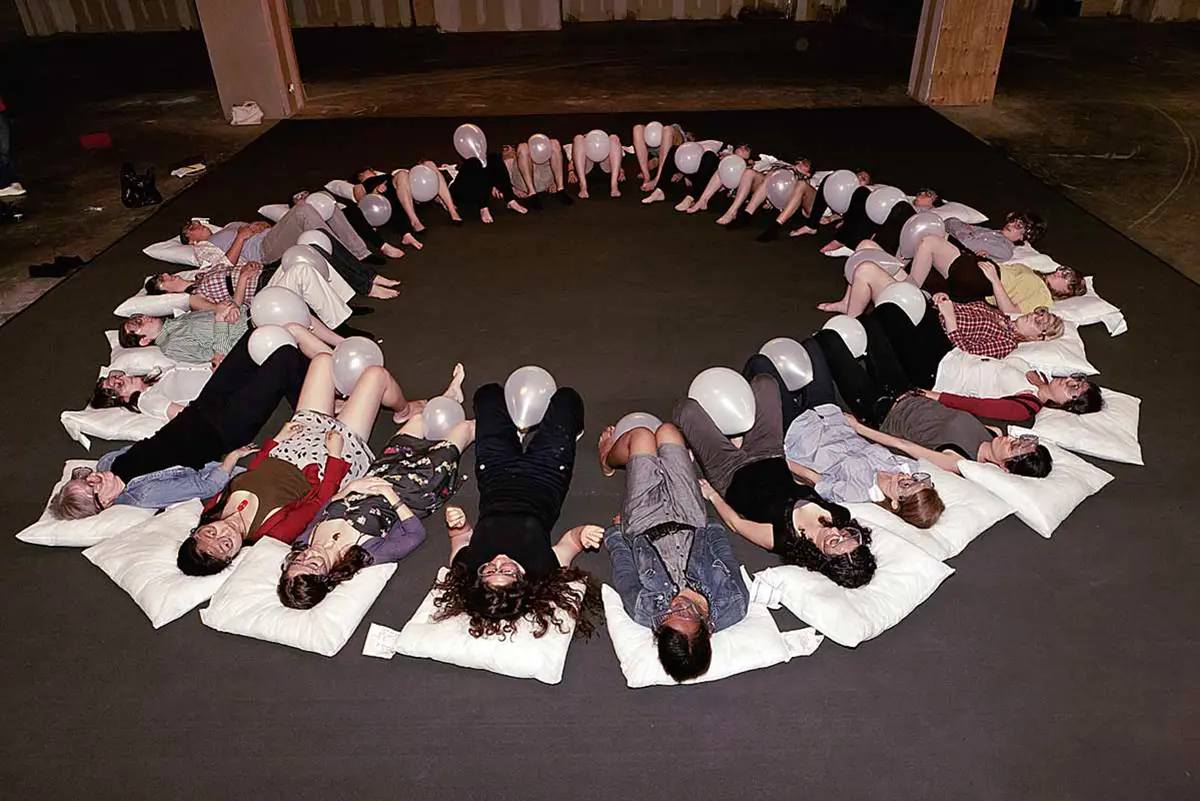
On my first visit, seeking relief from work-induced anxiety, I was prescribed Anagrams, Acronyms, and Aliases, where I rearranged the letters of my name with Scrabble tiles; Philosophical Casino, where I posed questions to oversized die inscribed with quotes by Plato, Schopenhauer, and others; and The Tuning Effect, in which the therapist Mel. S. Kimura-Bucholtz led a group of about fifteen of us through mediation exercises for observing our bodies in order to recalibrate our senses. On my second visit, for romantic conflict the intake counselor sent me to Cityleaks, where I anonymously exchanged my own secret with that of a previous visitor; Compatibility Test for Couples, where staff helped me choose fruits to represent me and my mate, and then blend and drink them; and Epitaph, where I wrote the words I'd like to be remembered by after death.
Reyes' treatments no doubt helped me and other participants work out the mundane problems that fill an individual life. What was most remarkable about Sanatorium, though, is that the artist gathered together a community of anonymous bystanders as the context for doing this. After asking the die our questions at Philosophical Casino, we posted them on the wall. Displayed for others to read, even the most straightforward questions could be quite heart wrenching. "Should I leave New York?" and "Should I quit my job?" were asked often. But, "Should I ask my girlfriend to marry me?" or "Will love and/or work bring happiness?" articulated the doubt and longing that plagues the pursuit of a meaningful life.
Both because of the immense variety of treatments offered and because visitors came to the project seeking therapy for an infinite number of problems, no experience of Sanatorium was the same. In one way or another, however, all the exercises led participants through an experience that involved using objects-conceived in the broadest sense to include language, food, knowledge, architecture, iconography, numbers, etc.-in ways that ran counter to how they are usually used in our exchange economy. Instead of utilizing objects as transactional goods, we are asked to form a community, albeit temporary, of transgressors seeking aesthetic values in these objects.
That attuning ourselves to the aesthetic experience of objects could have regenerative effects relates to the Kantian belief that the benefit of aesthetic experience is that it locates knowledge in the senses, beyond cognition. Reyes' therapies bring to mind methods developed by Lygia Clark in the late 1970s and early '80s when she abandoned art to exclusively practice psychotherapy. Reyes, on the contrary, proposes that this abandonment of art is not necessary. Instead, he attests to the persistent benefits of aesthetic experience as revealing a glimpse of the embodied mind, an instance where affect can be experienced outside of our culture of consumption. What is so wonderful about the Santatorium's therapies, after all, is that they are all decidedly low-tech and, as a result, make visible the cognitive-psychic processes that can be triggered through the process of interacting with tangible, sensible things.
HARPER MONTGOMERY