
Roberto Fabelo’s exhibition at Panama’s Museum of Contemporary Art is impressive because it is full of monstrous characters and semi-human creatures in strange situations. There are huge pots in which human beings are simmering, men who are becoming insects, and voluptuous women riding giant roosters. Nevertheless, the initial feeling is not one of horror, but rather a sense of wonder regarding these images from a strange world and, above all, about this artist’s extraordinary draughtsmanship.
Fabelo is a true master of disegno, the term used in the Italian Renaissance to describe the gift that some artists have to combine the ability to draw with the intellectual capacity to invent an image. His skill with the artistic line is impressive in all the different techniques and supports he employs, including ink on paper, crayon on cardboard, or acrylic on silk. Even his paintings are actually drawings because, instead of using brushes, he usually draws with oil sticks that allow him to create his figures by moving the stick over the canvas or, as in many cases in this show, over a length of stretched vinyl.
Fabelo’s lines are restless, agitated, repetitive. His style is one of almost physical expressionism in which we can intuit the movements of his hand or the way in which his lines, parallel, curved, or cross-hatched, slowly build up the volumes. Years of practice with chiaroscuro allow him to produce characters of convincing three-dimensionality. Sometimes, Fabelo creates shapes starting out with a black surface, in the manner of a printmaker creating a mezzotint, in which he scratches and polishes the plate in order to create the lighter areas. The painting titled Grand Egg, for example, was drawn with white oil sticks on black vinyl, in such a way that the egg seems to emerge from a very dark place. Inside its broken shell, we see a crowd of animals, as if in a dark and ovoid Noah’s Ark. In other words,
Fabelo sometimes creates portraits on round black backgrounds, like tondos, or he uses light creamy vinyl, the color of old parchment, on which he draws with sepia tones, creating the feeling of an old master drawing.
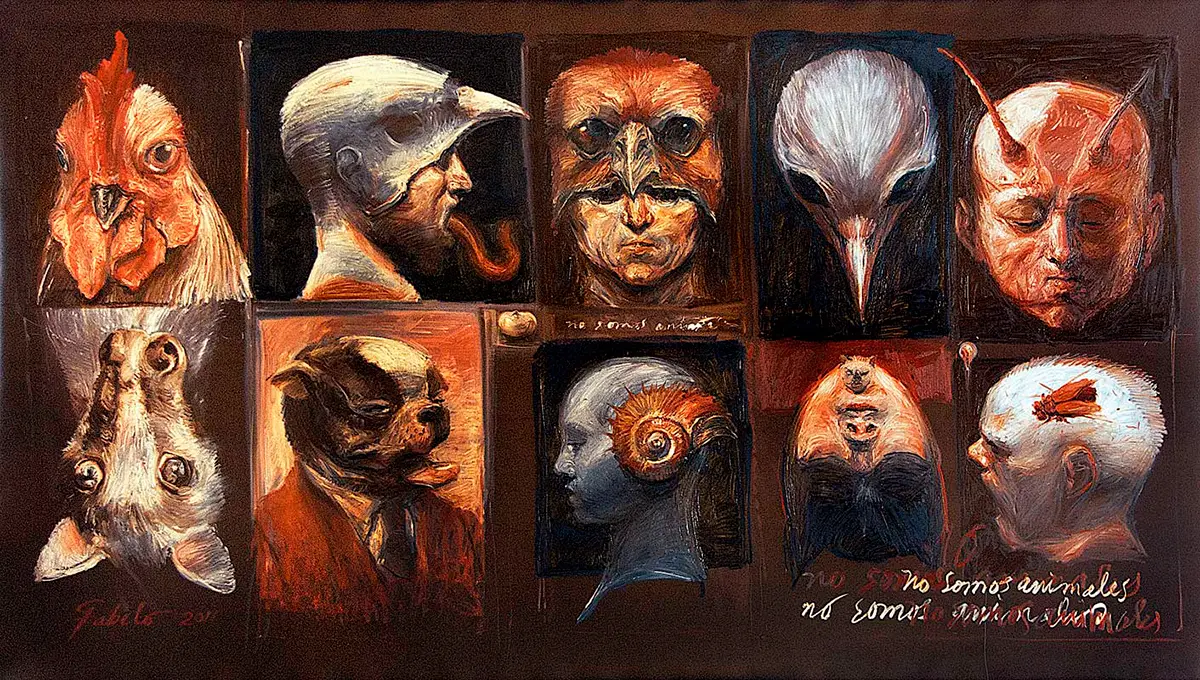
In his paintings from the series: We are not Animals, he paints a group of heads that mix human and animal features, as in a sampler of exotic typologies. These “men” have pointy ears, horns protruding from their foreheads, canine heads on top of their own, or insect-like antennas. Fabelo depicts grotesque men, usually painting only their heads, onto which he incorporates surrealistic features. On one of those heads we see a congregation of rhinos that initially resembles a plague of beetles; on another, large flies. Often, the people in his paintings bear helmets in the shape of a nautilus shell or the head of a bird.
Fabelo’s women are treated in a dramatically different way than men. They appear full-bodied, with wings tied to their backs like angels, with fishtails like mermaids, or like amazon warriors riding huge cocks with splendid plumage. In the case of The Garden of your Dreams, the voluptuous woman-jockey astride a beautiful rooster wears a helmet with a long, pointy bird’s beak, a harness on her shoulders to hold up her wings, and red high-heeled shoes. At the height of her hip and her knee, two screws reveal that she is actually a doll-woman with hinges at the joints, like the product of some nightmare. Finally, a neutral-colored background with a repetitive pattern of nipples completes this sexually-charged image, which would provide an interesting adventure for a Freudian analyst. We get a similar feeling from the painting titled Naturaleza casi viva, casi muerta, an oil on canvas that gives the exhibition its name. In this painting, a mass of mermaids with naked breasts, some of whom wear shell-shaped helmets, toss and turn in the crowded space of what looks like a brimming casserole of steaming seafood. The artist delights in painting the exaggerated, almost caricature-like sensuality of the women’s details: fleshy breasts, rounded bellies, and rosy buttocks. Next to the casserole, in the foreground, we see a large fork which leaves no doubt regarding what the future holds for these women.
In other paintings of cooking pots with titles such as Calentamiento (Warming), Fabelo stages his version of the global ecological drama, in which the liquid, which is probably hot and surely dangerous, is spilling over the edge towards us. In some of these paintings, there is only the threat of overflowing, but in others, we see the heads of recognizable animals floating in the liquid mass: a hippopotamus, a rhinoceros, a man. Fabelo is concerned with the planet’s environmental issues and the relationship between men and animals, subjects about which he makes important statements. Nevertheless, what stays on our minds are his paintings about themes related to essential human issues such as existentialism, sexuality, and the balance between what we dream and what we believe is real.
MÓNICA E. KUPFER