
The first solo exhibition by Cuban artist Santiago Rodríguez-Olazábal at PanAmerican Art Project Gallery in Miami was interpreted by some as a reunion of sorts, while others saw it as a new approach to Afro-Cuban religion. Held in the main hall of the gallery, the exhibition was accompanied by the works of two other artists: Cuban Manuel Mendive, and Jamaican David Boxter, who presented their pieces in two adjacent and smaller exhibition rooms. These allowed viewers to evaluate the different connotations and forms of confronting and interpreting Afro-Caribbean culture, specifically form a religious point of view. The response to works that center on this theme has always been complex and neophyte spectators, for the most part, tend to approach an exhibition like this with caution.
Rodríguez Olazábal presents his work from the perspective of the person who creates it, assimilates it, and then delivers it after an arduous artistic process. From an early age and as part of an inherited tradition, this artist is initiated in santería or Regla de Osha, an exclusively Cuban religion that resulted from the process of transculturation. During his studies in the Academia de San Alejandro, Rodríguez-Olazábal found that this familiar religious world was the best source of inspiration and creativity for him. From that moment on, he decided not to merely narrate a religious ceremony or literally describe an event, and instead, he opted to fragment, to choose an experience, and use it in the elaboration of artistic discourse. His gaze is that of an observer who assimilates an event, interprets it, and reconfigures it as a personal and social experience.
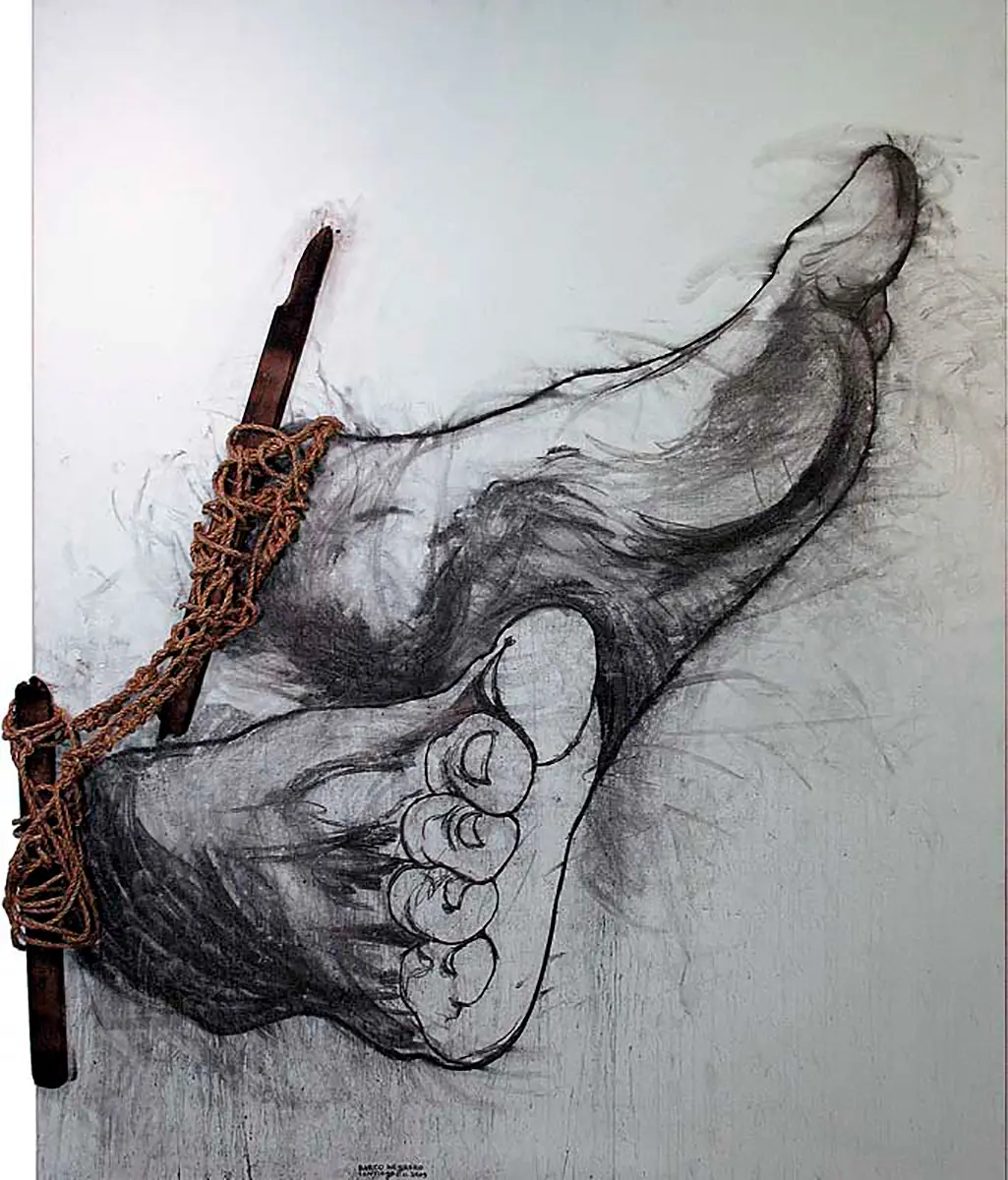
Consisting of more than 15 pieces created between 2009 and 2011, the exhibition succeeds in communicating Rodríguez-Olazábal's philosophy. Through his "strong" charcoal rendered figures of men and children, white and black, old and young, orishas or otherwise, this artist conveys the wide-ranging collection of characters that are part of the rich world that shaped the history of Cuba and the Caribbean. Barco Negrero (Slave Ship), for instance, represents the entrance of a whole "world" into the birth of a new culture. Only choosing to show the details of tied feet, the artist leaves us to imagine the rest of this great body that symbolizes hundreds of thousands of enslaved people who came into the New Continent with much to offer.
Afro-Cuban religions - especially santería- often contingent expressions in which help and salvation are asked for at the very last moment; where the faithful, although always respectful, maintain an informal relationship with the deity. Religion is enriched through the experience of those who practice it -and vice versa- and it becomes an evolving construct that adapts to the situation of its followers. Because of these premises, it becomes easier to interpret works that address universal and familiar themes that are part of the human experience and its history. Aside from being a beautiful work, Cada Cual con su Carga (To Each its Own Load) describes an old man holding a black umbrella that has a jute bag hanging from it. Placed in the center of landscape composition, the first impression the work gives is one of mystery. Nonetheless, few things are as true as the burden we carry with us until the end of our lives along with everything else that makes us somber; it is nothing more than the weight that we have experienced so far; but it is also something else we aspired to: to have a long life-and what this implies, namely that the load becomes even heavier.
Other works, like Eyebale (Blood), directly address the subject of religion. It is a heartbreaking piece that depicts an abundant stream of blood that gushes from the tied hands of a man. The extraordinary power of this image is strengthened by the charcoal used to render it, as it does not allow viewers to distinguish details from the figure. The subject becomes a barely silhouetted human mass.
One aspect that characterizes Rodríguez-Olazábal's work is an element that he has been using for a long time: the written word. It strengthens the concept of the image, supports it, and enables us to pull the connecting thread to begin disentangling the hank. This artist has developed an energetic and powerful work, for which he creates drawings made with charcoal, in order to accentuate the powerful faces and figures. Rodríguez-Olazábal incorporates rustic elements like ropes, rags, and wood to construct installation works. His works clearly constitute one of the most authentic examples of Cuban art from the last decade; it is honest work that successfully brings us closer to intrinsic themes from everyday life and Cuban culture.
MARISOL MARTELL