Arlés Del Rio’s exhibition includes a dozen paintings on canvas and five three-dimensional works that tell stories related to the environment in which this young Cuban has lived and developed, in what is his first show outside of the island. Although the exhibition brochure describes him as self-taught, Arlés Del Río’s work is surprising in terms of the artist’s ability to use a variety of artistic media, including charcoal, oils, and acrylics; and, in the case of his sculptures, plaster, copper, steel and objects trouvés. It is a body of work that combines an understanding of conceptual art with an authentic, even candid, way of expressing a personal message.
Several of his paintings focus on images of children, such as those that play in the street of popular urban neighborhoods. In two works titled simply From the Haiti Series, we see several shirtless boys, painted in a realistic manner, albeit only in shades of black and white that emphasize the incorporation of photography into the pictorial process. In one image, several boys hold their arms up to carry a large red box with the Coca-Cola logo on its side, which contrasts with the lack of color in the human figures. In the other painting, a solitary boy balances on his head, which is covered with a piece of cloth (where he could balance a container of fruit, for example) a large globe, in which the green landmass of the Americas appears surrounded by oceans and covered by white bits of atmosphere, as it would look from outer space. Although they carry heavyweights, these boys do so without pain, as if neither a case of sodas nor the world, were heavy. In another composition, a boy extends his arm towards the foreground to show us a cell phone in which the SONY brand has been altered into TONY, presumably the name of its proud owner.
The relationship between human beings and commercial brands is present in other works titled From the Series After Reality. There is a naked and muscular three-dimensional male torso in white plaster which, in the place where his head should be, has a (real) can of Pinocho Soda Crackers. It is a product that all Cubans recognize, with its colorful red and white tin container with the image of the children’s character Pinocchio, whose face is reproduced as part of a graphic design that dates from the sixties, if not earlier. It isn’t clear whether this man is hiding his face inside the large can, or whether his head has symbolically become one of those molded tin cubes as a consequence of too many years subjected to a diet of limited variety and reduced opportunities. Just as the works with the Sony cell phone or the case of Coca Cola make reference to foreign brands, in this sculpture (and in the painting that echoes it, of three torsos with Pinocho-can heads), the emphasis is on how consumer products occupy an important position not just in how we feed ourselves, but also in our visual world.
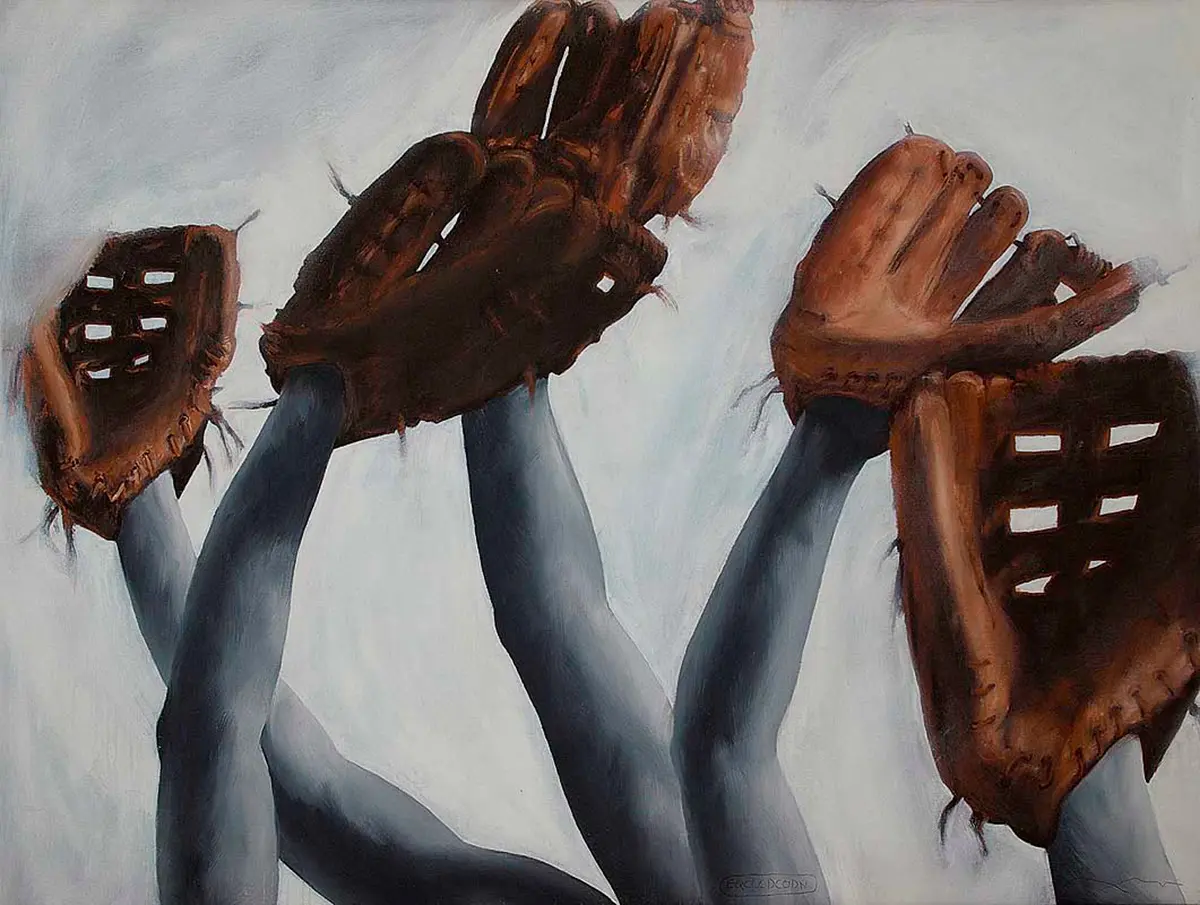
Another series titled Waiting for Things to Fall from the Sky, or Our National Sport is represented in this exhibition by two works. In a painting on canvas, five catchers’ arms (whose bodies we don’t see) stretch upwards towards heaven. The arms are painted in black and white, but the baseball gloves on their hands are painted in color. The gloves are empty and held open as if waiting to catch something. In the sculpture, there is only one arm with a leather glove on its hand, but in this case, it is the arm of a skeleton made of copper that stretches upwards from a small marble base. It seems clear that this is a commentary on life in Cuba, where baseball is a national sport and a symbol of pride, and where those who wait for things to fall from heaven probably starve to death.
The painting that gives the exhibition its title, Xlibrio (roughly translated, “Xlibrium”, a play on the word “Equilibrium”), shows two young male figures wearing sports clothing, whose bodies stretch across each other to form an “X”, over a horizontal canvas that is half-white and half-black. The two young men, who are identical, seem to be doing push-ups, balancing their hands and feet precisely on colorful Pinocho Soda Cracker cans. The artist presents a metaphor about equilibrium, on many levels. Artistically, there is a balance of volumes; a contrast between color and its absence; and between black and white. In reference to the figures, these young men are performing an exercise in equilibrium that helps to strengthen their muscles but is otherwise rather unproductive. All these elements come together with a sense of irony in a metaphor about life as a constant search for balance through great efforts that, sometimes, turn out to be useless.
MÓNICA E. KUPFER