
An influential painter and printmaker in the Oaxaca region, Mexican artist Demián Flores (1971) exhibits for the first time in Paris. Under the direction of Christine Frérot, the show’s curator, Flores presents fifteen works on a variety of technical supports, with many multiples (digital prints). A reflection on the permanence of the collective historical imaginary in Mexico’s contemporary reality, the exhibition was able to resist the current political pressures between France and Mexico and impose itself despite the cancellation of the Year of Mexico in France.
The title of the exhibition, Dévorations, gains full meaning in light of the serial collages created by the artist. These surprising collages mix mythological images of ancient Mexican codices with the outline of a modern character… taken from a first-aid manual. From this synthesis comes a "cultural palimpsest" or, to put it in a simpler way, the meeting or confrontation of epochs, identities, and customs that feed on and devour each other. An iconographic melting pot just like Mexico itself, a mestizo nation built on the basis of ancestral generations of indigenous ethnicities.
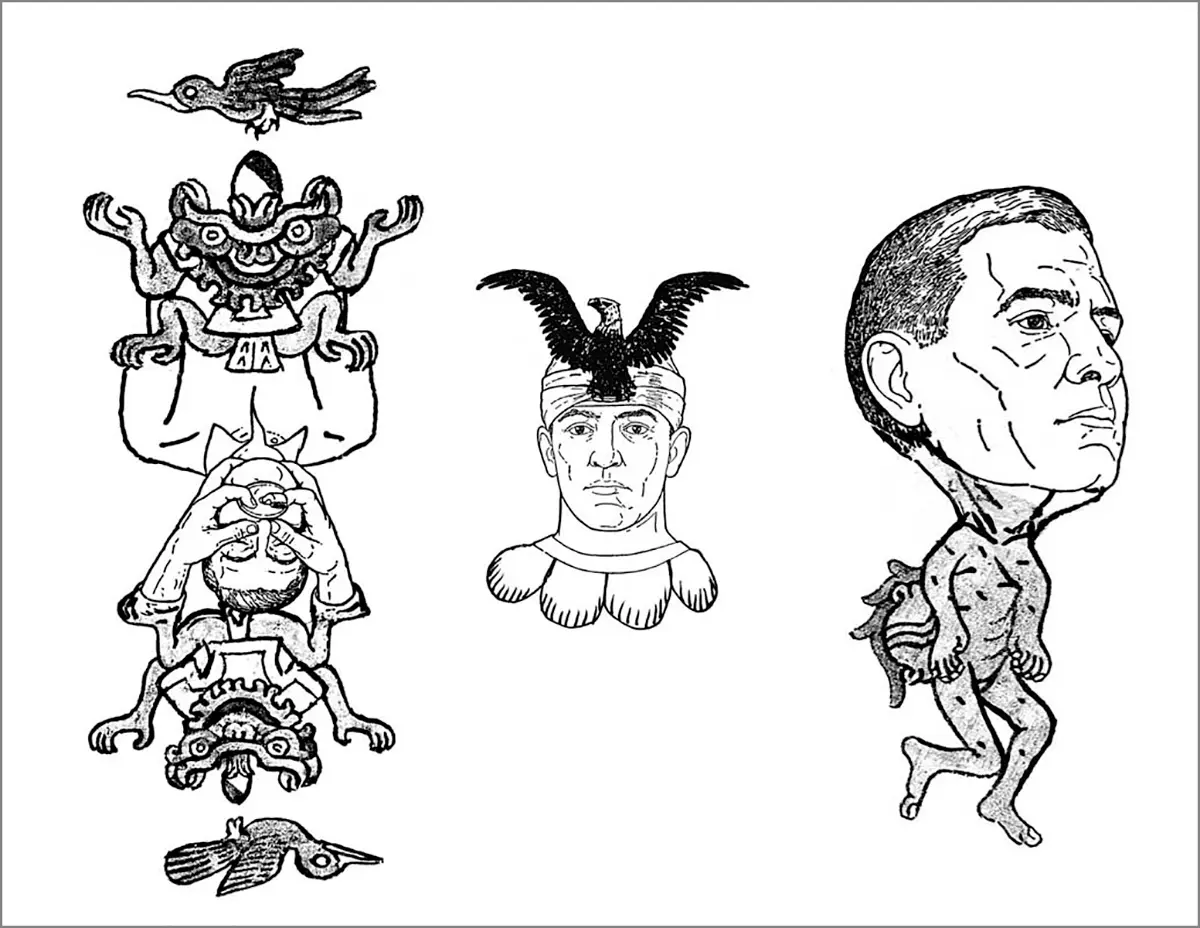
In front of the collages, we see golden weapons, symbols of powers, and violence that the artist presents as precious relics. They evoke a fatherland wounded by poverty, exploitation, and inequalities. Art appears as the “sole salvation,” as the Mexican writer and politician José Vasconcelos, who died in 1959, said. In a large canvas from the series La Patria, the artist revisits a similarly titled painting by Jorge González Camarena, dating from 1962: like his predecessor, Demián Flores finds inspiration in The Liberty Leading the People, a hymn to the Republic and to national identity signed by Delacroix. The canvas represents Juan Escutia’s heroic exploits: fleeing the American invasion in 1847, this Mexican youth threw himself from the heights of the Chapultepec castle, wrapped in the national flag, thus sacrificing his own life to safeguard the country’s symbol.
Finally, in the same gallery space, two large lithographs go back to the iconographic matrix of La Patria and the inspiration of the ancient codices, images whose continuous reappearance the artist often highlights in his work. Passionate about printmaking (his original education), Demián Flores updates the practice through touches of color applied in stencil (a technique used often in Street Art). Mixing with precision the tools of traditional and contemporary instruments, Flores’ works are in a permanent dialog from the past to the present.
Collage, painting, print-making: the Oaxaca artist carries more than one support in his bag, and this without having mentioned his embroidered textiles and his work in video (i). Projected in the gallery’s basement, a video is projected showing a wrestling match between two fighters who are…identical. Juxtaposing victory and defeat, this video proposes a reflection about sports as a medium for the construction of a (dual) identity. In the next room, we find the wrestler’s outfit imagined by the artist. Set apart, a textile embroidered by an indigenous woman from Flores’ native region (Juchitán) displays the Mexican National Seal: the eagle emerging from a sacred cactus, carrying a snake in its beak. Connected to the legendary foundation of Mexico City, this Aztec emblem symbolizes the fundamental opposition and union of sky and earth. “My art expresses a desire for cultural recognition,” Flores says. His hybrid and symbolic creations make it indeed difficult to deny the richness of Mexican cultures. “I see mestizaje as a contemporary metaphor,” the artist notes. At the age of 40, he proudly claims the plurality of his origins. His nickname, “Juchilango”, is a combination of Juchitán (his native town, to the southeast of Oaxaca) and the term chilango, which designates the inhabitants of Mexico City.
Very involved in community life, Demián Flores had the initiative of creating several cultural sites in his region. In 2006, he opened the Centro Cultural de la Curtiduría with the purpose of promoting the creation, edition, artistic dialog, and the organization of exhibitions. His dynamism is inexhaustible: driven by him, a multi-disciplinary space for urban art will soon open in Xochimilco, a peripheral area of Mexico City.
MARION KLING