
For his first solo exhibition at the Museo de Arte Moderno in Medellín, Elías Heim has chosen five works that convey his thematic obsessions: the museum space as a questionable container, hybridization as a debatable argument, mechanic mediums as transformative and questioning agents. Likewise, Heim proposes projects that are events insofar as they take place in time; that regard time and space as sources of meaning; preoccupations for technical and finishing processes that are brought to bear in order to complete the idea that animates each project.
Arranged in chronological order the proposals are as follow: Híbrida Flora Intermuseal (Hybrid Inter-Museum Flora, 1993) represents the only piece from the previous century; Women from the Rubble or Trümmerfrauen (2005), previously exhibited in Ibor (Spain), France, Cartagena of the Indies, and at the 41st Salon of National Artists; Flores Negras (Black Flowers, 2008), included in Heim's solo show titled Premonitory at the Museo de Arte Moderno La Tertulia in Cali; Secret Cabinet or Gehlmzimer (2009), shown to the public for the first time; and an interactive-habitable and designed for multiple uses and approaches-site-specific project for Medellin that alludes to the Vanitas.
Híbrida Flora Intermuseal is a piece that addresses exchange, conservation, physical life, as well as mechanical and active performance. It was his contribution to Drives, the exhibition I organized at La Tertulia and that also included works by artists like Alicia Barney, José Alejandro Restrepo, Doris Salcedo, Fernando Arias, and Miguel Ángel Rojas, among others. Three years later, Heim's piece represented Colombia during the Centennial Venice Biennale, after having first been exhibited at the 35th National Salon. The artist took air conditioner filters from the Museum Kunst Palast in Düsseldorf and relocated them inside La Tertulia, where it breathed in a new environment as it alluded to the large rainforest plants.
The title Trümmerfrauen was taken from a text by thinker Primo Levy. The eventual destruction of Heim's work during the exhibition alluded to the physical and moral violence that the Jewish writer experienced during World War II while held in a concentration camp. Heim was interested in taking back that idea and directly connected to the war, kidnappings, uprooting, and funerary events that take place in Colombian society.
Flores Negras originated in the observation of a small device called Maguen Eliahu, a metallic implement used to hold the penis of a boy who is about to be circumcised. It is a surgical, ritual, and a religious object-and if considered with suspicion, vaguely erotic as well. The Hebrew term literally means "shield of Elias." Elias is the prophet destined to return and, therefore, a symbol of hope. Circumcision represents the first consecration before God. It is a mutilation of the body, a violent action that involves blood and that can be interpreted as a sacrifice. Once the foreskin is removed it is then buried. It is in fact the first part of the body that dies to mark the beginning of life. It is perhaps a way of remembering from the beginning that life will eventually end. The device is usually made of silver and more recently of stainless steel. Some have decorative elements, but the essential design is intended to address the practical requirement for its use. When turned upside-down its outline reminds us of a flower. This resemblance has led to the variations and rhythms that constitute the mural. It is a great funeral garden, a populated forest that feeds from the ritual experience but never stops alluding to masculinity and femininity, fertility, and its required dose of eroticism.
Gehelmzimer or Secret Cabinet appears and disappears as it addresses buried historical memories. It sheds light on Nazi practices that took place in Barranquilla, Colombia, and that have come to the public's attention after the release of secret files from the KGB. It alludes to the visible and the invisible, to the positive and the negative. The work uses photography as appropriation, document, and resignification.
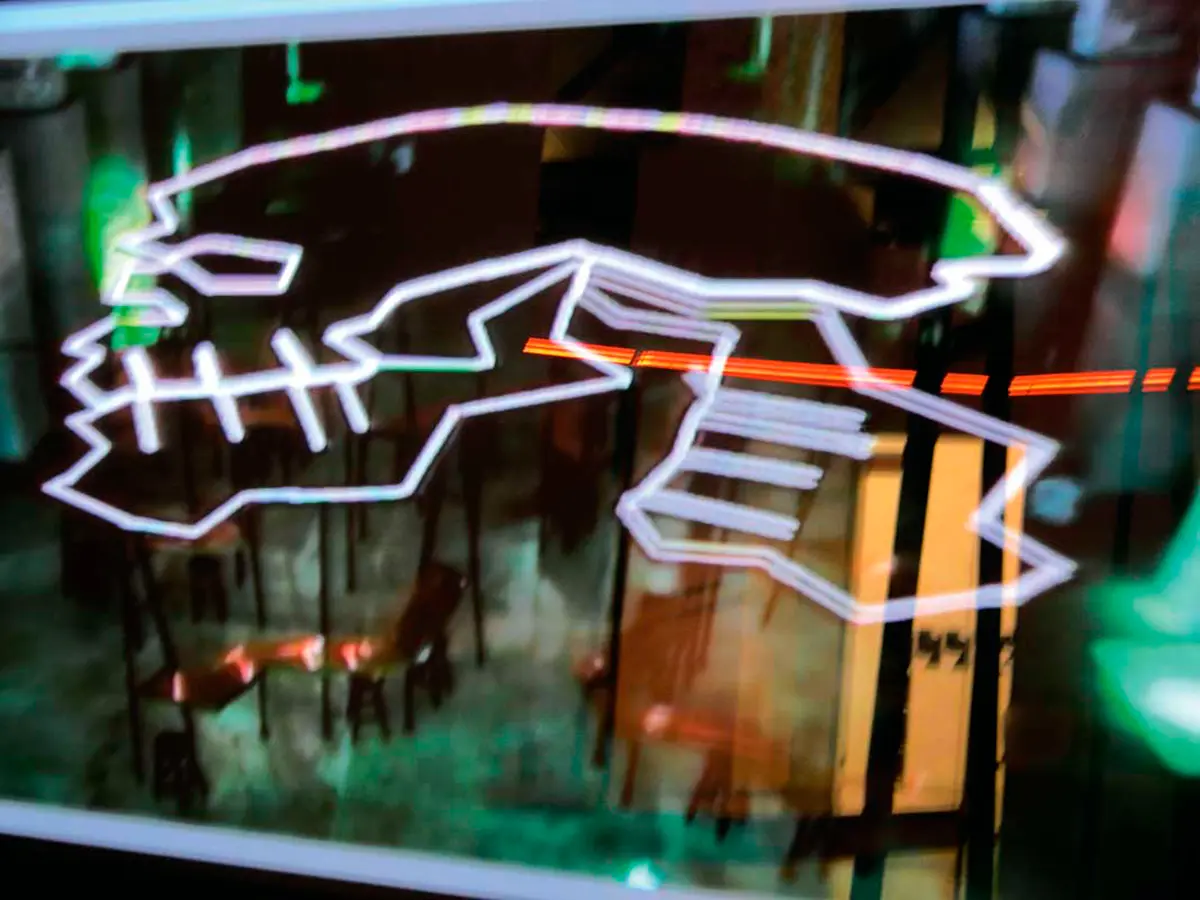
The large mobile neon skull with two jaws is also a great measurer of responses. It demands to be observed from above in order to appreciate the entirety of its design or to watch it on the television monitor. Violence, death, and devastation are combined with celebration and the unavoidable trivialization of tragedy. This work has its genesis in a piece titled La Maestra de Celán (The Master of Celan); a work that illustrates the famous phrase "Death is a master from Germany" by writer Paul Celan that fits the Colombian case perfectly. Part of the collection of the Museo de Arte Moderno in Bogota, La Maestra de Celán won the Biennial organized by that institution in1992. It consists of a copper pipe exposed to humidity from the atmosphere that outlines a skull capable of condensing the humidity from the environment and producing ice-which ironically turns the deathly image white. For the Medellin project, Heim turned the drawing into a neon piece whose luminosity expands. The double jaw is intermittently active and imitates the perpetual conversation with its unavoidably sarcastic smile.
MIGUEL GONZÁLEZ