
Graciela Sacco's gaze-she represented Argentina at the 2001 Venice Biennale-has always explored the interstice where personal space and the destiny of multitudes converge: each human being's ontological experience and a collective course traversed by socio-political frustrations.
Since 2007, starting with the M2 project, Sacco has focused on the perception and exploration of the space immediately around each human body, the space that determines its boundaries in relation with other bodies, the vital border between intimacy and the world. Sacco conjugates the notion of proxemia, or the measurement of the distance of interaction between people, with the notion of "admissible tension" (A.T.), which is "the load (weight) that a terrain on which we are planning to build something will bear. If that load is greater than admissible, any construction will inevitably collapse, sooner or later." She gazes at that "possession by right of a minimum of the planet's surface," that square meter each of us occupies, from the standpoint of a question about the limits of human endurance.
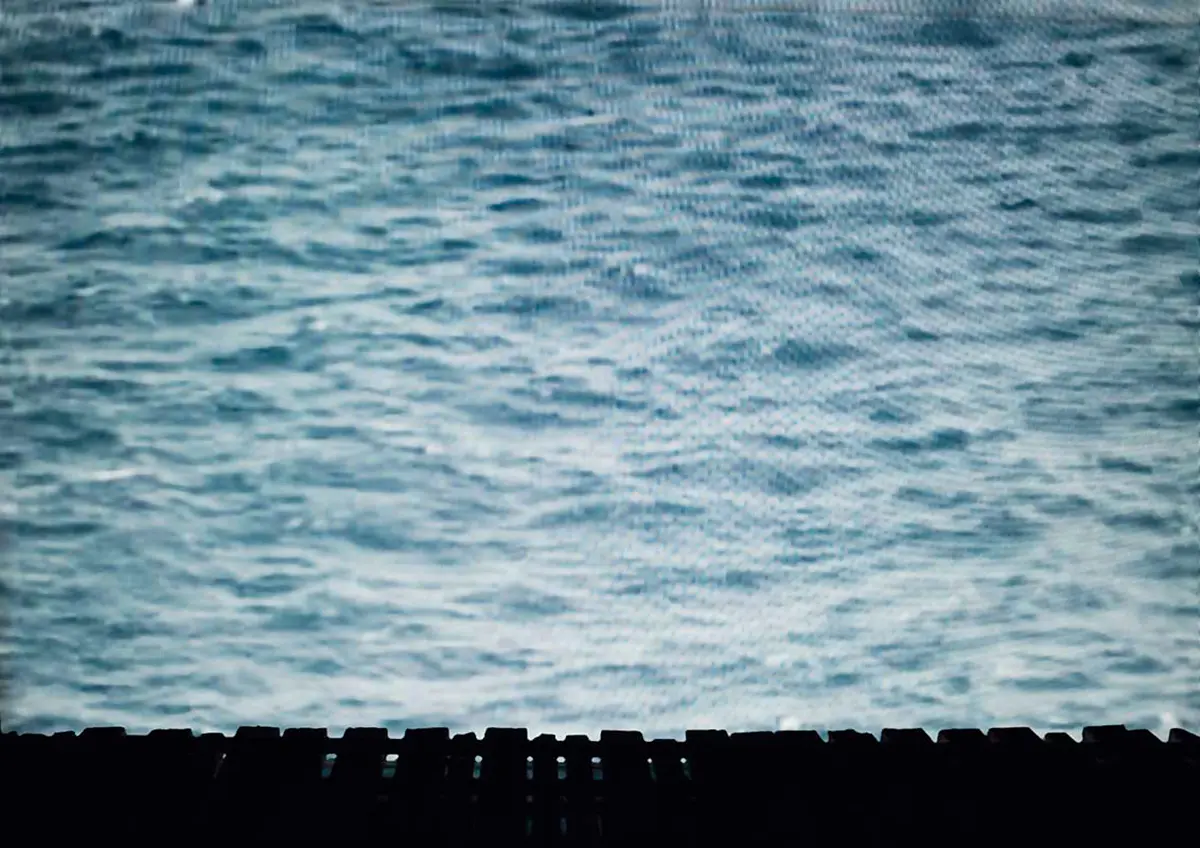
In her exhibition M2: T. A. (Metro Cuadrado: Tensión Admisible) at Diana Lowenstein Fine Art, Sacco explores the notion of maximum tension (the minimum of physical space for each existing body) through works and video installations that synthesize the way in which, throughout her career, she has captured psychological and social tensions by capturing or filming multitudes, bodies, faces, eyes, mouths, and projecting them on wood planks, PVC tubes, curtains, and a variety of objects from the vast architecture of culture, from tablespoons to structures referred to the notions of entering and exiting, such as windows or doors.
Sacco brings abrupt contents-displacement, segregation-to bear on images that are extracted from specific, violence-loaded contexts and rendered subtle to the point of quasi-abstraction in their formal resolution. In her installation Muro, she posits the violence of exclusion in the conceptual contrast between the half-open doors of a house's interior space-a dining room-in reference to the protective character of the domestic space, and the video projected into the interstice those very doors leave open, which a gap yawning towards an ambiguous, uncertain another side. The images seen by the viewer, taken from a film, are a recording of the new wall between Israel and the Palestinian territories.
In Sacco's work, the omnipresence of the eye forces us to look into dark areas of social reality. Thus, in Retrato I, a knife attacks the strip of eyes projected on the wall, which so often she has used to bring the viewer into a more intimate relationship with a stranger. And in Retrato II, a fork stuck on a stamp with the image of an open mouth speaks of the violence of hunger, evoking the now-legendary installation in which Sacco projected open, expectant mouths on the surfaces of spoons.
Sacco's vision of those maximum-tension situations reveals the element of absurd in the conflicts between human beings through resources such as the decontextualization and dramatization of gestures, exacerbated by her handling of time. In her video Esperando a los bárbaros, she projects, in black and white and in slow motion, the aggressiveness in the faces of soccer fanatics. In Enfrentados, she revisits her work about rising multitudes or masses divided into two enemy camps. The image worked in sepia tones, is frozen and projected onto a paper heliograph mounted on wood, and it brings to our gaze the memory of conflagrations where humanity appears ready to destroy a large portion of itself. Some of Sacco's works discard the presence of the human body and express in a metaphorical way, with images projected onto built objects, states of social combustibility. In Fuego, for instance, the image of the flames occupies the inside space of a moving fan.
There are no innocuous images in Sacco's work, images devoid of the charge of human history. Thus, the sea is not only the sea but a space contaminated by issues such as large-scale displacements. The video and installation of Cualquier salida puede ser un entierro contain images recorded in the sea of Finisterre, in Northern Spain, where the world was believed to end in ancient times and from where most Galician ships set sail towards the Americas after 1492. Many vessels sank in those dangerous, excitable waters dotted with sharp rock formations. At any rate, this sea has been crossed by multitudes throughout history, almost always in a northerly direction, in search of escapes that may very well end in death or that only extend the trail of the exclusion of those who seek space for a new life beyond their places of origin. Sacco's fencing-in of the ocean, with wood or PVC planks, signals the uncertainty of such a flight path.
The installation De la serie M2 infinito, ¿Cuánto es un metro cuadrado de destierro? presents, inside a cube made with acrylic and mirrors, a video recorded at Madrid's airport from a transparent platform that made it possible to capture the passage of itinerant multitudes. It also connects with the mass of expelled peoples-by violence and lack of opportunity, among other causes-that wander across the world searching for a place to resettle. This group of works-some of which are smaller versions of previous installations-transfers onto a minimal number of elements the maximum tolerable social load. Their power resides in their ability to suggest, in works of impeccable formal cleanliness, the weight of the common dark history of the human masses.
ADRIANA HERRERA