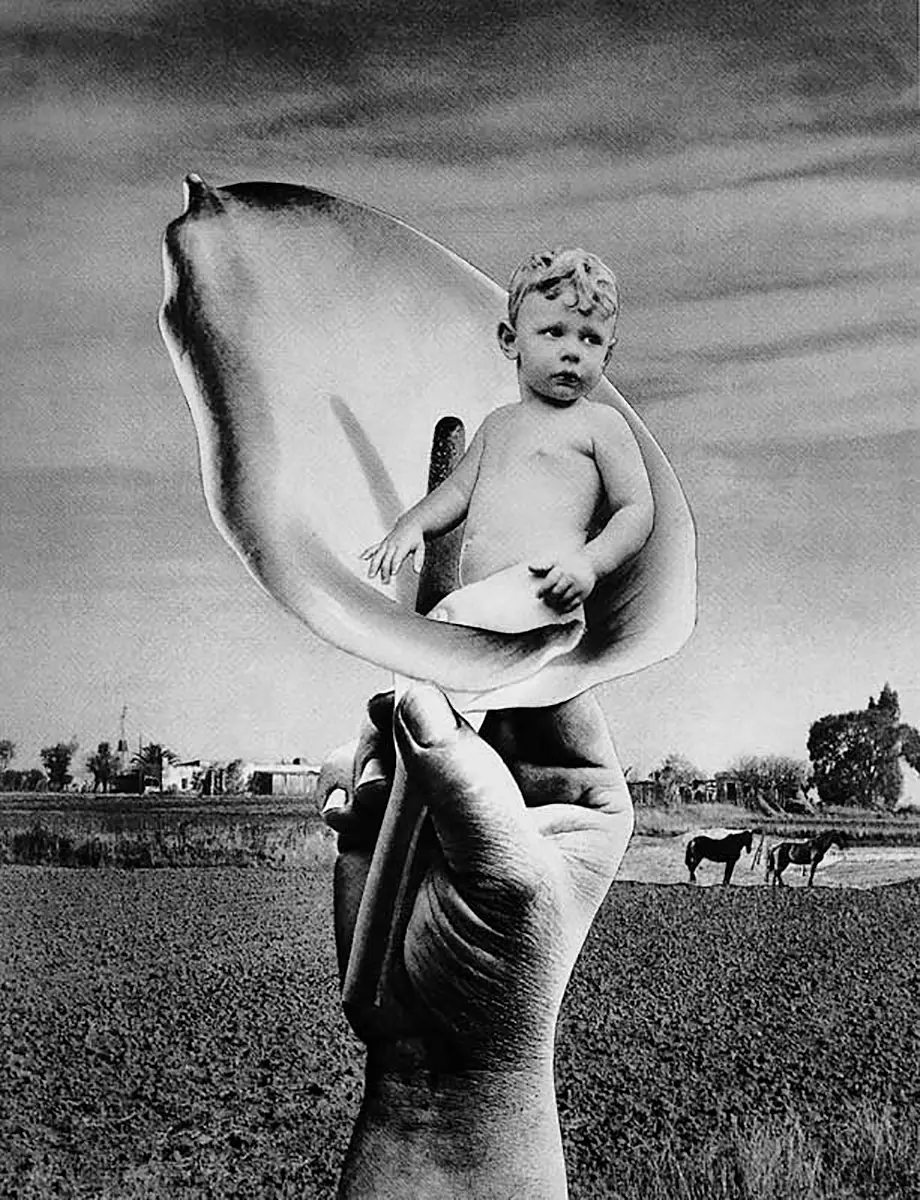
Protagonists of hallucinations and nightmares, women are idolized, threatened, trapped, labeled, objectivized, and transformed in the illustrations created by Grete Stern (Germany, 1904-Argentina, 1995), to illuminate texts-from 1948 and 1951-included in a sort of "psychological problem page" published in the very popular Idilio periodical. A woman can also be viewed as desolated, dismembered, tired, scared, and, sometimes at least, serene, in the pieces of the exhibition entitled Grete Stern. Los Sueños 1948-1951 (Grete Stern. The Dreams 1948-1951). It contains the complete collection of 46 vintage photomontages from the series Sueños (Dreams) that Stern published in the pages of that gossip magazine that targeted a female audience.
The photomontages in Sueños were created in the style of an artist formed in the Bauhaus, the European vanguard school from the 1920s. Also known for her portraits of famous intellectuals and anonymous indigenous people from the north of Argentina as well as landscapes and architectural photographs, her work is synonymous with Argentinean leap into modern photography. Fleeing Nazi oppression, in 1935 Stern moved to Argentina with her husband Horacio Coppola, also a renowned photographer.
The images exhibited at Malba belong to the private collection of Eduardo F. Costantini, founder of this private museum that will soon celebrate ten years since it was first opened to the public. These images also represent one of the five sets of works signed by the artist. It is important to make this clear as the photomontages that were part of this exhibition at Malba represent only one-third of all the existing original works. There are a total of 148 pieces-these 48 negatives were preserved because they were the only photomontages photographed by Stern before she handed them over-that have been digitized and distributed, also in the form of a book, by the Fundación CEPPA; and taken from the collection of the magazine (kept at the Biblioteca Nacional).
These brilliant images presented in photomontages had a key role in the shaping of the photographic vanguard in Argentina. Likewise, the texts that accompany the images contributed to popularizing psychoanalysis with the public at large. It is a fact that Argentina is the city with more mental health professionals per square foot in the world. The phrase "Psychoanalysis Will Help You" was written and signed, with the pseudonym Richard Rest, by two college students: Gino Germani (founder of the discipline of Sociology in Argentina), and Enrique Butelman (the person who introduce Jung in Argentina and founder of the Paidós publishing house). It is interesting to learn that female reader was asked to answer a questionnaire of more than 30 questions associated with their personal lives-their best and worst memories, childhood events, recurring and troubling dreams, etc.-that the authors would analyze before writing their responses.
The extraordinary and extravagant photos are surprisingly and powerfully synthetic. They showcase women going through dilemmas and conflicts and also denounce the prevailing domination over women that used to exist before. Stern knew about what she was talking about first hand: she pursued her professional life despite the opposition of her family. Independent and creative, in 1929 she founded in Berlin along with her friend Ellen Auerbach-a photography and design studio. They would sign their collaborative works as "ring + pit." Both artists represented what later analysis denominated "the new women of Weimar."
Some of the photomontages were modified by Stern for an exhibition in the early 1960s and were given new titles like Botella de Mar (Sea Bottle), previously known as Los Sueños de Inhibiciones (Dreams of Inhibitions, Idilio No. 80, 1950). The text that accompanies that photo reads "The bottle is generally an oneiric symbol of prison¿The woman dreaming appears inside a bottle, meaning that the dream is concerned with the totality of her being. Also, her calm expression indicates that which represents prison to her does not come from the outside but from within her." The model behind many of those Dreams was Etelvina Alaniz, a houseworker in Stern's home and second mother to the artist's children. She was instrumental in enabling Stern's incredible evolution as an artist, especially after the artist divorced her husband in 1943.
Speaking about the last retrospective of Stern at the Museo Fernández Blanco in Buenos Aires in 1995, researcher Luis Priamo had this to say: "Los Sueños de Inhibiciones represented her first-and most important-photographic work. In it, Stern expressed a radical opposition to the manipulation women had to endure in the Argentinean society of the time." Grete Stern's irreverent and sarcastic gaze does not stop at conveying compassion for the victims, but also goes on to address the alienating results caused by their capitulation to the status quo."
Modern and never far removed from the Bauhaus influence, Stern continued employing the photomontage method-almost unknown in Argentina-she began to use it in Europe. She eventually undertook several other projects with equally uncompromising results as she stayed loyal to what she once said: "I rather work in a kitchen before agreeing to take wedding photographs."
VICTORIA VERLICHAK