
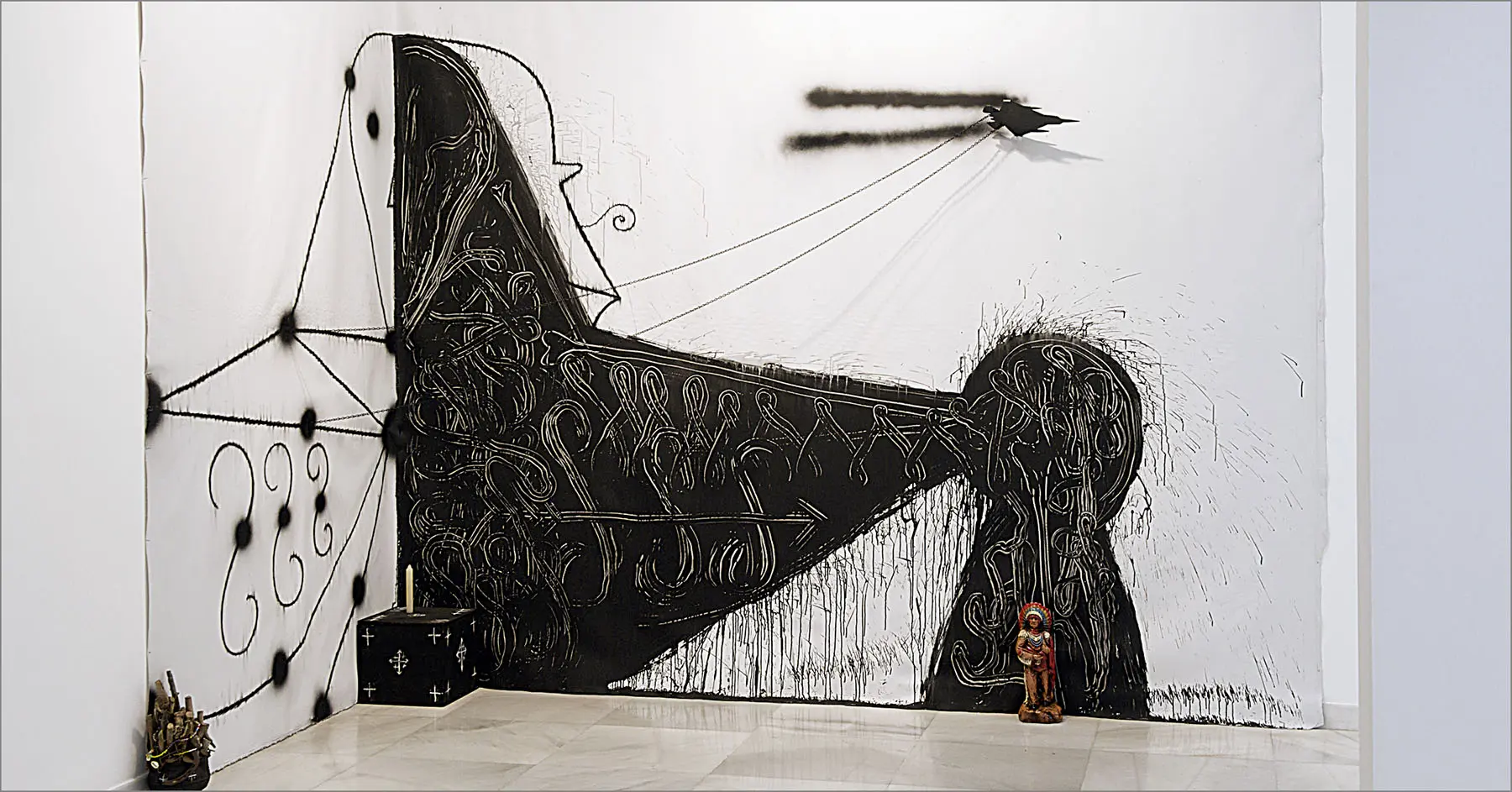
At some point in that utterly strange book that is Crowds and Power, Elías Canetti wrote that the source of modern Man’s melancholy is his inability to metamorphose. This to say, his inability to exercise the extraordinary faculty that so-called primitive peoples possess—and is still embodied by Siberian shamans or Cuban babalaos—of, in a trance state, doubling into their totem animal or allowing themselves to be taken over by one of the deities that populate their tumultuous pantheons. That same faculty needs to be brought to bear as we attempt to understand the works José Bedia presented in Nomadismos, his large-scale show at the CAAM in Las Palmas. The exhibition centered around some installations and some potent murals in which this extraordinary Cuban artist displays his extravagant talent for draftsmanship and for the composition of elegant sets of figures that combine animals, objects, and people, following a logic that is more that of metamorphosis that that of the purely external and aleatory associations cultivated by Surrealism. Things That Drag Me is a good example of how seriously Bedia takes his metamorphosis gambit. The title suggests a self-portrait that nevertheless moves away from the paradigm as adhered to by Western artists at least since Leonardo produced his. The question at this point is not simply one of fidelity or aesthetic quality, but of the abysmal differences at the level of culture, or even of the kind of society. Vasalio’s classic drawing of a nude male figure with open arms and legs is not only an aesthetic canon, but also the representation of an anthropological paradigm that isolates Man, separating him radically from animals, plants, and the rest of the natural world. Bedia’s Man lacks such paranoiac identity because, to begin with, instead of one head he has two, which look at each other and are anomalously conjoined by a bridge where two trucks face-off, suggesting a body that, more than human, is a corpus mundi, a body that mixes itself with the body of the world. And the gap between these two heads outlines an arrow pointing straight to the navel, which is not just the indelible scar of the cut that separates a baby from his or her mother, but the link connecting, through a handful of chains, that cosmic body to models of airplanes and battleships, trucks, and, at the end of the two largest chains, two wooden canoes. The canoes are filled with various objects, offerings to the gods as much as food deposited at the tomb of those who start off on their journey to the land of the dead. And on the one of the right, we also find bottles of white rum, while the one on the left is presided over by a toy dog.
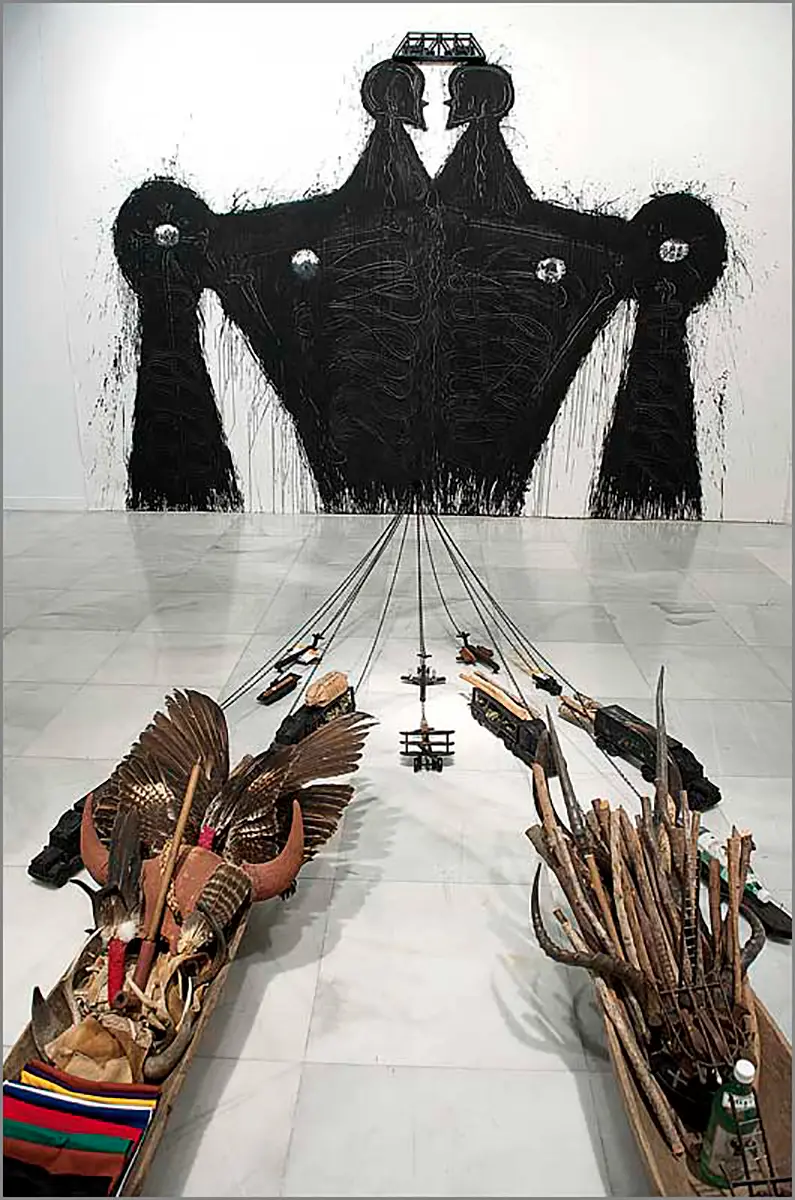
Another detail to be carefully considered in this fascinating installation is four points arranged along an imaginary line that runs nipple-high across a body normalized by modern anatomy. The points are small, blurry reproductions of highly significant scenes. On the left side, images of Indians from the American plains, and on the right are images of Afro-Cuban people. This linkage of two cultural traditions where metamorphosis has a large presence is reinforced in an untitled installation, reworked for this exhibition, which includes a wooden replica of the classic image of a Native American chief.
True, in our de-sacralized society José Bedia’s art is untimely and eccentric, and not only because the kind of metamorphosis he is devoted to has been rendered unthinkable, but also because it is impracticable. At least in the terms, he evokes with seriousness and commitment to religiosity that very few contemporary artists can or want to assume. The contemporary art world is skeptical, and agnostic at best. As demonstrated, by way of contrast, an episode that Bedia himself conveyed to me. It happened at the São Paulo biennial when two black cleaning women stopped working when they found themselves in front of the image of an Afro-American deity. “At that point,” Bedia continues, “they started debating possible interpretations of the message I was trying to convey.” By doing that, the women not only demonstrated their knowledge of the codes necessary for deciphering that specific work of art but demonstrated the vitality of an African-rooted iconographic language that still encodes what is most valuable in their subaltern lives. A language that, thanks to Bedia’s splendid work, also proves its ability to imagine, from a position of subalternity, the most acute and current problems afflicting common people.
CARLOS JIMÉNEZ
Art critic and professor. Author of Los rostros de Medusa. Ensayos sobre la retórica fotográfica.