
The exhibition titled Recent Works by Julio Pacheco-Rivas (Caracas, 1953) was presented at the Galería La Cuadra under the curatorship of Miguel Miguel.
A self-taught artist, Pacheco-Rivas showed his artistic skills early on and was recognized for it. In the mid-1970s, when he began to show a particular interest in the construction of labyrinthine spaces as well as in the use of a pastel palette, he was awarded the Arturo Michelena Prize (1976), a recognition of great importance during that period. Years later he traveled to Paris, a city in which he stayed for ten years and where his artistic production intensified. Since his return to Venezuela, Pacheco-Rivas has been creating-with unwavering perseverance and through a very personal language-work that is very consistent as a result of a very sophisticated formal approach, which has earned him an important place in the world of Venezuelan contemporary art.
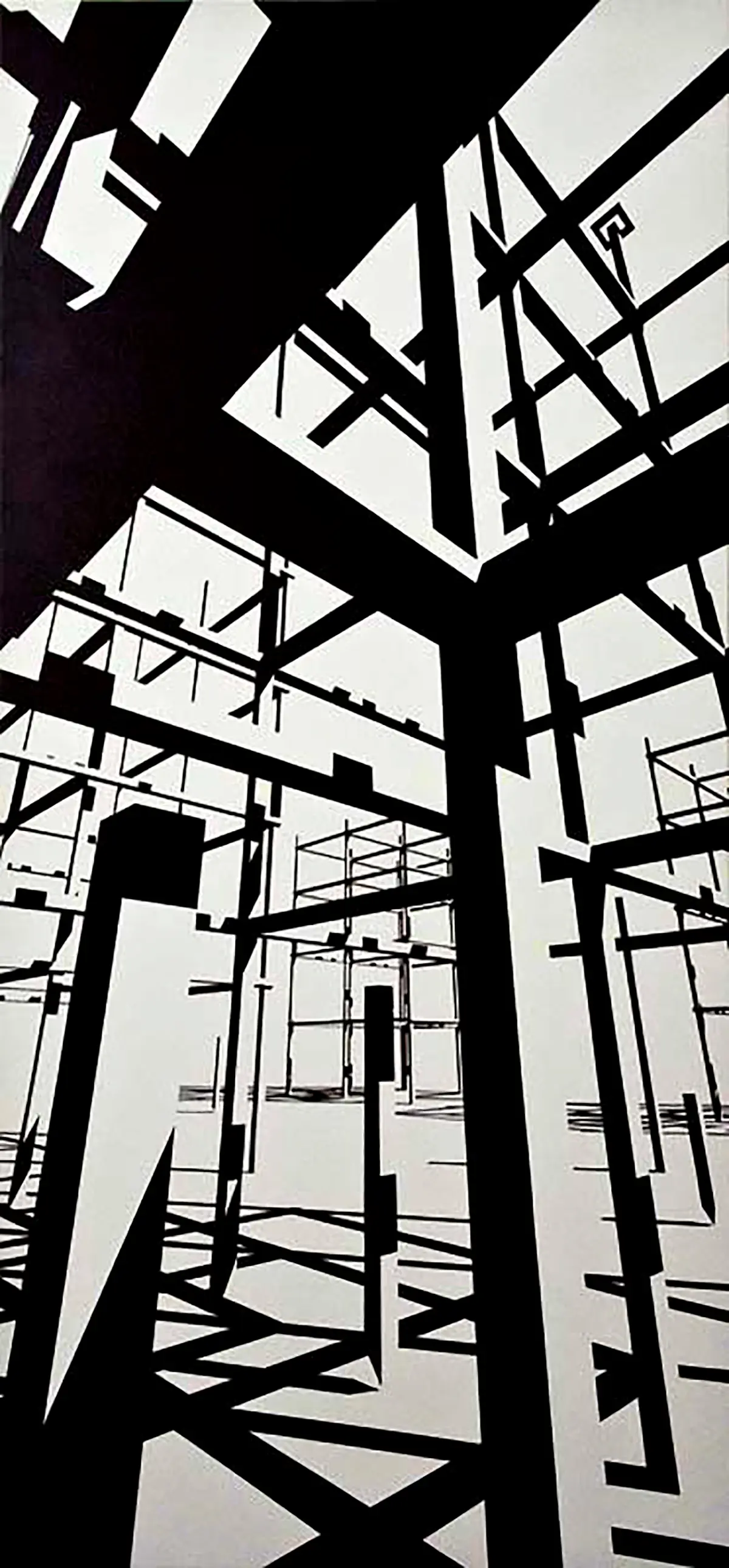
The exhibition Recent Works consisted of ten pieces specially created by the artist for the La Cuadra gallery space. These works attest to the evolution his art has experienced in recent years, through a process that the artist has understood as the logical aftermath of prior artistic inquiries. There is no doubt that since the mid-2000s Pacheco-Rivas had been creating pieces that pointed to a crucial moment in his artistic trajectory; a moment achieved through an intensification of the relationships between illusory perception and its representation in the plane in the form abstract elements. By then, his fictitious landscapes had already morphed into mostly imaginary architectural landscapes and solitary spaces rendered in perfect conic perspectives. He abandoned the corporeity of volumes and objects, opting instead to describe these in silhouettes. The images became "flat" and led viewers into an unusual perceptive experience in which that flatness-constructed with black silhouettes on a white background-struggled with the depth of the space-suggested by the most basic memories we have of forms and by our recollection of this artist's previous works-that such representation alluded to. This contradiction in Pacheco-Rivas's vocabulary that led to monochromatic and flat solutions was a consequence of the imaginary effect that the artist embedded in the perception of his invented landscapes-now observed and presented against a "backlight."
Pacheco-Rivas understands that the elements of light and visual memory are a central aspect of the formal changes his work has experienced since then. Light plays an important role in the struggle he inserted into the visual perceptions of his work; a perception that is generated from within the frame-as the illusory space where something occurs manifested in the plane as a representational or perceptive innovation-of his imaginary spaces. The overwhelming light that flattens the objects is part of that which is represented; it blurs volumes and vanishes colors. The visual memory plays a leading role from the outside, from the viewer's gaze that tries to capture, by relying on previous experiences, the spatial resolution that has been disguised by the transformative effect of light on the forms and volumes.
These inquiries are approached in-depth in Recent Works. With a nearly Renaissance-like gaze, Pacheco-Rivas experiments with the effect of light on the objects that are part of his imaginary spaces. Powerfully embedded, light tangentially floods the space creating a highly-contrasting effect. It, however, does not flatten the shapes any longer; instead, it disarticulates them as it renders the rational relationships between the volumes abstract. Black abstract-geometrical patches spread across a white space and follow architectonical rhythms in search of a constructive spirit that is nonetheless elusive. Often the image spreads beyond its boundaries as it merges with the space on the wall, as observed in the works titled Fat Sally I and Fat Sally II.
The gaze once again relies on our recollection. It reconstructs that abstract chaos to form images of solitary and imaginary landscapes-a truly important part of this artist's work-and in details or fragments from a whole that is more deeply deserted than ever before because of the intense light. As Pacheco-Rivas has pointed out, the resulting images are like "vapors of perspective."
The visual work becomes even more complex in the pieces titled Detalles (Details). There, the artist focuses on the "representation" of the fragments of some of the larger pieces. Their contribution to the dynamic of the exhibition lies in that they invite viewers to render them "recognizable" as parts of larger images. Conversely, their independence as a set of geometrical forms distributed across a background enriches this perceptive interaction-clearly present in the current poetic of Pacheco-Rivas-between abstraction and that which is being represented.
KATHERINE CHACÓN