
In her show The Other Landscape, presented at Galería Luisa Strina, Laura Belém introduced a new gaze on the metropolis. Belém has developed her site-specific projects on the basis of references that are found in urban contexts. This artist, who lives and works in Belo Horizonte, Minas Gerais, stands out in the contemporary scene as a persistent explorer of the status of the landscape. Her creative process reveals a conscious vocation for reflecting on the places of time and of human nature.
The specificity of place plays an important role in Belém’s visual poetics.
We can trace the artist’s interest in the reinvention of landscape art back to her participation in the 51st Venice Biennale, invited by curator Rosa Martínez, with Enamorados, 2004-2005, an installation comprised of two boats, reflectors, and a timer, located in the Venetian lagoon. In this installation, the presence of a code of alternating light signals conceived to create a means of communication for the “boats-lovers,” Belém established a new dynamic of fluids in an aquatic landscape, synonymous with the perception of the site recreated by the artist.
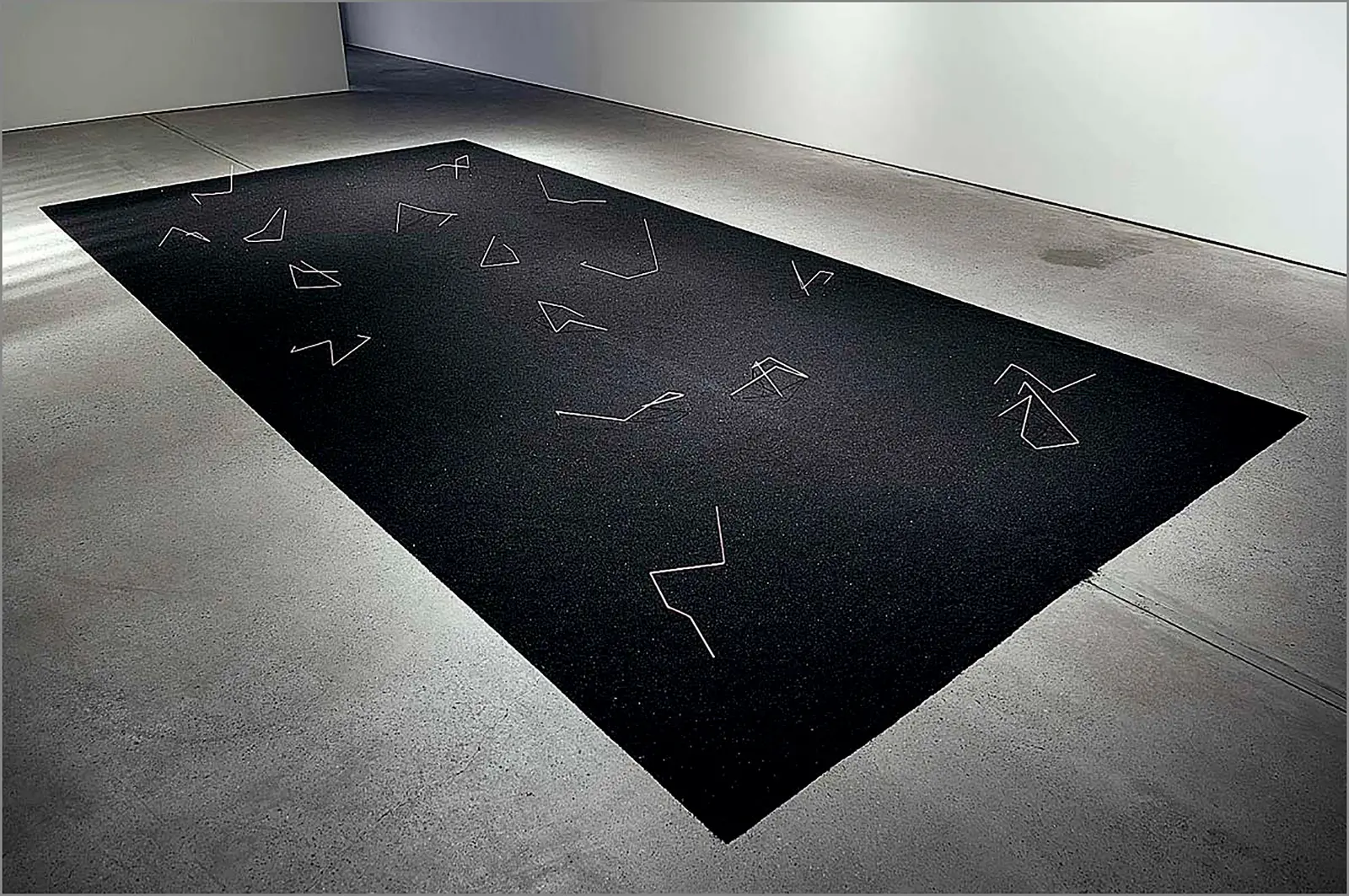
For her show at Luisa Strina Gallery, Laura Belém proposed a tour of São Paulo, codified in two installations: The Great Wave, elaborated with sinuous cutouts of the Copan building—an important reinforced concrete structure in the country—and Sculpture Garden, the geometry of the big city recreated in plastic drinking straws.
As one walks through São Paulo’s public spaces, among the buildings and streets of an urban body that vibrates with the vitality and chaos of a congested landscape, asphalt, and concrete are our constant guides. Laura Belém, however, seeks out a different slant for that misencounter of the urban space, for that “congested landscape,” creating a playful dimension for our perception.
Each mark of this fragmented city reinvented by the artist accessed levels of reflection in the evidence of a time interval lived in the poetics of that urban space. It was in that context that the artist proposed a trajectory, Sculpture Garden, 2011. The work consists of a thin layer of black material (5.75 x 2.82 m) arranged on the gallery floor and pockmarked by small sculptures of plastic straws. This thin layer of black material could refer to the continuity of asphalt—an omnipresent element in the big city—making the visitor wonder about the substance present here: is it asphalt, granite, iron shavings, shoe polish?
Given the uncertainty about the materiality of this “other landscape,” visitors were invited by the environment to modulate their gazes—moving closer, observing the “garden” from a variety of angles, moving around—in order to recompose a searching reading of the place.
The trajectory proposed by the work placed viewers within the framework of a silent miniature of a “sculpture garden,” confronting them with the evidence of art of the frame, restoring free associations of time and space.
Laura Belém invited viewers to make a “pause” in the everyday bustle of the megalopolis, bringing to them another possible reading of São Paulo’s memory. The artist referred to the memory of that urban territory through the inclusion of the sinuous Copan building, a famous housing and commerce enclave in the city. In this way, the artist reinvented an emblematic structure of the construction projected by Oscar Niemeyer between 1951 and 1966, a point of reference in Brazil’s modernist architecture.
Belém’s creation also registered an almost olfactory dimension of childhood memory, using those plastic straws to compose the curved outlines of sculptures set on a hypothetical urban park, on a reduced scale.
The urban park recontextualized by the artist invited viewers to construct another spatial situation; it invited to the conscious disenchantment of that altered temporal interval. The investigative dimension of Belém’s visual poetics establishes a new horizon for our dominion over the landscape, subverts our usual expectations of the city’s architectural space, and, ultimately, generates a necessary pause in the everyday misencounter of our perceptual experience.
The show The Other Landscape, held between May 10th and June 18th in São Paulo, was imagined by Laura Belém as an essential breathing moment in the congested environment of a metropolis that pays little attention to the rhythms of its own inhabitants.
CLAUDIA FAZZOLARI