Since the death of Marco Ospina in 1983, there has not been in Colombia an important exhibition of his work. This is one of the closest explanations behind the absence of any relevant survey of his artistic legacy and the role he played in the cultural and intellectual history of Colombia during the Twentieth Century. The organization of the exhibition entitled Marco Ospina, Painting and Reality represents a timely occasion to look back at this important chapter in Colombian art. A part of the Study of Modern Art in the Colombia program of the Fundación Gilberto Alzate Avedaño, the exhibition gathers a valuable group of works by this painter, as well as some documents that are essential for historical and biographical interpretations.
It is often said that Marco Ospina was the first abstract painter in Colombia. It is a claim hard to refute indeed. Nonetheless, what is its significance without being able to assess the conditions under which he arrived at that artistic modality? And most importantly, which directions did he take with his proposals? What are the poetic and formal characteristics of his work?
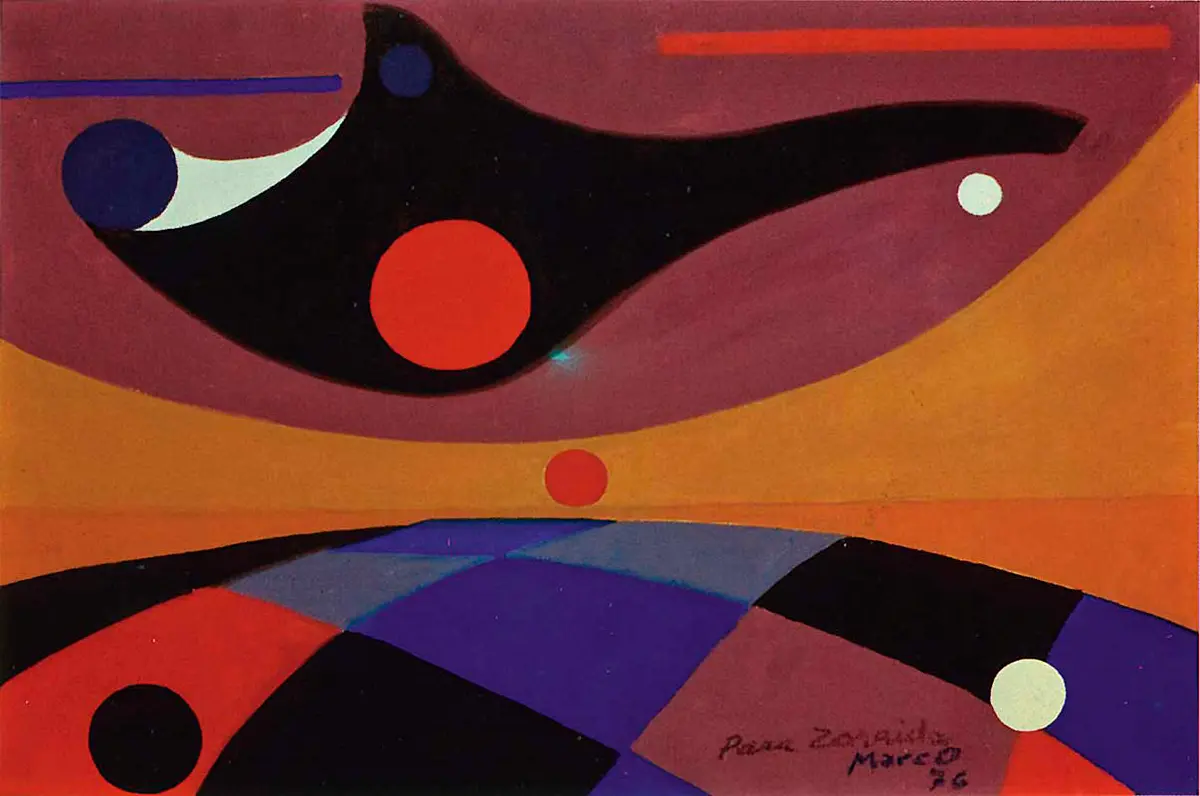
Many cues about these questions can be found in this exhibition. John Castles, curator of the show, centered his work on Ospina's arrival to abstraction and on the various approximations to that artistic language by this artist, concretized during his professional trajectory; from proposals still very much circumscribed to the traditional genres in painting-landscape in particular-to the most "inorganic" works created during the 1950s. Spectators in the exhibition will find some of his most relevant and beautiful works like the mythic piece entitled Capricho Vegetal (Vegetable Caprice, 1946), La Aurora (Dawn, 1950), or Sputnik-Construcción Dinámica (Sputnik-Dynamic Construction, 1952).
The exhibition also includes a space dedicated to biographical research about the author. There, it is possible to appreciate other important facets of his intellectual life as a teacher, art critic, and as promoter and collaborator for some cultural ventures-meaningful to the cultural life in Colombia-presented in a complete chronology by Katia González.
It is important to acknowledge the determination that the team involved in the organization of the exhibition showed to overcome the difficult task of finding and securing a meaningful number of works by Marco Ospina in public and private collections. It was a hard undertaking that fortunately culminated with the finding of the archives and collection owned by Ospina himself-today managed by the Fundación Marco Opina-ProArte, recently created by the artist's daughter, Lina Ospina, and grand-daughter, Zaraida Gutiérrez-Ospina, both of whom reside in Mexico.
Nature and abstraction are the two poles of tension in the exhibition and the two structural elements in Ospina's work. When confronted with the poetic and conceptual opposition between these two terms, the answer by the painter from Bogota is made abundantly clear in the exhibition: it offers several clues to examine the appreciation and study of abstract art in the country and to address this artist's particular involvement in it; it also looks into the multiple ties between this painter ahead of his time-at least with respect to the consolidation of abstract art in Colombia-and the first abstract movement established in the country a decade later. The exhibition was inaugurated on June 17 at the Fundación Gilberto Alzate Avedaño and remained open to the public until August 15.
SYLVIA JULIANA SUÁREZ