The artist Mariella Agois completed her graduate and post-graduate degrees in Fine Arts at the School of the Art Institute of Chicago. She creates ink drawings on paper, engraving on linoleum, paintings with adhesives from bronze sheets on canvas, and digital photography that she calls "digital compositions". Agois presents her thirteenth individual exhibition entitled Sinsecuentes. The title is a neologism-an invented word that did not previously exist-that originated from the idea of a broken sequence, a non-sequence.1 For this exhibition, she presents three small-format pieces and nine large-format ones. The images and the visual language she uses in each series and exhibition are always different from earlier ones and that makes her work more interesting, innovative, and fresh.
Agois does not use tape to guide the outlines but instead prefers to draw in freehand. In the work Sin Título II (Untitled II)-one of the largest works in the exhibition there is a rhombus in the middle of the composition that expands like an echo throughout the image. There is one section that has been cut and that appears to have moved to the right.
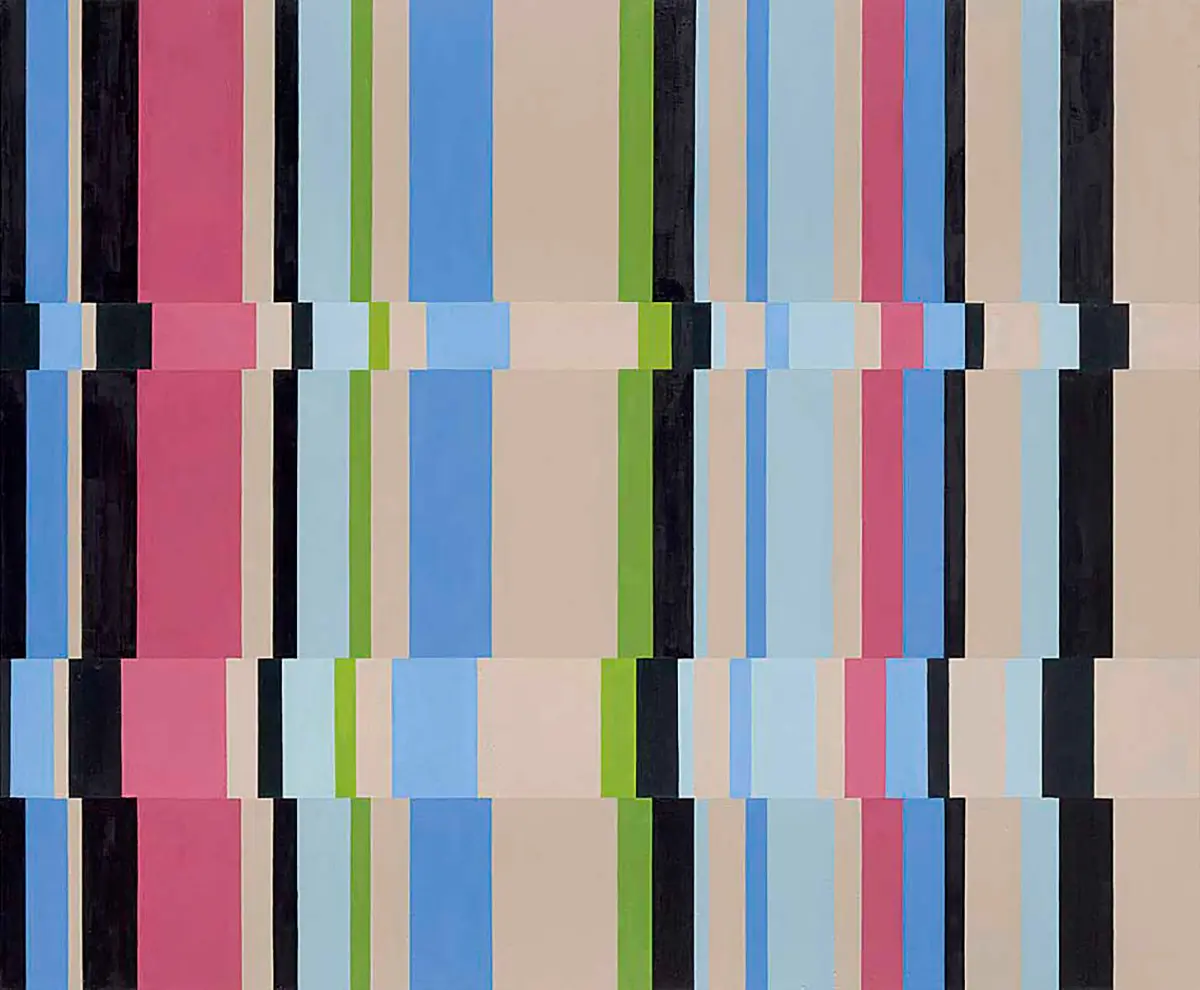
Thus the name of this exhibition that suggests a sequence was interrupted. It is as if there has been a break in the order of the figures. Some could think of this work as closer to an Op Art proposal by Bridget Riley, but the interruption in the order turns it into something altogether different and innovative in Agois' artistic language. While movement in Op Art is suggested by the spectator's own gaze, in her work the inference of movement is actually physical and contained within the frame. There is also the suggestion of planes that float over the work Sin Título III (Untitled III). In the work Sin Título I (Untitled I) several vertical lines of various thicknesses and seven colors are part of the composition. There are two variations within this uniformity; each occupies one section of the image as if they were two disruptions. Psychologically speaking, Agois' work has real meaning. Something is not quite working in something already formed. In something already formatted, pre-stabilized, a problem lurks that does not fit, like what occurs between the world and our society. Everything an artist makes has meaning in the unconscious and that is precisely the meaning of Angois' work in this series.
There is also an installation with 37 small works of various shapes: rectangular, square, circular, and of different thicknesses. These small works hide written words of phrases rendered with various typographies. The phrases are painted in dark or light blue and all are placed over a black background. Some were rendered with a stencil and others were painted. Some words are split in order to confer new meaning to them; words like for instance, Pesa-dos, in which "pesa" (weight) is placed on top of "dos" (two); or D-lito, Yono-soye-va (I am not Eva), Me-Boy, Piens-o-no-p-ienso, Perdiendo la Memoria, Pedadil-lla, among others. About this Agois said "it represented an immediate way to include words that I was interested in because of personal reasons. There was no intention of saying anything meaningful with them, other than the meaning of the word itself, something that for me is ludic." 2 The installation´s visual language and the geometric abstract art paintings, also with a visual language of their own, just like every single series created by Agois, have much merit, since creating one´s recognizable visual language is the most difficult task an artist must undertake.
With this exhibition, Agois demonstrates that her work is like a metamorphosis in a constant process of transformation and in a continuous search for new forms of expression. In all likelihood, her next exhibition will offer a completely different visual language.
NOTES
1. Interview with the artist, august 2011.
2. Idem.
AUGUSTO CHIMPEN